A low-carbon computing platform from your retired phones
Transforming Retired Smartphones into a Low-Carbon Computing Infrastructure
By Jennifer Switzer and David Patterson (Google Research) June 12, 2026
With the backing of Google, researchers at the University of California San Diego (UCSD) are pioneering a sustainable "second life" for consumer mobile devices. Their goal is to mitigate the environmental impact of the digital age by repurposing old hardware into a functional computing resource.
The Sustainability Challenge: Two Types of Carbon
The environmental cost of our computing habits is generally split into two categories:
- Operational Carbon: The emissions resulting from the electricity consumed while hardware is running.
- Embodied Carbon: The emissions generated during the extraction of raw materials and the actual manufacturing of the hardware.
While the industry has made strides in reducing operational carbon through green energy and efficiency, embodied carbon remains a stubborn hurdle. The most effective way to reduce this footprint is to extend the lifespan of existing hardware.
The Solution: Phone Cluster Computing
To tackle this, UCSD is exploring "phone cluster computing." This involves harvesting the motherboards from discarded smartphones and organizing them into clusters to serve as a general-purpose cloud computing platform.
Supported by Google, the university is developing a datacenter powered by 2,000 Pixel smartphones. This initiative will provide students and researchers with an affordable, low-carbon cloud alternative, drastically reducing the need to manufacture new server hardware.
Why Smartphones?
The average consumer replaces their phone every four years, usually to gain new features or better aesthetics. However, the internal compute capabilities of these "retired" devices remain remarkably potent. Most contain integrated processors, accelerators, memory, and storage that are still highly capable.
Performance: Phone vs. Server
Interestingly, the single-threaded performance of a modern smartphone's primary cores is often equal to or even superior to that of modern multicore servers.
 Comparison of single-threaded performance between a 2023 Pixel Fold and an ASUS RS720A-E11 server using SPEC benchmarks.
The primary difference is scale:
- Servers: Feature dozens of multithreaded cores and massive memory pools.
- Smartphones: Feature a small number of heterogeneous cores and typically
8-12GBof RAM.
The engineering challenge, therefore, is to identify or adapt applications that can operate within the memory and processing constraints of a single smartphone.
From Consumer Gadget to Datacenter Node
You cannot simply plug thousands of unmodified phones into a rack; it would be inefficient and potentially dangerous. The transformation process follows a specific pipeline:
1. Hardware Refinement
Smartphones are packed with components useless in a server environment, such as screens, cameras, chassis, and batteries. Removing these saves space and increases safety, as batteries are not rated for the heat and environment of a datacenter.
Crucially, the motherboard accounts for roughly 50% of the device's embodied carbon, making its reuse the most impactful part of the process.
2. Software Overhaul
While Android is built on Linux, the mobile-specific "userspace" is not suitable for cloud tasks. Researchers replace Android with a general-purpose Linux distribution. This provides:
- Better programmability.
- The removal of mobile-specific restrictions, such as the
low memory killerdaemon, which normally throttles memory-intensive apps to save phone battery.
3. Orchestration and Scaling
To match the power of a single modern server, it takes approximately 25 to 50 smartphones. To manage this fragmentation, the team uses containerized applications managed by Kubernetes. The phones are grouped into self-managing clusters of 25-50 devices to act as a single virtual unit.

Real-World Application: Academic Cloud Computing
Many university tasks—such as hosting Jupyter notebooks, running grading scripts, or managing EdTech apps—do not require massive server clusters. Many of these run on tiny cloud instances like the AWS t3.micro (2 vCPU, 1 GB memory), which is well within the capability of a single smartphone.
Experimental Results
UCSD is implementing the 2,000-phone cluster to support courses like Systems Programming and Parallel Computation.
Initial tests show that even a small cluster of 20 phones can handle the peak submission loads for a class of over 75 students. For example, a CPU-intensive matrix multiplication assignment (taking ~50 seconds per device) was handled efficiently by the cluster.
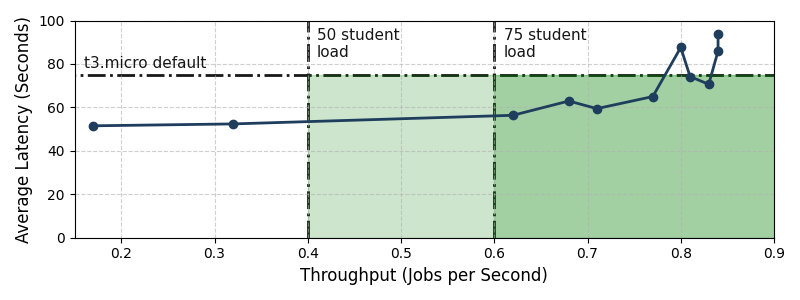 The green zone indicates where the 20-phone cluster meets or exceeds standard throughput and latency requirements for academic grading tasks.