21 years and counting of 'eight fallacies of distributed computing' (2025)
21 Years Later: Revisiting the Eight Fallacies of Distributed Computing (2025)
It seems illogical that in an era of advanced connectivity, we still cling to assumptions about networking that have been proven false since the medium's inception. Whether we are developers, system administrators, or end-users, we struggle to abandon these ingrained misconceptions.
The most definitive catalog of these errors is known as the Eight Fallacies of Distributed Computing.
The Core Fallacies
These are the common myths we often mistakenly treat as truths:
The network is reliableIt is not.Latency is zeroIt is always present.Bandwidth is infiniteIt is limited.The network is secureIt is vulnerable.Topology doesn't changeIt is dynamic.There is one administratorIt is fragmented.Transport cost is zeroIt has a price.The network is homogeneousIt is diverse.

📜 The Origin Story
This list didn't appear overnight; it evolved through the contributions of pioneers at Sun Microsystems.
- The Foundation: Bill Joy and Tom Lyon (two of Sun's eight founders) established the first four fallacies.
- The Expansion: Peter Deutsch later contributed three more.
- The Final Piece: James Gosling added the eighth and final fallacy.
The Legacy of Sun Microsystems
Sun's impact on modern computing is staggering. By combining the UNIX OS, high-speed graphics, and a functional Internet protocol stack, they catalyzed the desktop computing revolution before eventually being acquired by Oracle. Their DNA exists in:
- Operating Systems: Linux distributions, BSD variants, and Android.
- Key Technologies:
Java(the language)ZFS(file system)NFS(Network File System)

🌐 Why These Fallacies Still Matter
While these eight points are the primary focus, they have inspired other lists regarding common misconceptions about names or dates/times—errors we encounter daily in web forms and app interactions.
For network operators and software architects, these fallacies are "hidden constants." Understanding them is vital for anyone designing:
- Network protocols
- Services that receive network calls
- Applications that initiate network requests
"The goal is to provide practical, albeit abstract, guidance on how to transmit data and the critical questions one must ask about network behavior."
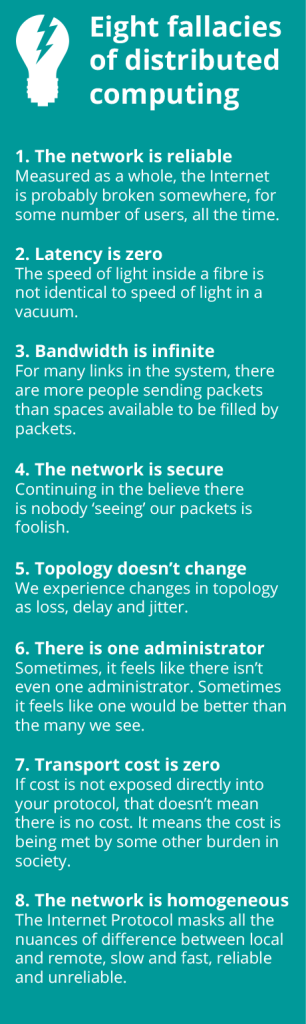
🔍 A Deep Dive into the First Three Fallacies
Below is a detailed analysis of how these fallacies manifest in real-world services.
1. The Myth of Reliability
On a global scale, the Internet is always broken for someone, somewhere. Our perception of a "stable" connection is often just a result of optimism.
- The "Five Nines" Trap: Believing in reliability often leads to the dangerous assumption that "failure won't happen to me."
- Packet Loss: We cannot assume a sent packet is a received packet.
- Protocol Solutions: While
IP(v4 or v6) provides no delivery guarantee, higher-layer protocols likeTCPandQUICare specifically engineered to detect and recover from loss.
2. The Myth of Zero Latency
Latency is the umbrella term for delay and jitter.
- Physical Constraints: Delay is limited by the speed of light (). Interestingly, light travels slower through fiber optic cables than through a vacuum.
- Mediums: Because of signal conversion (copper fiber), satellite-to-satellite laser or microwave links can actually be faster than terrestrial fiber.
- Jitter: This is the variance in delay, which creates significant hurdles for live streaming and gaming.
Example: Netflix uses buffering and error-correcting codes to mask these fluctuations and ensure smooth playback.
3. The Myth of Infinite Bandwidth
While modern speeds feel immense, the system is often congested. When more packets are sent than the link can handle, we encounter a chain reaction:
While Content Delivery Networks (CDNs) hide this by moving data closer to the user, the "last mile" (our home link) remains a primary bottleneck.

📊 Summary Comparison
| Fallacy | Common Misconception | Technical Reality | Mitigation Strategy |
|---|---|---|---|
| Reliability | "Packets always arrive" | IP is best-effort | Use TCP or QUIC |
| Latency | "Data is instant" | Limited by and hardware | Buffering & Edge Computing |
| Bandwidth | "Capacity is endless" | Congestion Queuing | CDNs & Traffic Shaping |
Conceptual Logic for Network Handling
def send_data(packet):
    try:
        transmit(packet)
    except NetworkFailure:
        # Addressing the "Reliability" fallacy
        retry_with_exponential_backoff(packet)
    except LatencyTimeout:
        # Addressing the "Latency" fallacy
        adjust_timeout_settings()


