AI chemist improves a challenging reaction in medicinal chemistry
AI Chemist Optimizes a Complex Medicinal Chemistry Reaction
Date: June 17, 2026
Research Publication
In a collaborative effort with Molecule.one’s Maria, OpenAI's GPT-5.4 has successfully identified a surprising additive that enhances the yields of Chan-Lam Coupling for more than 80% of the substrates tested.
OpenAI’s venture into the sciences is driven by the conviction that sophisticated AI can serve as a potent collaborator for researchers—enabling them to bridge disparate concepts, explore a wider array of hypotheses, refine experimental design, and accelerate breakthroughs for the benefit of society.
A Trajectory of Scientific AI
This achievement is part of a broader pattern of AI-driven scientific contributions, including:
- Mathematics: Advancements regarding the unit distance problem.
- Theoretical Physics: New insights into gluon amplitudes.
- Biology: Utilizing
GPT-5to reduce the costs associated with cell-free protein synthesis in automated environments. - Life Sciences: The creation of
GPT-Rosalind, a model tailored specifically for drug discovery and biological research.
This latest project moves beyond theoretical reasoning into the realm of medicinal chemistry, where success is measured by tangible results in a physical lab, accounting for experimental noise and real-world molecular behavior.
The Integration: GPT-5.4 Maria
To achieve this, OpenAI linked GPT-5.4 with Maria, an agentic AI integrated with a high-throughput laboratory. The goal was open-ended: improve a critical class of chemical reactions.
The Autonomous Workflow
The system operated through a continuous loop of hypothesis and testing:
AI Responsibilities:
- Literature review and hypothesis generation.
- Experimental design and execution.
- Data analysis.
- Iterative refinement of proposals.
Human Responsibilities:
- Designing steering and grading prompts.
- Selecting the most viable proposals for testing.
- Providing minor corrections to experimental plans.
- Assisting with basic lab operations.
- Independent validation of final results.
Solving the Chan-Lam Coupling Challenge
The most successful proposal, identified as OAI-M1-03, targeted a specific, difficult version of the Chan-Lam coupling—a reaction essential for creating carbon-nitrogen (C-N) bonds.
Why This Matters
Organic chemistry is the foundation of small-molecule drugs, electronics, and agricultural products. However, synthesis is frequently the primary bottleneck in drug discovery.
| Feature | Impact on Drug Discovery |
|---|---|
| Reliability | High-yield reactions allow scientists to test more diverse molecules. |
| Efficiency | Reducing byproducts saves time and resources. |
| Accessibility | Reliable C-N bonding opens new paths for molecular exploration. |
The specific challenge involved primary sulfonamides. These are critical components in:
- Anticancer medications
- Diuretics
- Antimicrobials
Historically, the coupling of primary sulfonamides with boronic acids has been plagued by low yields inefficient results.
The Breakthrough
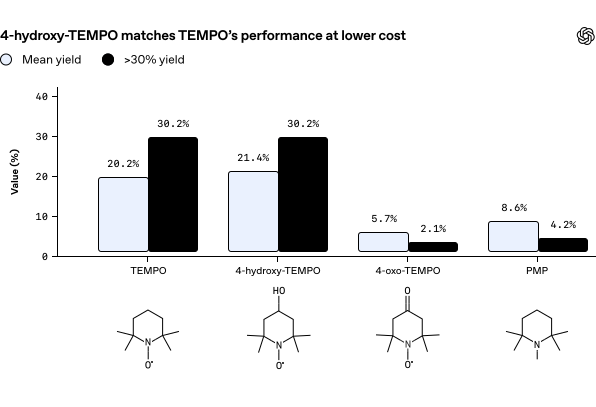
GPT-5.4 independently hypothesized that mild oxidants, specifically TEMPO, could boost the reaction. After two cycles of experimentation in the Maria Lab (which processed a total of reactions for OAI-M1-03), the results were significant.
Yield Improvements:
- Boronic Acids: of substrates.
- Sulfonamides: of substrates.
- Mean Yield: .
- High-Yield Success: .
Validation and Conclusion
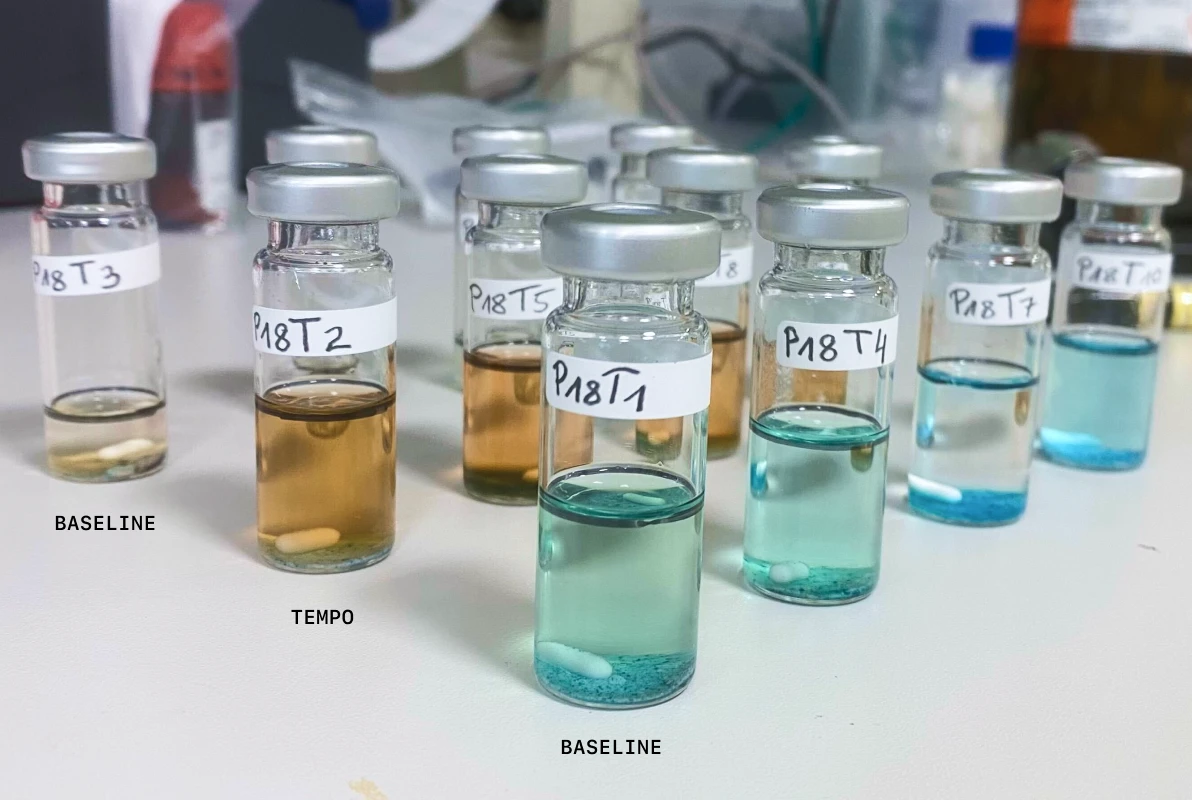
To ensure these results weren't merely an artifact of micro-scale screening, human chemists performed bench-scale validations.
Bench-Scale Results:
- 11 out of 14 substrate pairs showed higher yields.
- Most cases exhibited a more than twofold increase in yield.
This project demonstrates a glimpse into the future of scientific research: AI systems that don't just process data, but act as partners throughout the entire research loop—from reviewing literature and proposing unexpected ideas to designing experiments and arriving at verifiable scientific findings.