Pull request limits are cutting down the noise
Reducing the Noise: How Pull Request Limits Help Maintainers

By Camilla Moraes & Ashley Wolf | June 18, 2026
Open source participation is at an all-time high, and while most contributors are acting in good faith, the sheer volume of submissions is overwhelming. The fundamental problem is simple: the time it takes a human to review a pull request (PR) hasn't decreased, but the number of PRs has exploded.
When high-quality contributions are buried under a mountain of low-quality "noise," the work that truly deserves attention becomes nearly impossible to find.
GitHub is addressing this by introducing pull request limits, a tool designed to manage the flow of incoming contributions and reduce the burden on maintainers.
🛠️ How the Mechanism Works
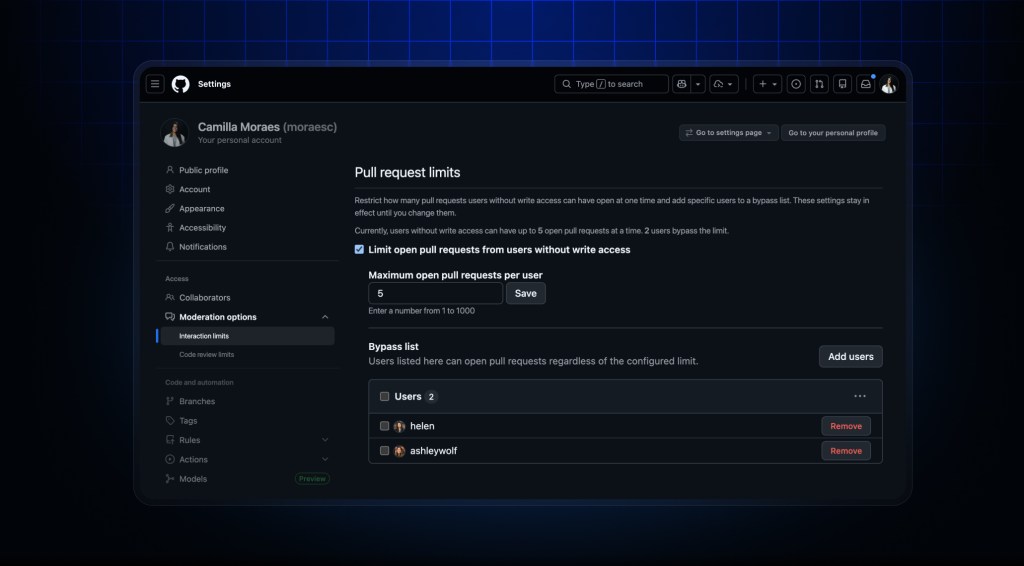
A pull request limit establishes a ceiling on the number of active PRs a user without write access can maintain in a specific repository.
The Logic Flow
If a user reaches their limit, they are blocked from opening new PRs until they either open more close or merge an existing one.
Key Details:
- AI Contributions: PRs generated by
Copilotor other AI agents count toward the user's limit. - The Bypass List: Maintainers can designate trusted contributors to a
bypass list. These users are exempt from limits without needing full write permissions. - Persistence: Unlike interaction limits (which act as temporary cooldowns), PR limits are persistent and configurable.
Comparison: Interaction Limits vs. PR Limits
| Feature | Interaction Limits | PR Limits |
|---|---|---|
| Nature | Temporary cooldown | Persistent setting |
| Control | Automatic/System-driven | Maintainer-configurable |
| Goal | Stop immediate spam bursts | Manage long-term contribution flow |
🧠 The Psychology of Prioritization
When opening a PR takes seconds, there is no incentive for a contributor to polish their work before submitting. However, when a user is limited to a few open slots, they must make a judgment call on which changes are most valuable.
This shift moves the first layer of filtering from the maintainer to the contributor. A smaller, more curated pool of PRs makes it significantly easier for maintainers to spot high-quality work and reduces the dread of encountering "slop."
Voice from the Community
"We’ve had problems on Homebrew for a while with enthusiastic users submitting many pull requests that need near identical review. This allows us to still have outside contribution... while gating users to a level of pull requests we can cope with." — Mike McQuaid, Homebrew
"At OpenClaw we get a huge volume of pull requests from the community and had to build our own bots for fighting spam. We are super glad GitHub has been able to develop out-of-the-box solutions..." — Vincent Koc, OpenClaw
📈 The Cost of Creation vs. Review
The ecosystem has shifted. In January 2023, the volume of merged PRs across GitHub was approximately:
We are witnessing an "Eternal September" for open source. Even when work is submitted in good faith, it can accumulate faster than any volunteer can process. By implementing these limits, GitHub aims to return focus to maintainers without completely shutting the door on new contributors.
🗺️ The Roadmap: Future Contribution Controls
PR limits are only the beginning. GitHub is developing more granular tools to manage the "contribution funnel."
Upcoming Features
- Pull Request Limits (Available Now)
- Archiving PRs (Shipping Soon): Admins can hide low-quality or spammy PRs from the main view.
- Note: GitHub chose
ArchiveoverDeletebecause some organizations require records for legal compliance.
- Note: GitHub chose
- Issue Limits (In Development): Similar caps will be applied to the number of open issues a non-collaborator can create.
- Smarter Bypass Signals (Up Next): Automating trust. Instead of manual lists, bypasses could be granted based on:
- Previously merged PRs in the repo.
- Account age.
- Organization membership.
- Cross-Repository Controls (Exploring): Investigating ways to stop "spraying" (opening PRs across hundreds of different repositories simultaneously).
{
  "roadmap_status": {
    "pr_limits": "deployed",
    "archiving": "beta",
    "issue_limits": "development",
    "smart_bypass": "planning",
    "cross_repo": "research"
  }
}
❤️ A Note of Gratitude
Open source exists because of the people who do the heavy lifting: the late-night reviewers, the mentors, and the triagers. Your feedback shaped this feature.

Try the pull request limit in your settings today and let us know your thoughts.
About the Authors
| Author | Role | Bio |
|---|---|---|
 Camilla Moraes Camilla Moraes | Product Manager | Focused on maintainer tools. |
 Ashley Wolf Ashley Wolf | Director, OS Programs | Strategy lead for OS and Steering Committee for the TODO Group. |