Physicists Track and Trap the Elusive Neutrino
Capturing the Ghost: The Saga of the Neutrino
By Simon Frantz | June 24, 2026
The pursuit of the neutrino has pushed the boundaries of experimental physics, necessitating the construction of some of the most daring and colossal apparatuses in human history.
The "Poltergeist" Beginnings
Roughly seven decades ago, physicists Frederick Reines and Clyde Cowan embarked on a mission to capture a particle that many believed was invisible. Their setup—a 10-ton detector encased in heavy lead and damp sandbags—was positioned adjacent to a high-output nuclear reactor at the Savannah River Plant in South Carolina.
They aptly named this endeavor Project Poltergeist, as they were essentially hunting a ghost.
The Theoretical Void
The need for this particle arose from a mystery involving beta decay. For over twenty-five years, scientists noticed a discrepancy in energy conservation during radioactive decay. Mathematically, the energy balance didn't add up:
In 1930, Wolfgang Pauli proposed a daring hypothesis to save the law of conservation of energy. He suggested that a neutral, nearly massless particle was escaping the scene, carrying the "missing" energy with it.
"I have postulated a particle that cannot be detected." — Wolfgang Pauli
Because these particles possess no mass (as originally thought) and no electrical charge, they can glide through the entire planet—and our own bodies—without leaving a trace.
The Strategy: Mass and Isolation
To catch a particle that refuses to interact with matter, physicists realized they needed two things: an immense volume of target matter and extreme isolation from cosmic radiation noise.
The First Great Trap: Homestake
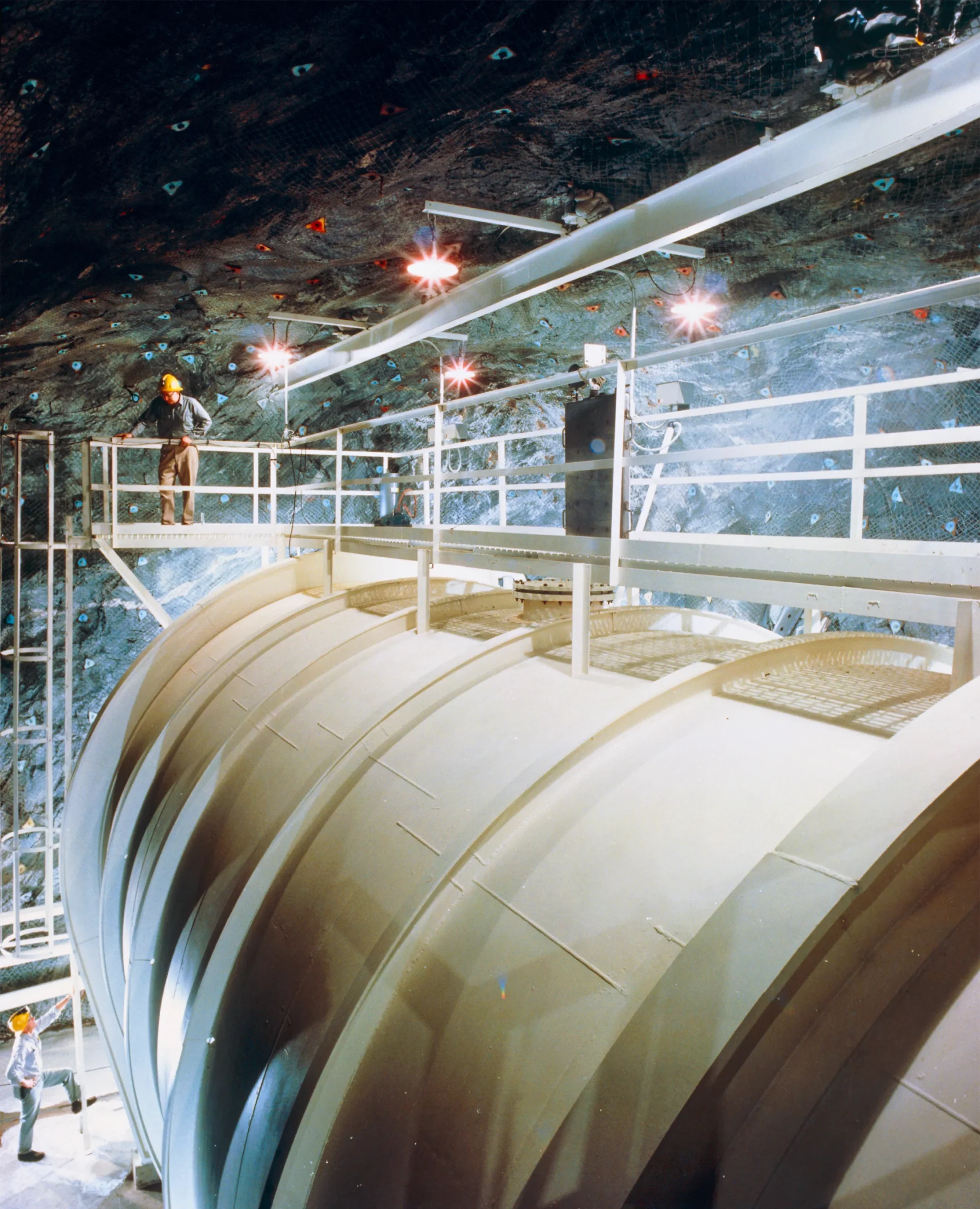
Ray Davis and his team at Brookhaven National Laboratory went 1.5 kilometers beneath the earth in South Dakota's Homestake mine. They utilized a massive tank containing approximately 400,000 liters of perchloroethylene (a chlorine-based dry-cleaning solvent).
- The Mechanism: A neutrino striking a chlorine nucleus would transform it into a radioactive argon isotope.
- The Result: Over 25 years, Davis found only of the solar neutrinos predicted by theoretical models.
The Evolution of Detection
The "missing" neutrinos of the Homestake experiment remained a mystery until more advanced detectors were built in Japan and Canada.
The Water-Based Revolution
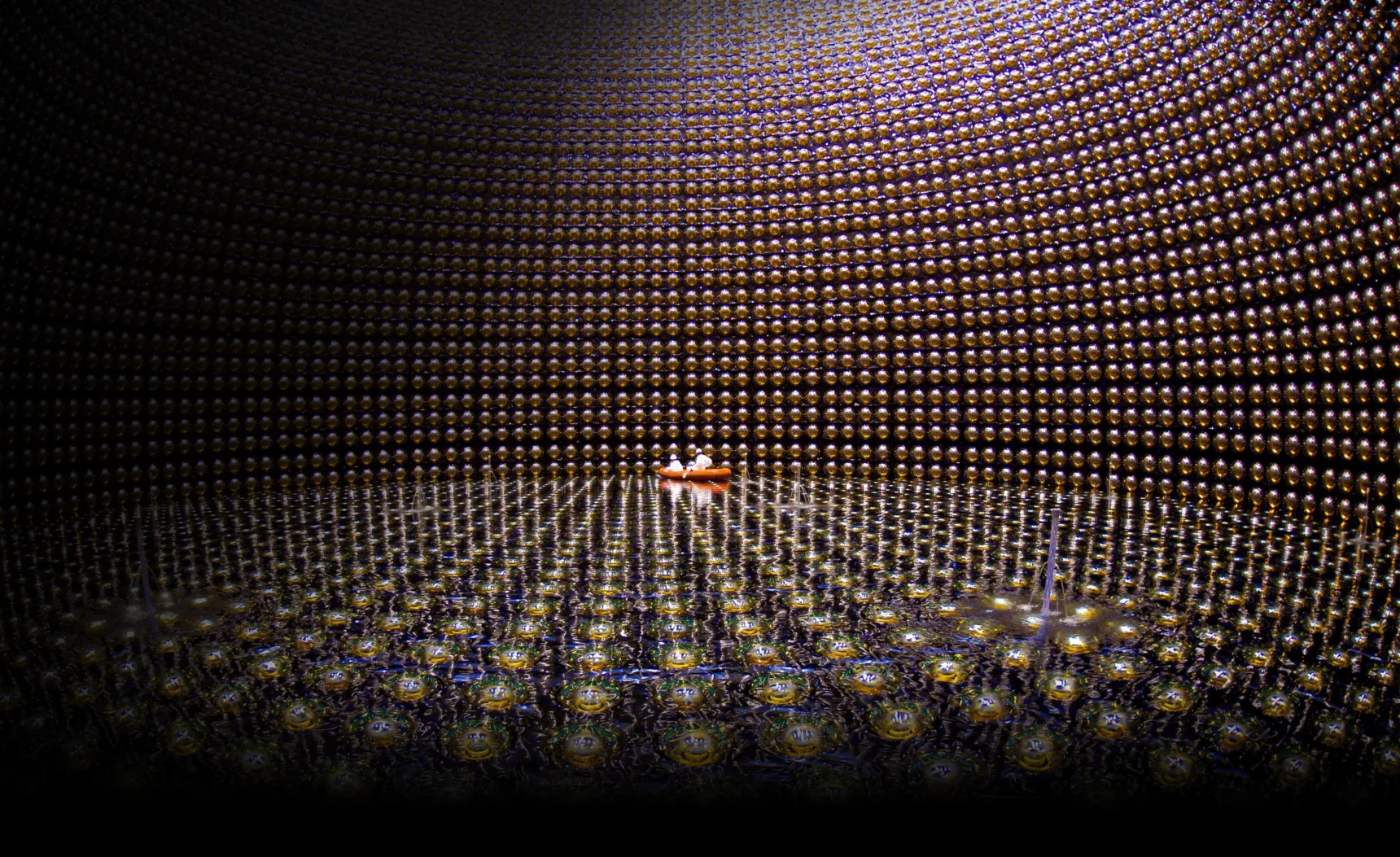
Masatoshi Koshiba developed the Kamiokande detector in the Kamioka mine, utilizing 3 million liters of ultrapure water. When a neutrino occasionally collided with a nucleus in the water, it produced an electron moving at relativistic speeds, creating a signature flash known as Cherenkov light.
Solving the Puzzle: Neutrino Oscillation
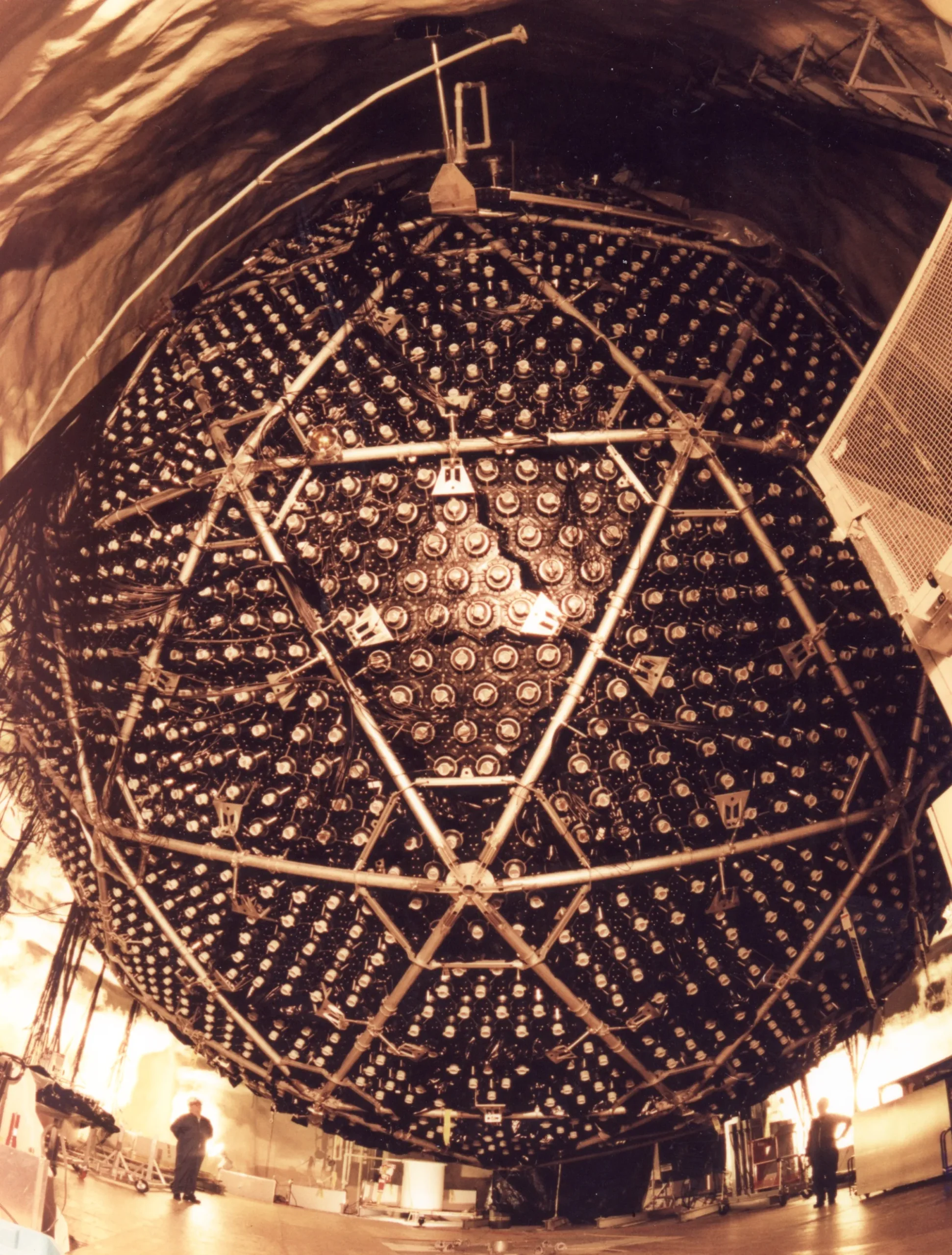
The discrepancy found by Davis was finally explained by the Super-Kamiokande and the Sudbury Neutrino Observatory (SNO). They discovered that neutrinos are not monolithic; they exist in three distinct "flavors."
| Flavor | Associated Particle | Detection Method |
|---|---|---|
| Electron | Electron | Water/Chlorine |
| Muon | Muon | Ice/Water |
| Tau | Tau | High-energy collisions |
The breakthrough was the discovery of oscillation: neutrinos can switch between these flavors as they travel. For this to happen, neutrinos must possess mass—a fact that contradicts earlier physics models.
The Modern Frontier
Today, the scale of these experiments has reached an industrial level, turning natural landscapes into sensors.
- IceCube: Located at the Amundsen-Scott South Pole Station, this observatory uses the Antarctic ice sheet to map the Milky Way's neutrinos and trace them back to supermassive black holes in active galaxies.
- KM3NET: Situated on the Mediterranean seabed, this telescope has recorded the most energetic cosmic neutrino ever seen.
- JUNO: China's Jiangmen Underground Neutrino Observatory (launched 2025) provided the world's most precise oscillation data in June 2026.
Future Milestones
The hunt continues with several upcoming projects:
- Hyper-Kamiokande (Hyper-K): Japan's next-generation giant.
- DUNE: The Deep Underground Neutrino Experiment in the American Midwest.
Data Simulation: A Neutrino Event
If we were to represent a detection event in a simplified log, it might look like this:
{
  "event_id": "NU-2026-06-24",
  "detector": "JUNO",
  "energy_gev": 15.4,
  "flavor_detected": "electron_neutrino",
  "oscillation_state": "confirmed",
  "timestamp": "2026-06-24T14:22:01Z"
}
Through these audacious efforts, the particle that Pauli believed was forever beyond our reach has become a vital tool for understanding the deepest secrets of the cosmos.
