What is a Lithium-ion capacitor?
Understanding Lithium-ion Capacitors
Provided by JTEKT Corporation, this guide explores the nature, mechanics, and advantages of Lithium-ion capacitors.
Overview of Power Storage
Capacitors are specialized energy storage devices categorized as secondary batteries (rechargeable). While various materials have been utilized to develop different types, the market for high-capacity storage is primarily split between two technologies:
- Electric Double Layer Capacitors (EDLC)
- Lithium-ion Capacitors
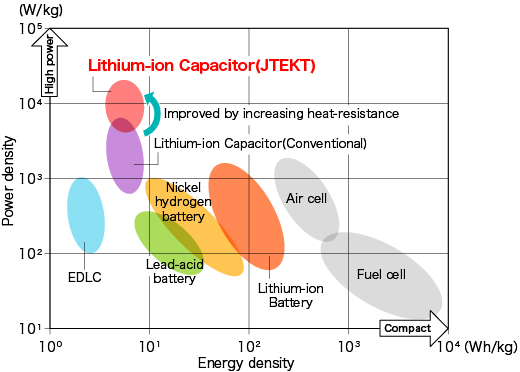
Key Characteristics
The defining trait of a capacitor is its ability to facilitate extremely rapid charging and discharging cycles.
While they cannot match the total energy storage of a standard battery, they excel in other areas. Compared to lead-acid or standard lithium-ion batteries:
- Power Density: Significantly superior.
- Durability: Minimal performance degradation over repeated cycles.
- Longevity: Much longer operational lifespan.
Performance Comparison Matrix
The following table compares standard storage devices. (Legend: = Excellent, = Good, = Average)
| Feature | Li-ion Battery | EDLC | Conventional Li-ion Capacitor | Libuddy (JTEKT) |
|---|---|---|---|---|
| Energy | ||||
| Power Density | ||||
| Service Life | ||||
| Temp Range () | ||||
| Operating Voltage () |
What is Libuddy? Libuddy is JTEKT's advanced Lithium-ion capacitor. By enhancing heat resistance, it has achieved a wider operating temperature range, which in turn significantly boosts both its service life and power density.
Principles and Architecture
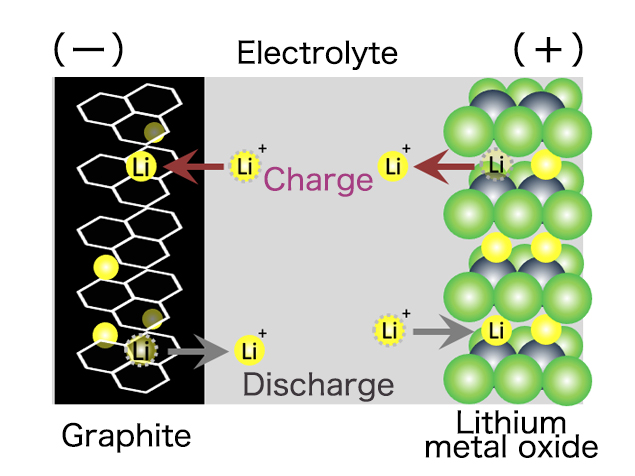
A Lithium-ion capacitor is essentially a hybrid device. It merges the positive electrode of an EDLC with the negative electrode of a Lithium-ion secondary battery.
This hybrid design creates a "best of both worlds" scenario:
- Higher energy density than standard capacitors.
- Increased safety compared to standard Lithium-ion batteries.
Charge and Discharge Mechanisms
| Device Type | Positive Electrode (+) | Negative Electrode (-) |
|---|---|---|
| Li-ion Battery | Lithium chemical reaction | Lithium insertion/removal |
| EDLC | Electrolyte ion adsorption/desorption | Electrolyte ion adsorption/desorption |
| Li-ion Capacitor | Electrolyte ion adsorption/desorption | Lithium insertion/removal |
Technical Specifications
The following data highlights the quantitative differences between these technologies:
| Metric | Li-ion Battery | EDLC | Conv. Li-ion Cap | Libuddy |
|---|---|---|---|---|
Energy (Wh/L) | ||||
Power Density (W/kg) | ||||
| Cycle Life (cycles) | ||||
| Temp Limit () |
Form Factors and Production
There are two primary physical designs for these capacitors:
- Can type
- Laminated type Used by JTEKT
The manufacturing process for Lithium-ion capacitors closely mirrors the production steps used for standard Lithium-ion batteries.
# Conceptual representation of Capacitor Selection
def select_storage(priority):
    if priority == "high_energy":
        return "Lithium-ion Battery"
    elif priority == "ultra_fast_cycle":
        return "EDLC"
    elif priority == "balanced_performance_and_life":
        return "Lithium-ion Capacitor (Libuddy)"
Electrical Glossary
To better understand the metrics above, refer to these definitions:
- Current (
A): The volume of electrons flowing per second. - Voltage (
V): The potential difference between two specific points. - Watt (
W): The amount of electrical energy output per second.- Formula:
- Watt-hour (
Wh): The total accumulated electrical energy.- Formula:
- Internal Resistance (
mΩ): The inherent resistance within the storage device. - C-rate (
C): A measure of how quickly a battery is charged or discharged relative to its capacity. - Joule heat (
J): Thermal energy produced when current passes through a conductor. - Primary battery: A non-rechargeable battery (discharge only).
- Secondary battery: A rechargeable battery.
- Float charging: Charging a battery at a constant voltage to maintain full charge.
- Power density (
W/L,W/kg): Electrical power relative to volume or mass. - Energy density (
Wh/L,Wh/kg): Electrical energy relative to volume or mass.
