Reduce GVisor Cold Starts with GPU Snapshotting
Reducing GVisor Cold Starts with GPU Snapshotting
Restoring CUDA Workloads in Seconds
If you are managing AI models in a production environment, you are inevitably dealing with cold starts. It is a constant struggle: you extend cooldown periods to avoid the performance hit of scaling down too quickly, but this leads to inefficiency. The core challenge becomes a singular, complex problem: How do we get a model ready to handle traffic as fast as possible?
At Cerebrium, we have made solving the cold start problem a primary mission. This drive has led us to overhaul nearly every layer of our infrastructure:
- Custom VM images Faster node scale-ups.
- Custom image runtime Sub-second container image cold starts.
- High-availability orchestrator Low-latency routing across clouds and regions.
- CPU and GPU memory snapshots Restoring fully "warmed" containers in seconds.
The "Production Wall"
As organizations deploy massive custom AI models—such as Large Language Models (LLMs), real-time avatars, diffusion models, and transcription services—they hit a performance wall. Startup times for these GPU-heavy workloads can range from a few seconds to over five minutes.
Most of this latency isn't caused by the network; it's caused by the initialization sequence:
- Importing heavy libraries.
- Loading massive model weights.
- Initializing CUDA.
- Compiling kernels.
- Warming up the runtime.
Instead of repeating this expensive process every time a container spins up, we snapshot the fully initialized state—including CPU/GPU memory, process states, weights, and compiled kernels—and inject it into a new container.
The Result: For specific workloads, this approach reduces cold start latency by .
Deconstructing the Cold Start
Many developers believe cold starts are simply about "pulling the image" (downloading the container image to the host). While that is the first step, it is no longer the primary bottleneck for AI.
The real cost occurs after the image is present. The initialization path is a series of deterministic but expensive operations:
| Operation | Why it's slow | Determinism |
|---|---|---|
| Python Imports | Loading PyTorch and dependencies | Same modules every time |
| Weight Loading | Moving GBs of data to GPU VRAM | Same bytes every time |
| Kernel Compilation | torch.compile and CUDA graph capture | Same kernels every time |
| Runtime Prep | KV cache initialization | Same state every time |
Since we are recomputing known results on every scale-up, the solution is to freeze the result and restore it on demand.
The Snapshot Process
The mechanism for creating a checkpoint follows a strict sequence:
- Pause Execution: Halt all application threads, processes, and active GPU operations.
- Dump Memory: Serialize the current state of both CPU and GPU memory into files.
- Store: Upload these checkpoint files to high-speed storage.
- Restore: Rehydrate the memory in a new container, repair non-persistent state, and unpause.
The restored process is an exact replica of the warmed-up runtime: PyTorch is already loaded, weights are in VRAM, and the application is immediately ready for traffic.
High-Level Architecture
To implement this, the checkpointing logic must reside where it can control the entire container lifecycle: between the container runtime and the sandbox (where the workload actually runs).
Cerebrium utilizes gVisor sandboxes for secure isolation. We extended the runtime path to introduce a decision point during the boot sequence:
The Node Runtime Components
To manage this, we integrated two key elements into the node runtime:
- The Checkpoint Service: A lightweight agent on every host that manages the operational lifecycle:
- Downloading and caching checkpoints locally.
- Uploading new snapshots.
- Evicting stale or corrupted data.
- Reporting the status of the restore process.
- The Interceptor: This component catches the container creation request and determines if a compatible checkpoint is available.
Compatibility Logic
A restore cannot happen blindly. The system must verify:
if (image_id == match && gpu_type == match && machine_type == match && runtime_version == match)
If these conditions are met, the normal boot flow is bypassed in favor of the restore flow.
Visualizing the Impact
Below are the architectural and performance insights from our implementation:
 Conceptual flow of the snapshotting process.
 Accelerating cloud deployment.
 Detailed runtime architecture.
 The interaction between gVisor and the GPU memory.
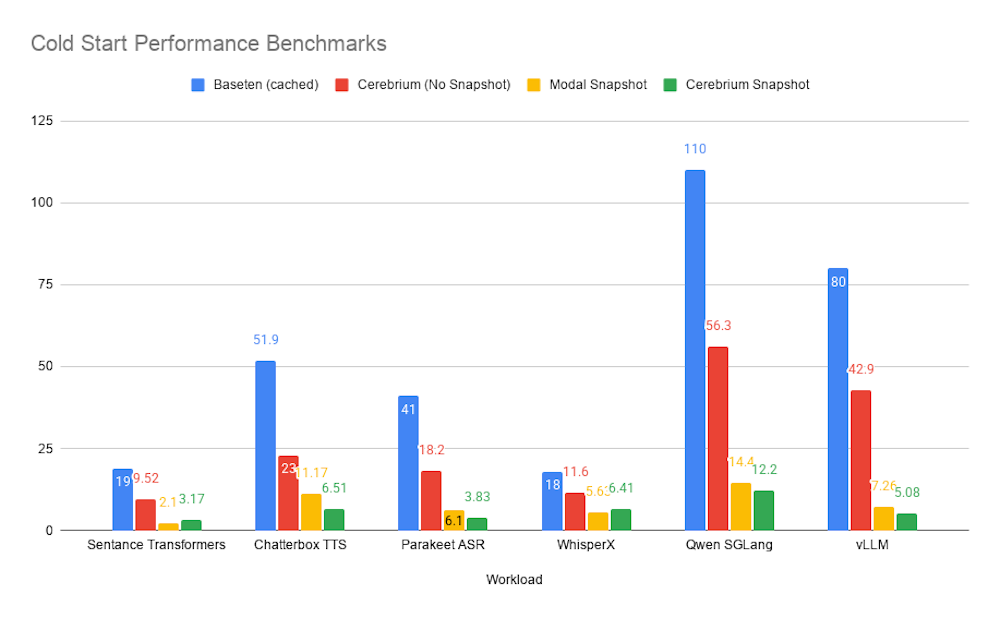 Benchmarks showing the drastic reduction in startup time.
Summary of the Cerebrium Approach
By treating the "warmed" state of a CUDA workload as a portable asset rather than a repeatable process, we can deploy complex models like vLLM with unprecedented speed.