Neural Render Proxies for Interactive and Differentiable Lighting
Neural Render Proxies: Enabling Interactive and Differentiable Lighting

This research introduces a groundbreaking Neural Render Proxy (NRP) designed to facilitate the differentiable relighting of static scenes. By keeping the camera and materials constant, this system allows for lighting adjustments at interactive speeds.
📋 Publication Metadata
| Detail | Information |
|---|---|
| Release Date | July 1, 2026 |
| Venue | Eurographics Symposium on Rendering (EGSR) 2026 |
| Primary Authors | Sergio Sancho, Alexander Rath, Marco Manzi, Pascal Chang, Amit H. Bermano, Derek Nowrouzezahrai, Markus Gross, Marios Papas |
| Affiliations | Disney Research Studios, ETH Zurich, Tel Aviv University, McGill University, Mila – Quebec AI Institute, CIFAR |
🖼️ Visual Overview

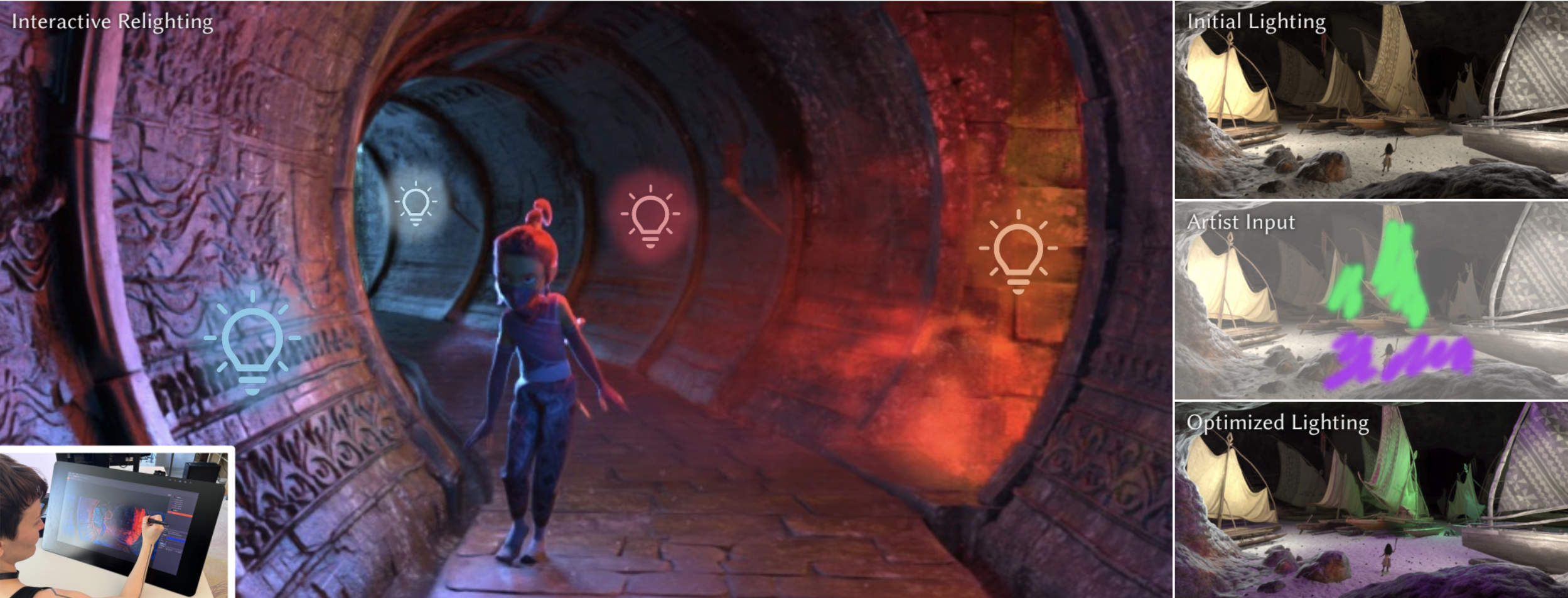
🔍 The Challenge: The Lighting Bottleneck
In the professional CG animation pipeline, lighting is often a grueling process. Artists face significant hurdles because:
Slow offline renderersare required for even the smallest tweaks.- Global illumination requires extensive sampling.
- Complex shaders demand heavy computation.
Consequently, the iteration loop—the time between making a change and seeing the result—can stretch from minutes to several hours per single frame.
💡 The Solution: Neural Render Proxies (NRP)
To solve this, the authors propose a method that decouples the rendering process. Instead of calculating everything at once, they separate path sampling from emission computation.
The Technical Workflow
- Data Collection: A single, light-agnostic render pass is performed to gather light transport data via path samples.
- Dynamic Sampling: Lighting conditions are sampled on the fly.
- Neural Learning: A lightweight, scene-specific neural network is trained to map how light travels from any point in the scene to a specific pixel.
Mathematically, the proxy approximates the light transport equation:
🚀 Key Advantages & Performance
The NRP approach offers several systemic benefits:
- Compatibility: It works seamlessly with production renderers that are not inherently differentiable.
- Efficiency:
- Low memory overhead during the inference phase.
- Performance scales based on resolution, parameter count, and light sources.
- , but is of scene geometry or material complexity.
- Speed: Achieves interactive frame rates of approximately
30–60 Hz. - Fidelity: Maintains a visual quality that closely mirrors ground-truth path tracing.
Project Goals Achieved:
- Interactive relighting speeds.
- High visual fidelity.
- Differentiable pipeline for inverse workflows.
- Independence from scene complexity.
🛠️ Inverse Workflows
Because the NRP is differentiable, it enables gradient-based inverse workflows. This means artists are no longer limited to trial-and-error; they can solve for specific lighting parameters using:
- Intuitive image-space edits.
- Generative AI targets.
# Conceptual logic for the differentiable update
def optimize_lighting(target_image, current_lighting):
    while not converged:
        image = NRP.render(current_lighting)
        loss = calculate_loss(image, target_image)
        gradient = compute_gradient(loss, current_lighting)
        current_lighting -= learning_rate * gradient
    return current_lighting
⚖️ Copyright Notice
[!IMPORTANT] The documents in these directories are provided by the authors for the purpose of timely, non-commercial dissemination of technical work. All copyrights are retained by the original authors or holders. Users must adhere to the copyright terms invoked by each author; reposting without explicit permission is prohibited.
Explore More: Research at Disney | People | Publications