The US Government Is Now a Shareholder in 26 Companies
The US Government Is Now a Shareholder in 26 Companies
An Analysis of Washington's Pivot Toward Direct Equity Ownership
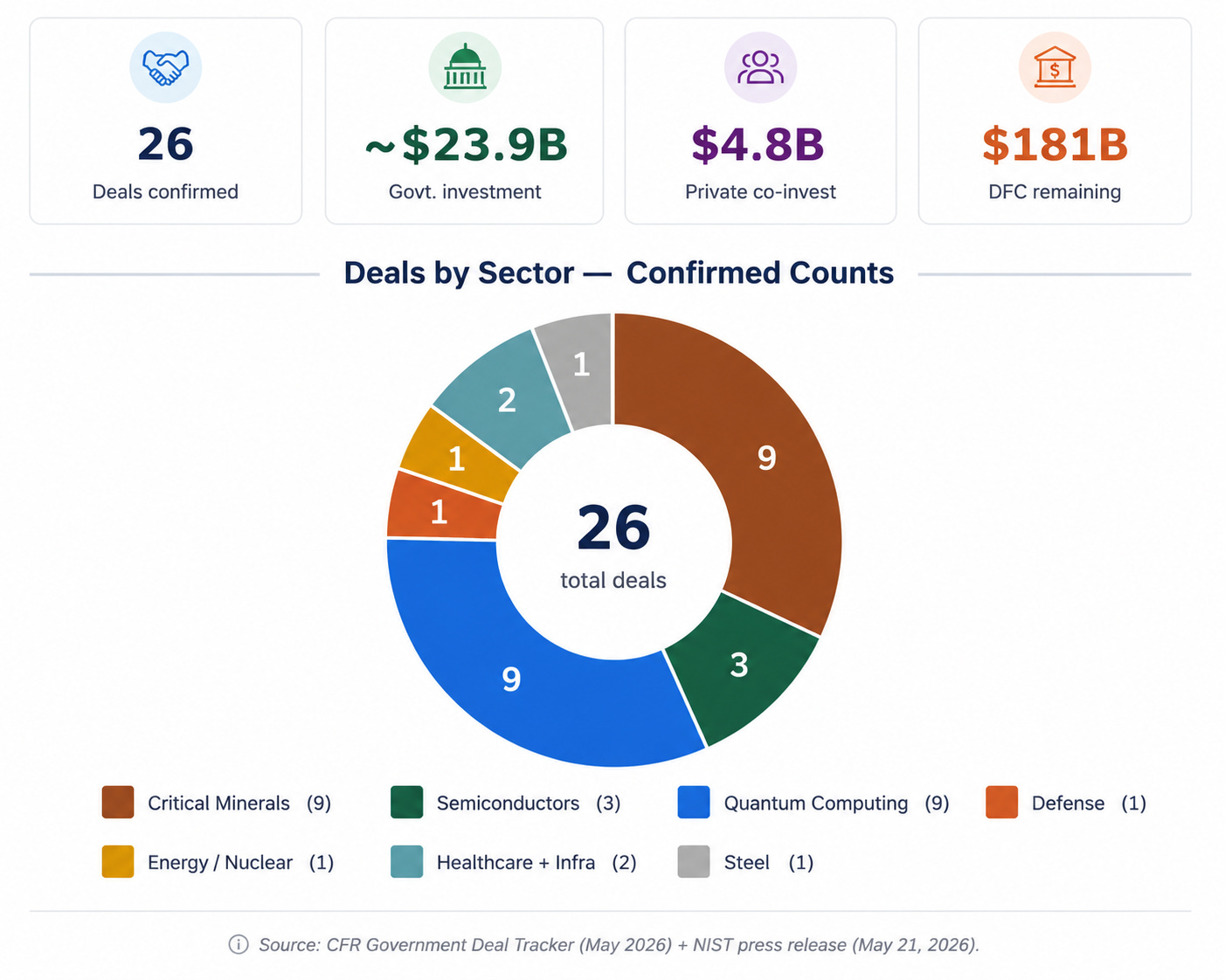
Since the start of 2025, the United States government has fundamentally altered its approach to industrial policy. Rather than acting solely as a benefactor, Washington has transitioned into a venture capitalist, securing equity stakes in 26 different companies spanning nine strategic sectors.
The Critical Metric: There is a staggering discrepancy between current spending and legal authorization.
This \text{\181 billion}$ gap represents a massive reservoir of capital ready to be deployed into the private sector.
📈 The Evolution of the Portfolio
The trajectory of these investments has accelerated rapidly. While the CFR Government Deal Tracker initially logged 17 "pre-quantum" deals, the pace shifted gears on May 21, 2026, when the government acquired stakes in nine quantum computing firms in a single week.
Strategic Targets
Washington is targeting "bottleneck" technologies and national security vulnerabilities:
- Rare Earths: A 15% stake in the only domestic rare earth miner.
- Semiconductors: Investment in
xLight, a startup developing laser systems to break ASML's dominance in EUV lithography. - Energy: Participation in the nuclear initiatives of Westinghouse.
- Defense: A munitions-focused deal with L3Harris.

🛠️ The "National Champion" Playbook
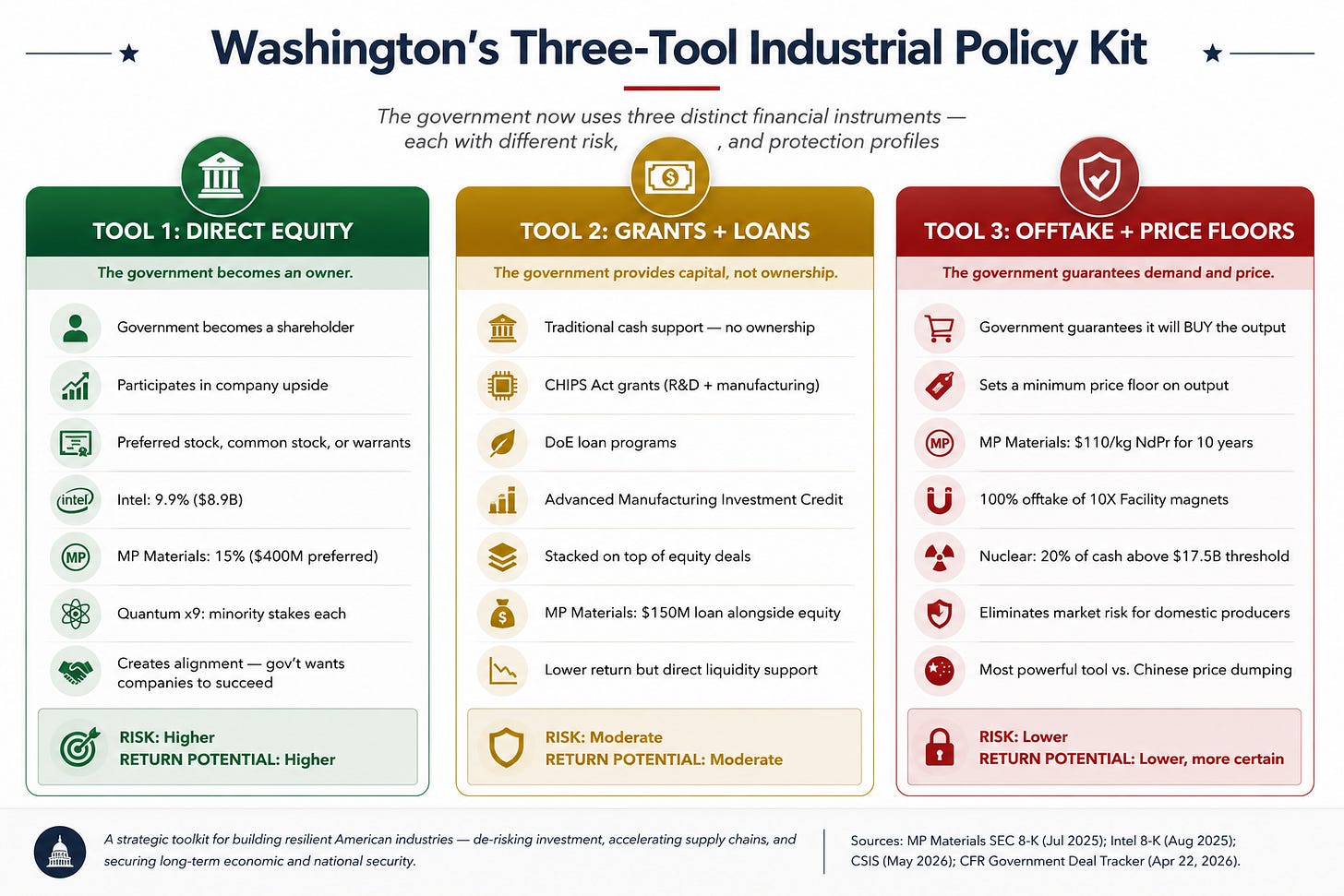
The government has moved beyond simple grants to a sophisticated, three-tiered incentive structure. By combining these tools, Washington creates "National Champions" that are virtually impossible for private competitors to challenge.
The Three-Tool Strategy
- Direct Equity: Acquisition of common stock, preferred stock, or warrants (e.g., Intel, L3Harris, xLight).
- Traditional Support: A layer of R&D grants (via the CHIPS Act), DoE loans, and Advanced Manufacturing Investment Credits.
- Revenue Guarantees: "Off-take" agreements where the government guarantees a minimum purchase price for output.
Case Study: MP Materials (NYSE: MP)
The government didn't just fund MP Materials; it guaranteed its economic viability:
- Equity: $400M in Series A Preferred Stock (15% stake).
- Upside: Potential for an additional $350M in preferred stock and a $150M loan.
- Floor: A 10-year price floor for NdPr set at $110/kg.
- Market: A commitment to buy 100% of the 10X Facility's output for a decade.
💰 The Funding Engine: DFC Modernization
The legal mechanism enabling this spree is the Development Finance Corporation (DFC). Originally limited by the BUILD Act, the landscape changed in December 2025.
The DFC Modernization and Reauthorization Act of 2025 provided three critical upgrades:
- Ceiling Increase: Raised the investment limit from \text{\60 billion} \rightarrow \text{$205 billion}$.
- Domestic Scope: Extended authority to invest domestically via the Defense Production Act.
- New Capital: Authorized a \text{\5 billion}$ equity revolving fund at the Treasury.
📋 The Confirmed Portfolio
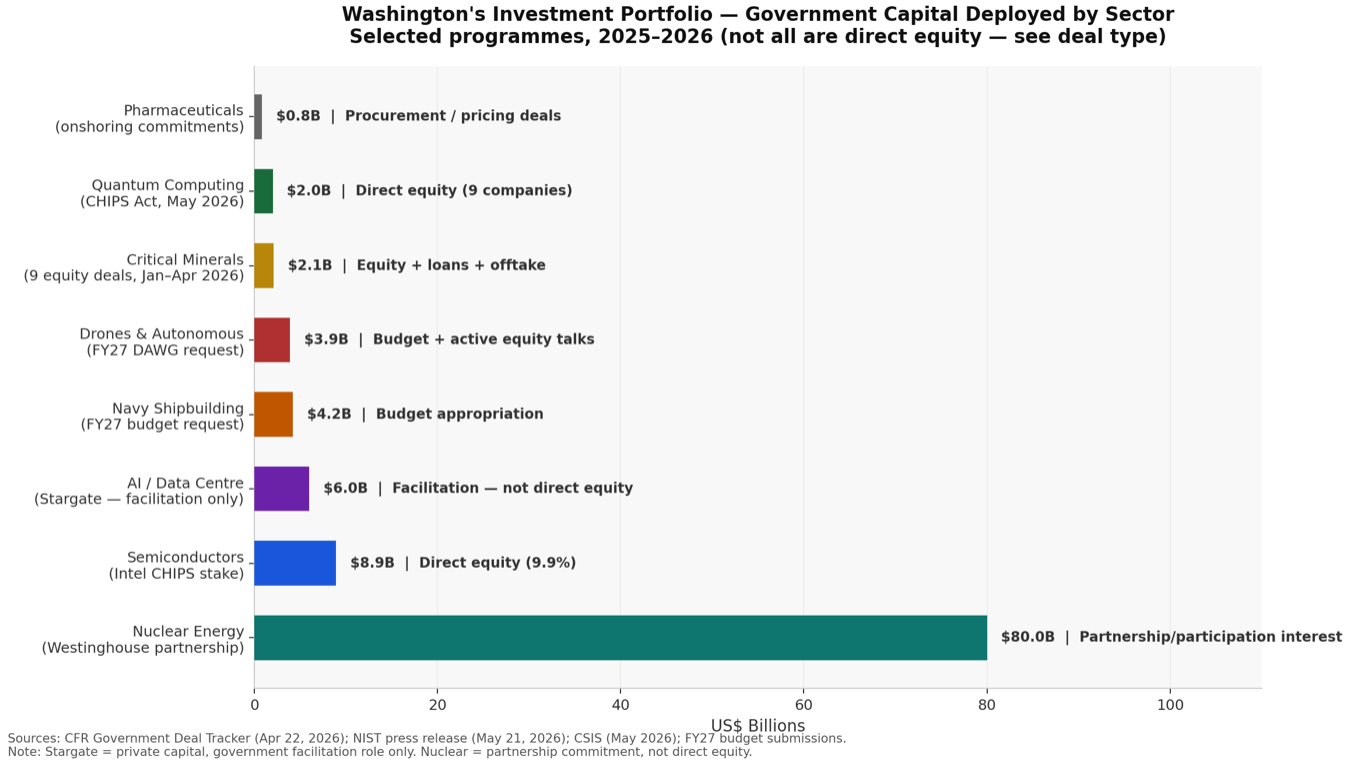
To date, $23.9 billion in government capital has been deployed across 26 deals. Notably, this has crowded in $4.75 billion from private partners, including Goldman Sachs, J.P. Morgan, and the Emirati sovereign wealth fund ADQ.
Critical Minerals Breakdown (The Flagship Sector)
| Company | Ticker | Stake/Terms | Key Detail |
|---|---|---|---|
| MP Materials | MP | 15% | $110/kg price floor; 100% off-take |
| USA Rare Earth | USAR | 8–16% | Financing-for-equity + warrants |
| Lithium Americas | LAC | 5% | Linked to $2.23B DoE loan restructure |
| Trilogy Metals | TMQ | 10% | $35.6M investment + 3.75% warrant |
| Others | N/A | Various | Korea Zinc, ReElement Tech, Vulca |
🔍 Final Analysis: What's Next?
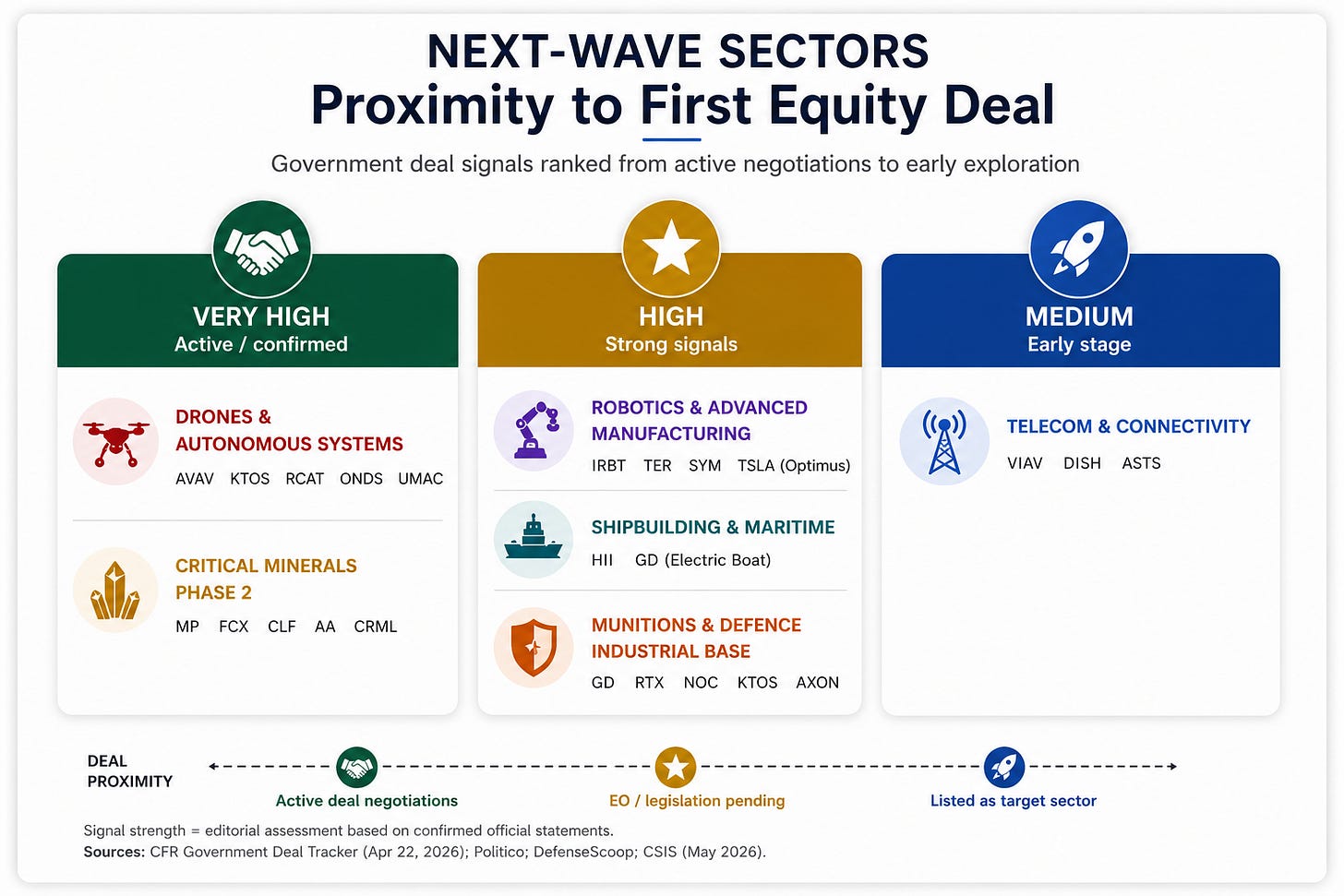
The government has already established positions in critical minerals, quantum computing, healthcare, and infrastructure. With $181 billion in remaining capacity, the focus now shifts to identifying the next set of "National Champions."
def investment_strategy(sector):
    if sector == "Strategic_Bottleneck":
        return "Equity + Grant + Price_Floor"
    else:
        return "Traditional_Grant"

# Current Status
print(investment_strategy("Quantum_Computing"))
# Output: Equity + Grant + Price_Floor
The core question for investors is no longer if the government will intervene in the market, but which public-market proxies will be the next to receive the "National Champion" seal of approval.