Giant trees have no trouble pumping water to top branches: new research
Giant Tropical Trees: Defying Gravity in Water Transport
Recent scientific findings indicate that the world's tallest tropical trees possess an extraordinary ability to transport water to their highest reaches without the struggle previously assumed by biologists.

Challenging the Status Quo
For years, the prevailing scientific consensus suggested a biological "ceiling" for tree height. The logic was simple: as a tree grows taller, the energy and pressure required to move water from the soil to the canopy increase, theoretically making these giants more susceptible to drought and limiting their overall growth.
Conventional theory: Height = Increased Vulnerability New Reality: Adaptive Compensation.
A study led by Cardiff University and the University of Exeter, published in the journal Science, reveals that giant Dipterocarp trees—the tallest flowering plants on Earth—have evolved mechanisms that "fully compensate" for the challenges of their stature.
Comparison of Theories
| Feature | Traditional Scientific Theory | New Research Findings |
|---|---|---|
| Water Transport | Becomes harder as height increases | Fully compensated by biological adaptations |
| Drought Risk | Taller trees are more vulnerable | No increased risk compared to shorter trees |
| Growth Impact | Height limits photosynthesis/growth | No height-related growth loss during severe drought |
The Mechanics of Hydraulic Ascent
Professor Lucy Rowland of the University of Exeter explains that trees utilize a system of narrow, hollow vessels to pull water upward. This process is driven by creating a state of low pressure at the canopy.
To describe this conceptually, we can look at the pressure gradient:
Where the extreme low pressure at the top allows water to remain liquid even when fighting gravity over distances exceeding 80 meters.
How Dipterocarps Adapt
The researchers identified specific biological "upgrades" in taller trees:
- Vessel Architecture: Water-carrying vessels are wider near the base of the tree to facilitate easier transport.
- Leaf Resilience: Leaves at the top are adapted to endure higher levels of water stress before they begin to wilt.
Field Research in Borneo
The team conducted extensive measurements in Malaysian Borneo, analyzing Dipterocarp trees with heights ranging from 7m to 71m.
Research Objectives:
- Measure hydraulic traits at various heights.
- Monitor trunk growth during the 2023-2024 El Niño drought.
- Compare growth rates between short and tall specimens.

The data showed that even during the severe El Niño event, the tallest trees did not suffer a disproportionate loss in growth compared to their smaller counterparts.
Why This Matters for the Planet
The implications of this study extend far beyond botany. These giants are critical components of the global carbon cycle.
"Understanding tall trees is vital because the tallest 1% of trees store more than half of above-ground carbon in forests," explains Dr. Paulo Bittencourt.
If current climate change models assume these trees are fragile and prone to drought-induced death, those models may be inaccurate. This discovery suggests a higher level of resilience in the rainforest's most important carbon sinks.
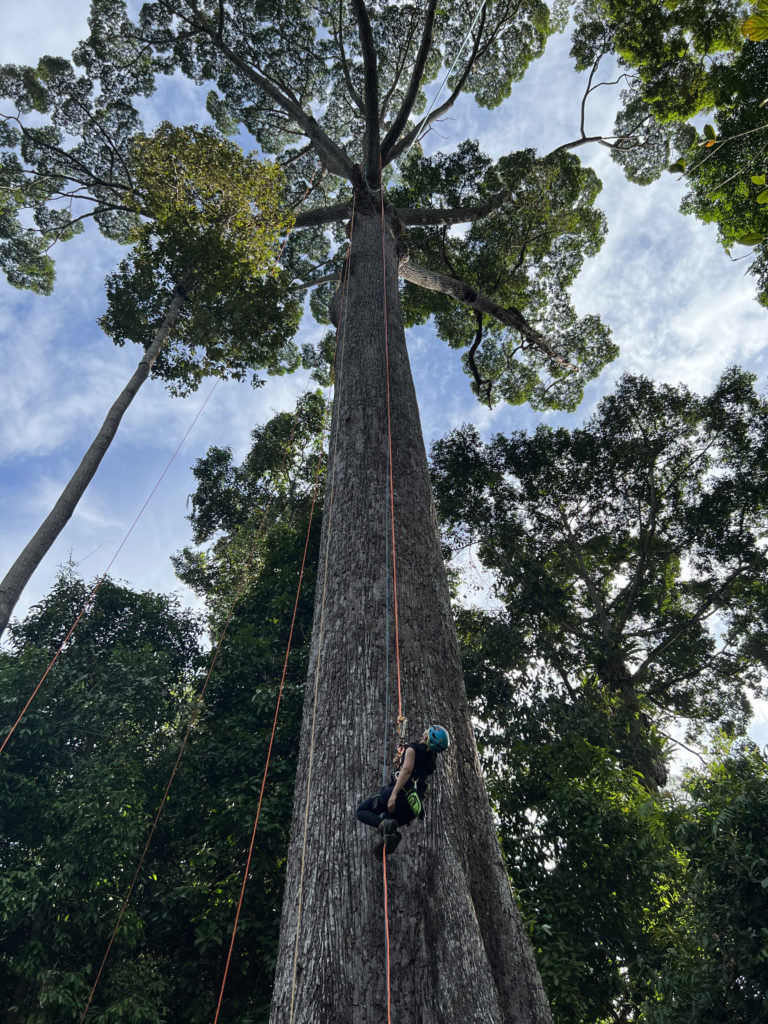
Palasiah Jotan, a PhD student and co-author, emphasizes that proving the hydraulic resilience of these trees strengthens the argument for the urgent protection of Borneo's rainforests.
Study Metadata & Collaboration
{
  "paper_title": "Height does not impair the hydraulic system of the tallest tropical Dipterocarp trees",
  "journal": "Science",
  "funding_body": "Natural Environment Research Council",
  "primary_locations": ["Malaysian Borneo"],
  "key_species": "Dipterocarp"
}
Collaborating Institutions:
- UK: University of Exeter, Cardiff University, UK Centre for Ecology Hydrology, University of Aberdeen.
- Malaysia: Sabah Forestry Department.
- International: Partners from the USA, Brazil, Spain, Germany, and the Czech Republic (including The Czech University of Life Sciences).