No more than 100 000 faint satellites should orbit Earth
The Ceiling of the Sky: Why Earth Needs a Satellite Limit
A recent investigation by the European Southern Observatory (ESO) warns that the current trajectory of satellite launches is unsustainable. If proposals to deploy over 1.7 million satellites—some of which are exceptionally luminous—come to fruition, the results would be manageable devastating for the field of astronomy.
To preserve the integrity of our cosmic observations, the study concludes that the total number of orbiting satellites must not exceed 100,000, and these must remain faint (below the threshold of naked-eye visibility).
The Escalation of Orbital Crowding
Since 2019, we have seen an exponential surge in orbital hardware. The current count has climbed to over 14,000 units, a trend driven largely by the Starlink network from SpaceX. However, future projections are far more aggressive.
"Until now we have managed, but it's getting worse," warns Olivier Hainaut, an ESO astronomer with three decades of experience and the author of this peer-reviewed study published in Astronomy Astrophysics.
While some corporations have attempted to reduce the reflectivity of their craft, Hainaut argues that the sheer volume of planned constellations is pushing us "beyond the limit."
Comparison of Proposed Constellations
| Project / Entity | Estimated Number | Primary Purpose | Potential Impact |
|---|---|---|---|
| SpaceX | Space-based data centers | Massive increase in visible streaks | |
| E-Space | Hundreds of thousands | Cinnamon constellation | Compounded sky brightness |
| China | Hundreds of thousands | CTC-1 and CTC-2 | Compounded sky brightness |
| Reflect Orbital | Nighttime sunlight delivery | Extreme light pollution |
The "Mirror" Threat: Reflect Orbital
The US start-up Reflect Orbital proposes a particularly disruptive system: giant mirror-satellites designed to reflect sunlight to Earth at night. These beams would cover areas of at least on the surface.
The brightness levels are staggering:
- Direct Beam: A satellite viewed from within its beam would be brighter than the full Moon.
- Indirect View: Even when not beaming directly at an observer, each satellite would shine as brightly as Venus (the "morning star").
- Urban Impact: In a city like Munich, these satellites might become the only visible "stars" in the sky.
Technical Impact on Astronomical Data
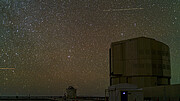
Hainaut's research utilized simulations to model the motion and luminosity of these constellations. The primary issue is the "zapping" effect: when a sun-lit satellite crosses a telescope's field of view, it leaves a brilliant streak that obliterates the data behind it.
Quantifying the Loss
For the Very Large Telescope (VLT) at Paranal, the SpaceX mega-constellation could cause:
- Field-of-view loss: Up to in images taken two hours into the night.
- Condition: This assumes satellites are not visible to the naked eye.
If brightness increases slightly, the Vera C. Rubin Observatory could find the majority of its images unusable for several hours every single night. In the case of Reflect Orbital, a single mirror-satellite trail could ruin an observation; a full fleet would result in total data loss whenever the satellites are illuminated by the Sun.
Beyond the Streaks: Global Sky Glow
The problem isn't just the lines across the images; it is the overall increase in background luminosity.
- Diffuse Light: Produced by satellites too faint to see individually.
- Scattered Light: Produced when light from bright satellites hits the atmosphere and spreads.
The study reveals that the Reflect Orbital fleet alone could make the entire night sky to times brighter.
What is at Risk?
The increase in background noise hinders our ability to detect:
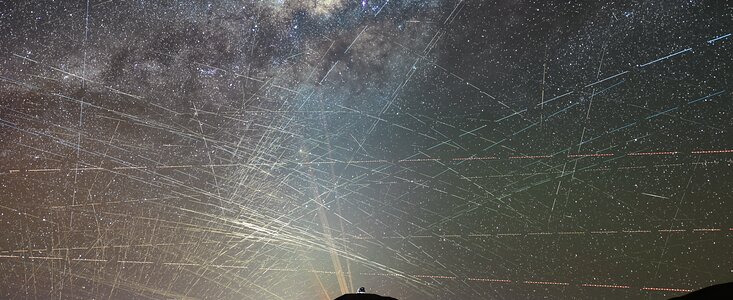 Visual representation of the "scratched" sky effect.
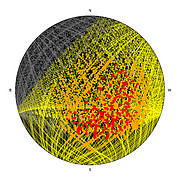 Predicted satellite density over the VLT.
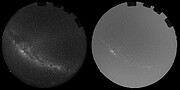 Simulation of light pollution from Reflect Orbital.