Should DayQuil Be Legal?
Is the Legality of DayQuil Questionable?
By Eli Richman | The Argument

At a glance, a bottle of Tylenol and a bottle of DayQuil might seem like different tools for different jobs, but a quick look at the ingredients reveals a different story.
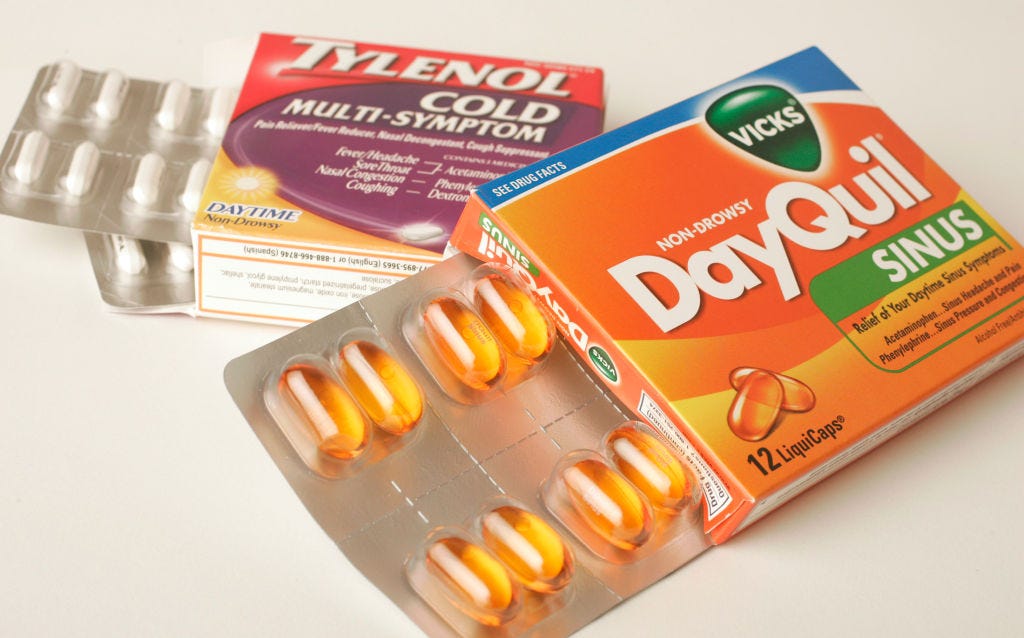
If you browse the cold and flu section of a pharmacy like CVS, you'll find roughly 100 different products, yet they all rely on about six active ingredients. This is the core of the over-the-counter (OTC) drug "grift": taking a few generic, cheap medications (and some expensive placebos) and bundling them into a high-priced combination package.
The Anatomy of a "Combo Drug"
Consider a standard 12-ounce bottle of DayQuil, retailing for approximately $15. The formula is essentially a mix of:
- Acetaminophen (The actual worker)
Dextromethorphan(Supposed to stop coughs, but often performs no better than a placebo—or even honey)Phenylephrine(Supposed to clear congestion, but essentially useless)
The only ingredient providing actual relief is acetaminophen, which constitutes only about 2% of the bottle's volume.
The Cost Disparity
| Product | Estimated Cost | Active Ingredient Value |
|---|---|---|
| DayQuil (Brand) | ~$15.00 | |
| DayQuil (Store Brand) | ~$10.00 |
To calculate the markup for the store brand, we use:
Convenience vs. Deception
Some might argue that this is simply a "convenience fee," similar to buying a pre-cut fruit salad. However, the author argues this analogy fails for three reasons:
- Price Scale: Pre-cut fruit is usually 4–12x the price; these drugs are marked up by thousands of percent.
- Substance: A fruit salad contains actual fruit. Many combo drugs contain ingredients that are essentially "fruit-shaped rocks"—they look like medicine but do nothing.
- Risk: Overeating melon is harmless; however, combo drugs frequently lead to accidental overdoses because patients may not realize they are taking multiple products containing the same active ingredients.
The Sudafed Shell Game
The most egregious example is the transition from pseudoephedrine to phenylephrine.
Pseudoephedrine is highly effective for congestion, but because it can be used to manufacture crystal meth, the government restricted it. To buy it today, you must complete a rigorous process:
- Provide full legal name
- Show government ID
- Provide fingerprints/SSN
- (Hyperbolically) Surrender your firstborn child
To bypass these hurdles while maintaining profits, manufacturers introduced phenylephrine. It sounds similar, looks similar, and is branded similarly to Sudafed, but it is medically ineffective.

"It is one of the most egregious examples of stupidity in the whole world of over-the-counter combination pills," says Dr. Jerry Avorn, a Harvard drug policy researcher. He notes that the industry's resistance to scientific data regarding phenylephrine's uselessness is "astonishing."
Regulatory Failure and the "Libertarian" Trap
The FDA is tasked with ensuring drugs are both safe and effective. However, the author suggests the agency has developed a habit of approving drugs with minimal evidence of efficacy. Once a drug is on the market, removing it is a "glacial" process.
Some conservatives and libertarians argue that the FDA should only regulate safety, leaving patients to decide if a drug is effective based on their own research. The author views this as naive:
def patient_behavior(reads_labels, compares_prices):
    if not reads_labels or not compares_prices:
        return "Buys expensive combo drug"
    else:
        return "Buys cheap generic"

# Reality check
print(patient_behavior(reads_labels=False, compares_prices=False))
# Output: Buys expensive combo drug
The reality is that most patients do not analyze clinical trials before buying cold medicine; they trust the branding and the regulatory seal of approval. Allowing unproven drugs to remain on the market under the guise of "providing options" only serves the pharmaceutical industry, not the patient.