GPT‑Live
Introducing GPT‑Live
OpenAI | Product Release Date: July 8, 2026
OpenAI is proud to unveil GPT‑Live, a groundbreaking generation of voice models designed to transform human-AI interaction. This technology is now the engine powering the updated ChatGPT Voice experience.
🎙️ What is GPT‑Live?
GPT‑Live is engineered to make interacting with an AI feel less like a series of commands and more like a genuine human conversation.
Key Architectural Pillars
- Full-Duplex Architecture: Unlike previous systems, GPT‑Live can process audio input and generate audio output simultaneously.
- Natural Conversational Cues: The model can now provide active listening signals (e.g., "mhmm" or "yeah"), handle rapid-fire exchanges, or remain silent while the user reflects.
- Intelligent Delegation: For tasks requiring high-level reasoning or web access, GPT‑Live offloads the work to a frontier model (like
GPT-5.5) in the background.
"Our vision is to enable truly natural human–AI interaction: a world where collaborating with AI feels as fluid and responsive as working with another person, while reasoning and complex task execution happen seamlessly in the background."
Current Offerings & Availability
- Models Released:
GPT-Live-1(Full power)GPT-Live-1 mini(Efficient/Fast)
- Deployment Status:
- Global rollout to ChatGPT users.
- API availability (Coming soon).
🔄 The Evolution of Voice AI
To understand why GPT‑Live is a leap forward, we must look at the outdated previous methodologies.
Comparison of Voice Architectures
| Feature | Cascaded Systems | Turn-Based Models | GPT‑Live (Full-Duplex) |
|---|---|---|---|
| Workflow | STT LLM TTS | Single Audio-to-Audio | Continuous Stream |
| Latency | High (Slow/Stilted) | Medium (Smoother) | Low (Instant) |
| Interaction | Rigid turns | Discrete turns | Fluid/Simultaneous |
| Nuance | Information loss | Silence-based triggers | Active listening |
Visualizing the Shift
1. The Cascaded Era
These systems functioned as a chain. For example, the original ChatGPT Voice used:
Speech-to-Text Large Language Model Text-to-Speech.
Because these were separate steps, the result was often robotic stilted and prone to data loss during transcription.
2. The Turn-Based Era
Advanced Voice Mode improved this by using a single model for audio. However, it still relied on discrete turns. The AI had to wait for a period of silence to trigger a response, which often led to awkward interruptions if the user simply paused to think.
3. The GPT‑Live Era
GPT‑Live utilizes a continuous interaction loop. The model makes decisions multiple times per second:
- Should I speak now?
- Should I keep listening?
- Should I interrupt?
- Should I call a tool?
🧠 Delegation for Complex Reasoning
GPT‑Live is optimized for interaction, not necessarily for deep research. To solve this, we decoupled the "voice" from the "brain."
The Logic Flow:
if user_request == "complex_reasoning" or "web_search":
    # Maintain conversational flow with the user
    gpt_live.say("Let me look into that for you...")
    # Delegate to the frontier model in the background
    result = gpt_5_5.process(request)
    # Bring the answer back into the live stream
    gpt_live.integrate(result)
This allows the AI to maintain a natural flow while GPT-5.5 handles the heavy lifting.
📊 Performance & Evaluations
We utilized new human-centric metrics to evaluate "pleasantness" and "flow." In 5–10 minute head-to-head tests, GPT-Live-1 and GPT-Live-1 mini were strongly preferred over Advanced Voice Mode.
Benchmark Results
- GPQA: Significant improvement in expert-level scientific reasoning (Biology, Physics, Chemistry).
- BrowseComp: Strong gains in agentic web searching and locating obscure data.
- -Voice Telecom: Outperformed previous models in realistic, multi-turn telecom support simulations.
🖼️ Visual Capabilities
GPT‑Live doesn't just talk; it integrates visual data seamlessly into the conversation.
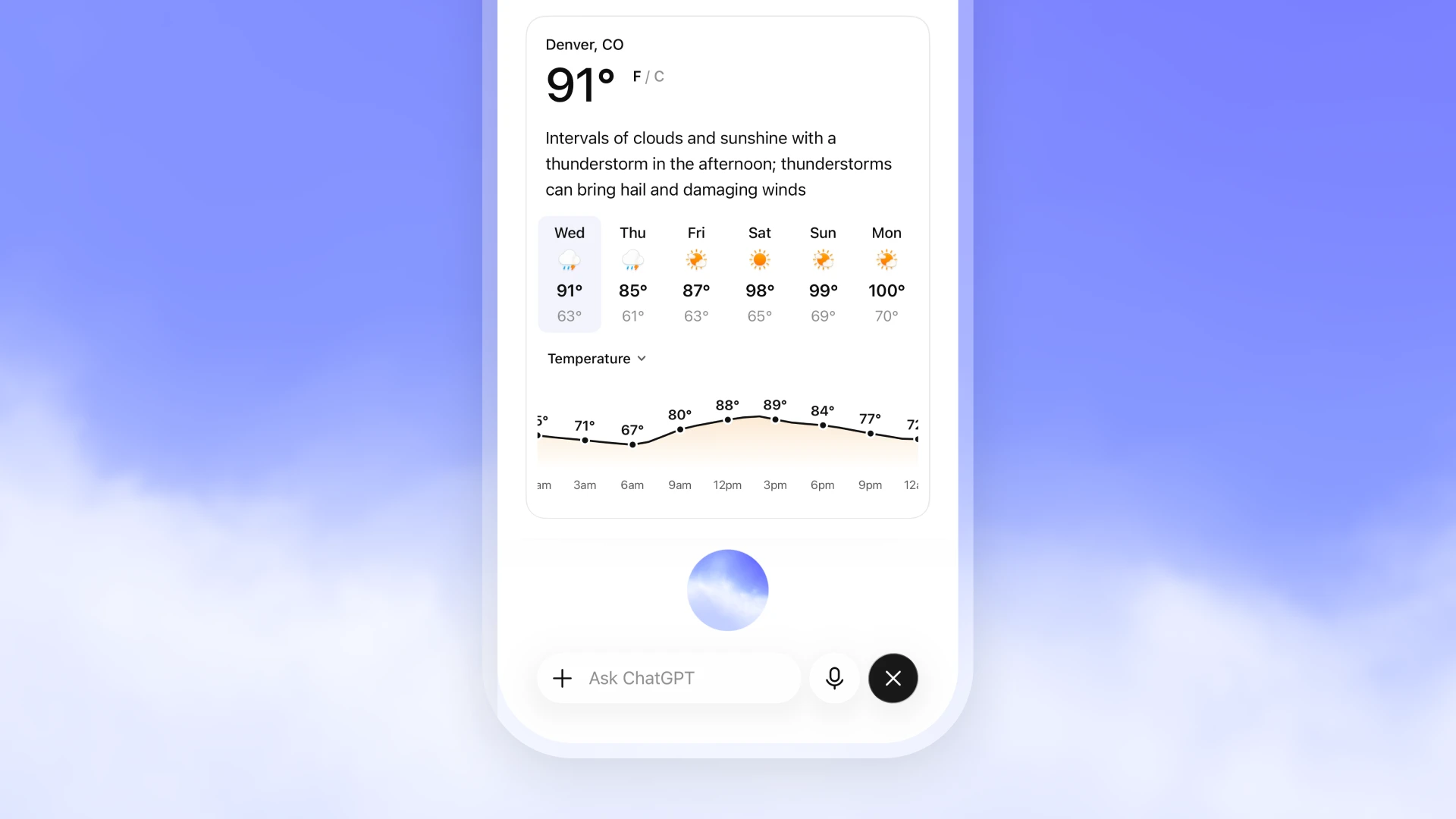 Example: Real-time weather updates for Denver.
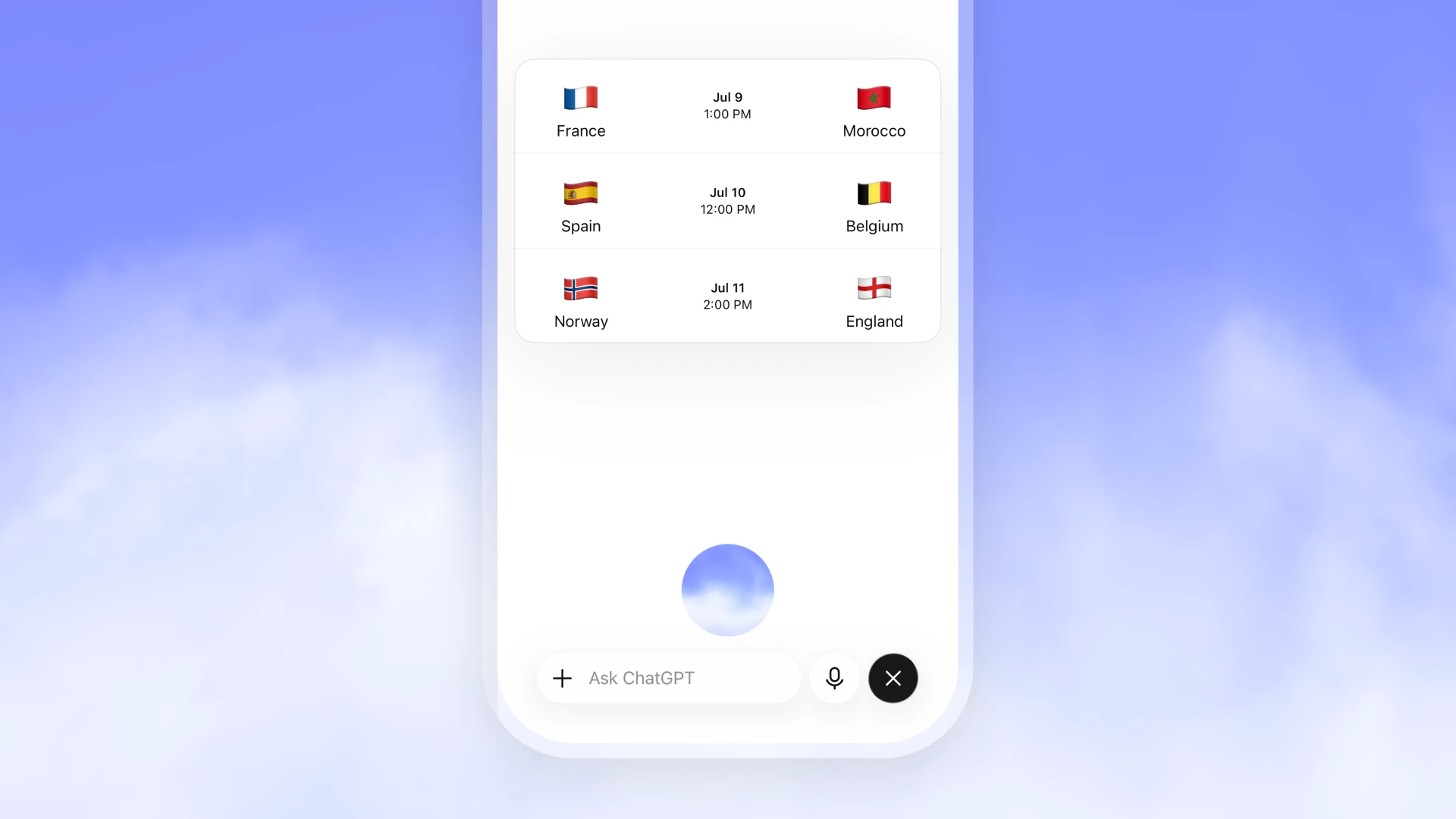 Example: Displaying international football schedules.
 Example: Locating nearby soccer pubs via maps.
Additional Assets