The glass backbone: Why the Army's logistics will break in the next war
The Glass Backbone: Why the Army’s Logistics Will Break in the Next War
For the past two decades, the United States Army has perfected a sustainment model tailored for permissive environments. This era was characterized by uncontested supply routes, heavy reliance on civilian contractors, and the use of static, fortified forward operating bases.
However, as the National Defense Strategy pivots toward multidomain operations and strategic competition, this drive for efficiency has evolved into a critical vulnerability. In the context of large-scale combat operations (LSCO), the deciding factor for victory will not be the sophistication of the weapons systems, but rather the ability to maintain combat power while under constant attack.
A lethal maneuver force that lacks a resilient logistical foundation is nothing more than a stationary target awaiting its own culmination.
📜 The Weight of History: Lessons in Logistical Overreach
History repeatedly warns that prioritizing "combat teeth" over the "sustainment tail" leads to disaster.
The German Failure in 1941
A poignant example is Operation Barbarossa. While German mechanized units achieved stunning initial breakthroughs against Soviet defenses, the high command operated on the flawed assumption of a brief campaign. They ignored several systemic hurdles:
- Geography: Immense distances and a lack of paved roads.
- Infrastructure: A mismatch in railway gauges meant German trains could not use Soviet tracks without significant modification.
Consequently, the Panzer groups outran their supplies. The halt at the gates of Moscow in the winter of 1941 was not a tactical defeat, but a systemic sustainment collapse. Fuel, ammunition, and winter gear simply never arrived.
The Core Lesson:
The "Iron Mountain" Fallacy
The Army must also purge the lessons learned from the 1991 Gulf War and the 2003 invasion of Iraq.
Six-month uncontested build-ups(Desert Storm)Absolute air and electromagnetic supremacy(Iraqi Freedom)
In a peer-to-peer conflict, the luxury of an "iron mountain" of supplies and friendly skies will not exist.
🇺🇦 The Crucible of Ukraine: The Transparent Battlefield
The war in Ukraine serves as a modern laboratory, proving that armies fail when they lose their logistics, not necessarily their weapons. We are now seeing the emergence of the Transparent Battlefield, where pervasive sensing and cheap drones have erased the concept of a "safe" rear area.
The Russian Experience
In February 2022, a 40-mile Russian convoy stalled north of Kyiv. This was a failure of logistics_management. Ukrainian forces didn't just fight the tanks; they targeted the fuel and support vehicles.
As the war shifted to attrition, Ukraine utilized HIMARS to strike deep-rear ammunition depots. This forced Russia to push its logistical nodes further back, which directly reduced the volume and speed of artillery resupply at the front.
⚠️ Core Vulnerabilities: Moving Bulk at Scale
The primary crisis for the US Army lies in the movement of Class III (Fuel) and Class V (Ammunition).
The Armored Brigade Combat Team (ABCT) Problem
An ABCT consumes a staggering amount of fuel daily. The current distribution pipeline is as follows:
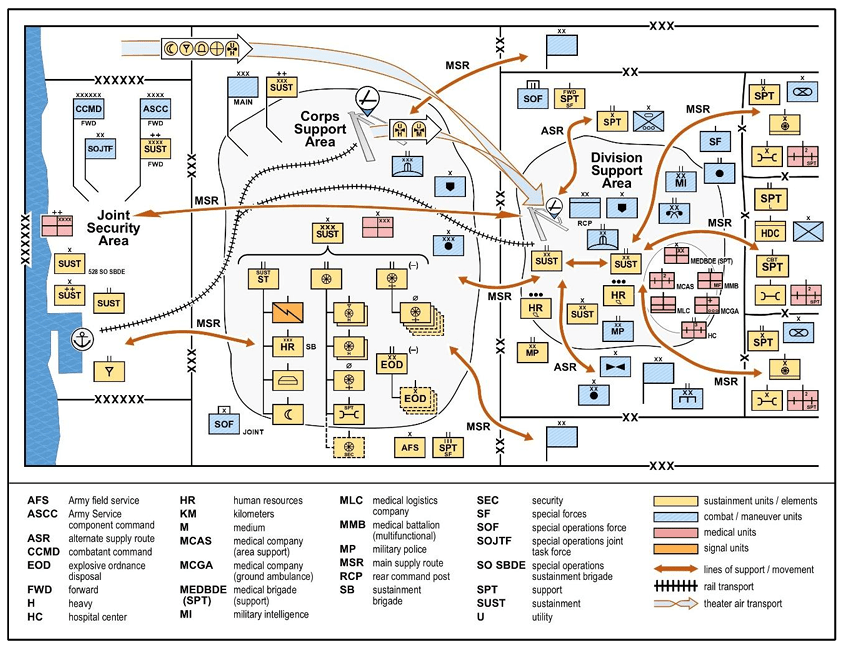
Division Support Area Brigade Support Area Combat Trains Command Post Frontline
| Feature | Current State (Permissive) | Required State (Contested) |
|---|---|---|
| Distribution | Centralized "Iron Mountains" | Distributed/Dispersed Nodes |
| Visibility | Low concern for signatures | Stealth / Low EM Signature |
| Protection | Lightly armored trucks | High survivability / Autonomous |
| Support | Contractor-heavy | Organic / Military-led |
Technical Failures
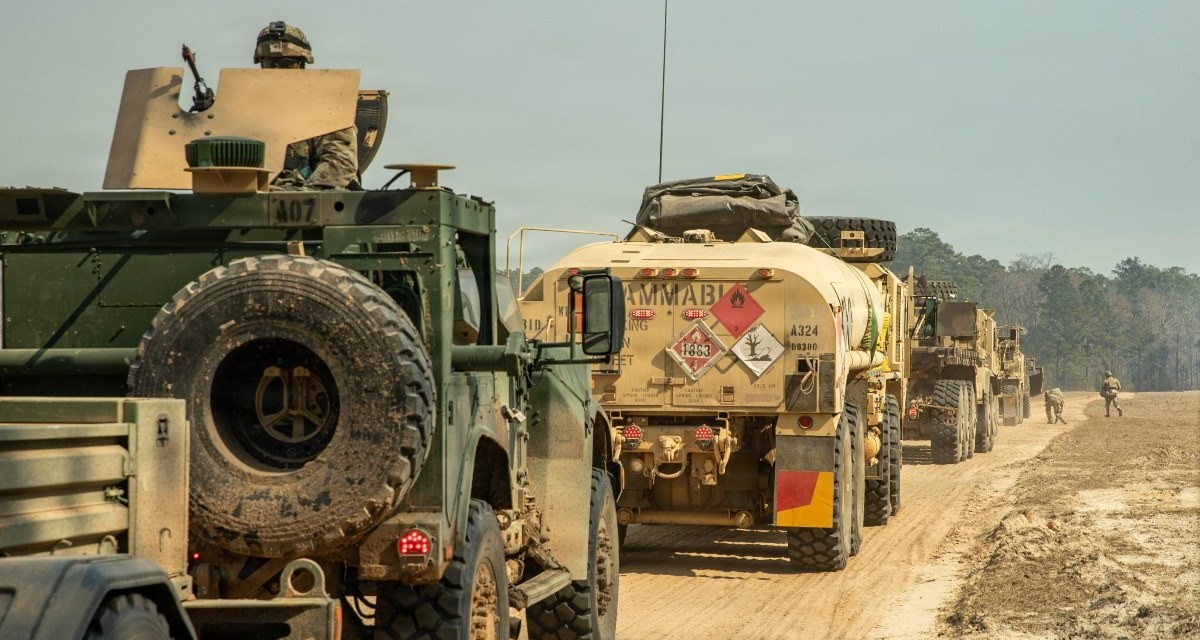
Current fuel platforms are too large and emit high thermal and electromagnetic signatures, making them easy prey for precision fires. Furthermore, maintenance gaps have degraded the actual available capacity of the fleet.
Required Improvements for Survival:
- Reduce thermal/EM signatures of fuel tankers.
- Increase the dispersion of sustainment nodes.
- Improve the operational readiness of heavy tactical vehicles.
- Develop autonomous resupply capabilities to reduce personnel risk.
The current system lacks the physical resilience to survive in an environment where the enemy can see everything and strike anywhere. Without a fundamental redesign, the Army's logistical backbone remains made of glass.