Australian energy retailers must provide three hours of free daytime electricity
Understanding the "Solar Sharer Offer": Free Daytime Power for Australians
Written by Donna Wentworth | Updated: June 25, 2026
Starting 1 July 2026, a significant shift in the energy market will occur. Energy retailers operating in South Australia, New South Wales, and South-East Queensland will be mandated to provide residential customers with at least three hours of complimentary electricity every single day.
The Core Concept: Why is this happening?
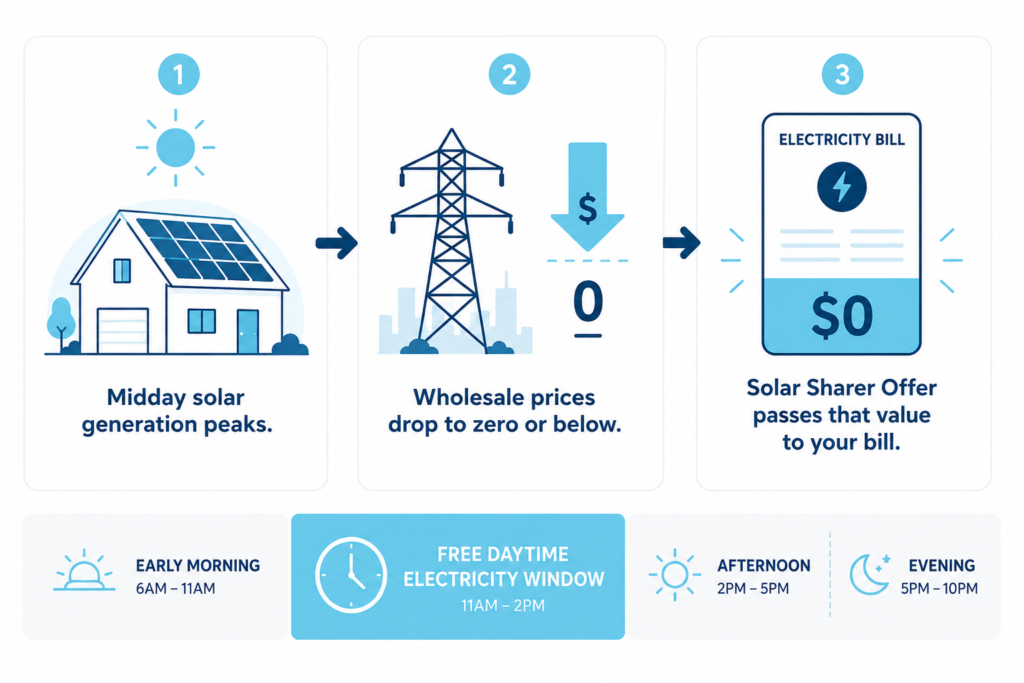
Australia is home to over 4.3 million rooftop solar arrays. During peak sunlight hours, these systems flood the grid with more energy than the market can typically absorb, driving wholesale prices down. Historically, these low costs stayed with the retailers; now, they are being passed to the consumer.
🛠️ How to Access Free Electricity
To take advantage of this scheme, you cannot simply wait for it to happen; there are specific requirements:
- Possess a Smart Meter: Most modern homes have one. If yours is outdated, most retailers will upgrade it for free.
- Opt-In: You must actively sign up through your energy provider once the program launches.
The Logistics of the "Free Window"
The free period is designed to align with maximum solar production. While exact times vary by region, you can generally expect the window to fall between:
11:00 AMto2:00 PM- OR
12:00 PMto3:00 PM
📍 Geographic Availability
The rollout is phased based on the federal Default Market Offer (DMO) framework.
| Region | Status | Expected Start |
|---|---|---|
| New South Wales | Confirmed | July 1, 2026 |
| South Australia | Confirmed | July 1, 2026 |
| South-East Queensland | Confirmed | July 1, 2026 |
| Victoria | Under Consultation | Possibly October 2026 |
| ACT / Other | Not yet confirmed | Check with retailer |
Pro Tip: If you live in a non-covered state, check with providers like AGL, Red Energy, GloBird Energy, or OVO Energy, as some have already introduced similar voluntary plans.
⚠️ The "Fine Print": The Usage Cap
When the program was first conceptualized, it was marketed as "no strings attached." However, following a public consultation in late 2025 involving 76 stakeholders, the government introduced a reasonable use cap.
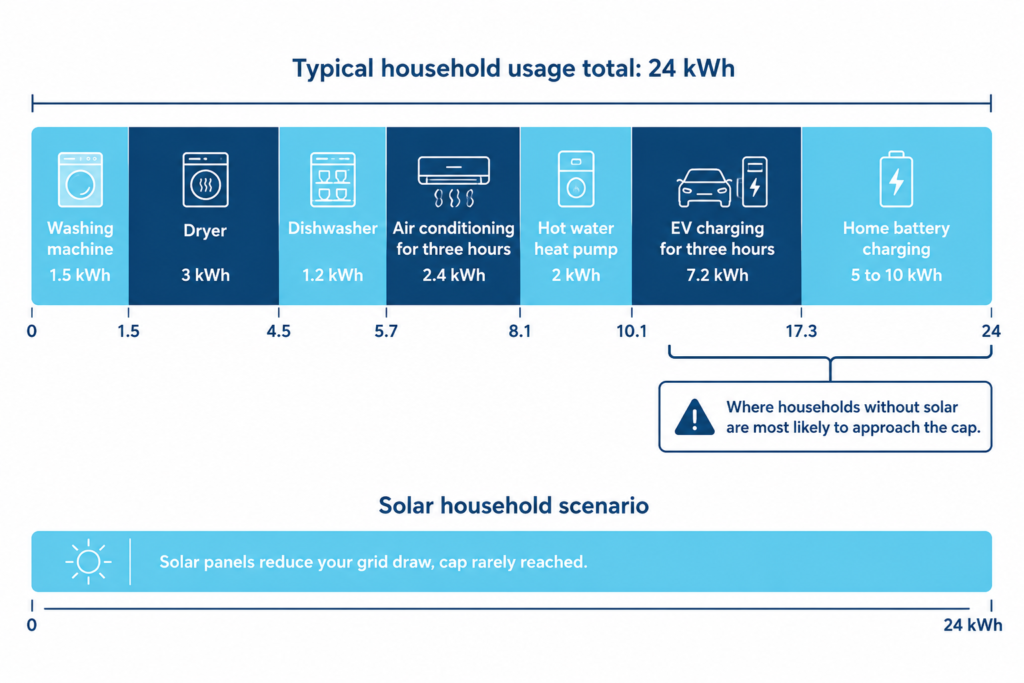
The Cap: 24 kWh per day.
"The cap ensures the Solar Sharer Offer remains financially viable for retailers and maintains fairness for all grid users." — Department of Climate Change, Energy, the Environment and Water (DCCEEW).
What does actually mean?
To put this in mathematical perspective, the cap is based on the average daily consumption of a five-person household:
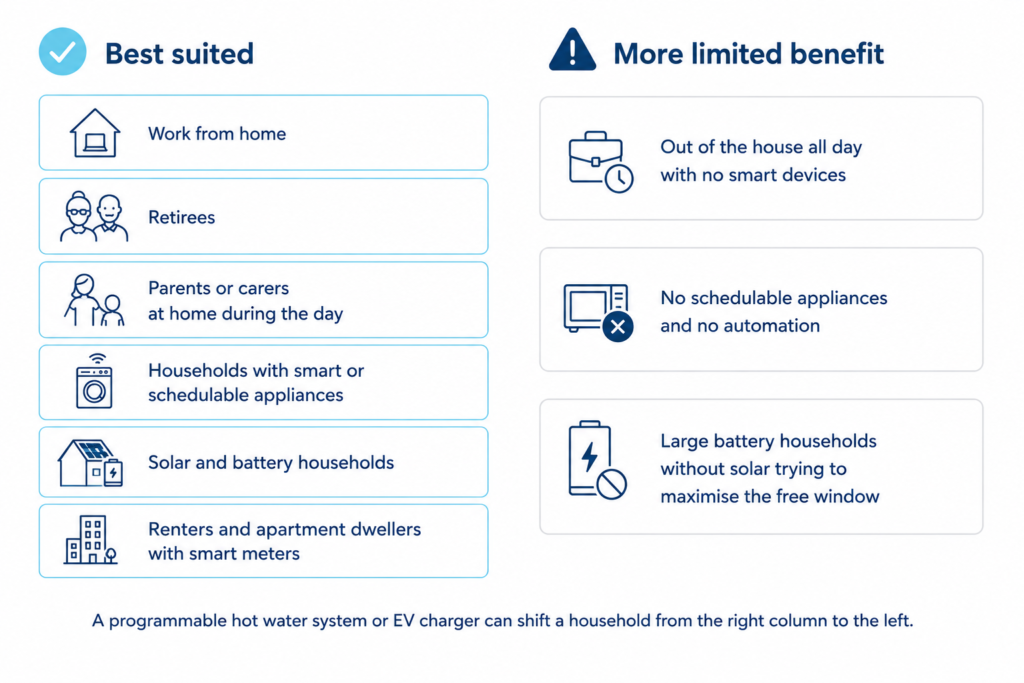
Who will actually hit the cap? Most solar-equipped homes won't notice the limit because their own panels cover much of the midday load. However, you might hit it if:
- You have a very small solar system but run high-energy appliances.
- It is a cloudy winter day with low solar generation.
- You are simultaneously charging a large home battery and an Electric Vehicle (EV) from the grid.
What happens if you exceed it? There is no penalty. You simply revert to your standard daytime rates for the rest of the window. Since daytime rates are still lower than evening peaks, shifting your load is still the smartest move.
💰 Estimated Annual Savings
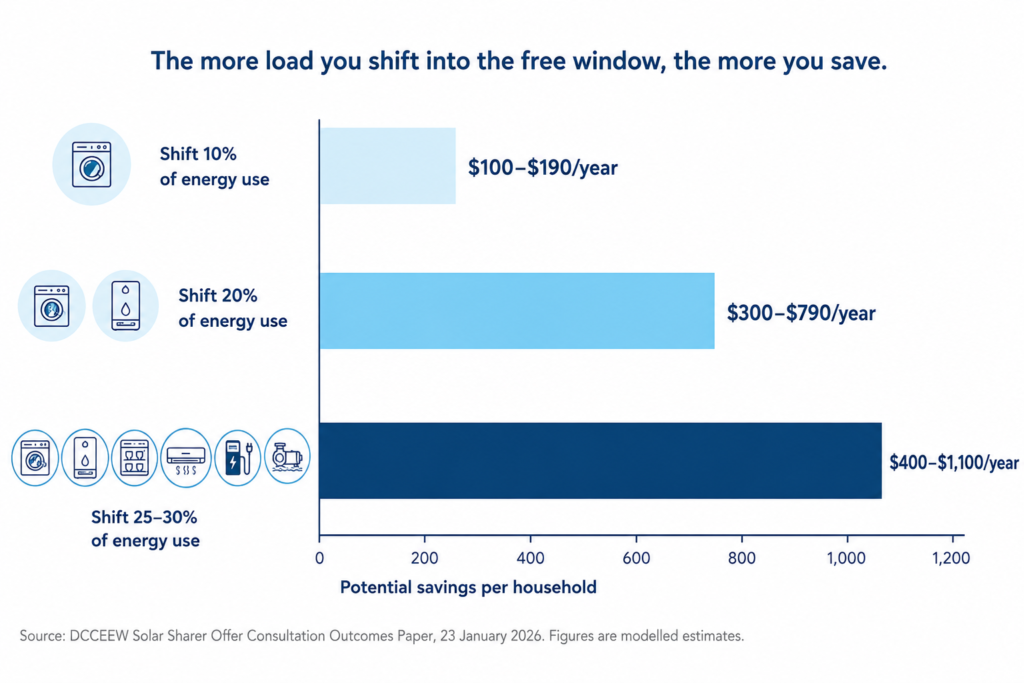
The amount you save depends entirely on your ability to "load shift" (moving energy-intensive tasks to the free window).
| Percentage of Load Shifted | Example Actions | Estimated Annual Savings |
|---|---|---|
| 10% | One major appliance daily | \100 - $190$ |
| 20% | Adding a dryer or midday hot water | \300 - $790$ |
| 25% - 30% | Pool pump, EV charging, dishwasher | \400 - $1,100$ |
🔋 Strategic Use for Solar & Battery Owners
For those with existing storage, this scheme is a game-changer. You can use the free window to "top up" your battery from the grid during overcast days or winter.
The Logic Flow:
if current_time == "Free_Window":
    if battery_level < 100%:
        charge_battery(source="Grid", cost=0)
    if ev_plugged_in == True:
        charge_ev(source="Grid", cost=0)
else:
    use_stored_energy(source="Battery")
By filling your battery for free at noon, you can power your entire home during the expensive late-afternoon and evening peaks without spending a cent.