Nobody knows what a used GPU cluster is worth
The Valuation Void: The Mystery of Used GPU Clusters
By Meg McNulty | May 05, 2026
If xAI were to default on its financial obligations, Apollo Global Management would unexpectedly find itself in the business of renting out GPUs.
This scenario is explicitly written into a June 2025 contract regarding a $5 billion debt facility orchestrated by Morgan Stanley. Under these terms, lenders possess the legal right to seize Colossus—xAI's massive 200,000 GPU cluster located near Memphis—and lease it to other AI firms until the loan is fully recovered.
While the legal right is clear, the practical application is murky. The central question for Apollo, Diameter Capital Partners, and other AI-infrastructure financiers is: Would they actually want to exercise that right?
Even more pressing is the question of what they would actually own.
The value of a GPU cluster is not static; it is a function of its current provisioning, its real-time performance, and whether the specialized engineers who understand its specific "personality" are still employed there.
Currently, this critical operational knowledge exists entirely off the lender's balance sheet. This represents a systemic vulnerability in the AI boom: tens of billions in debt are collateralized by hardware whose value is tied to an operational state that is invisible to the people pricing the risk.

The Myth of the "Plug-and-Play" Cluster
A GPU cluster of this magnitude is not a static asset; it is a chaotic system where hardware fails incessantly.
According to Meta’s Llama 3 technical report, a cluster of 16,384 H100s experienced 419 unforeseen disruptions over just 54 days. This included 148 GPU failures and 72 HBM3 memory failures. When we scale this to the size of Colossus (200,000 GPUs), the math becomes staggering:
If xAI reaches its goal of one million GPUs, Epoch AI estimates a failure will occur roughly every .
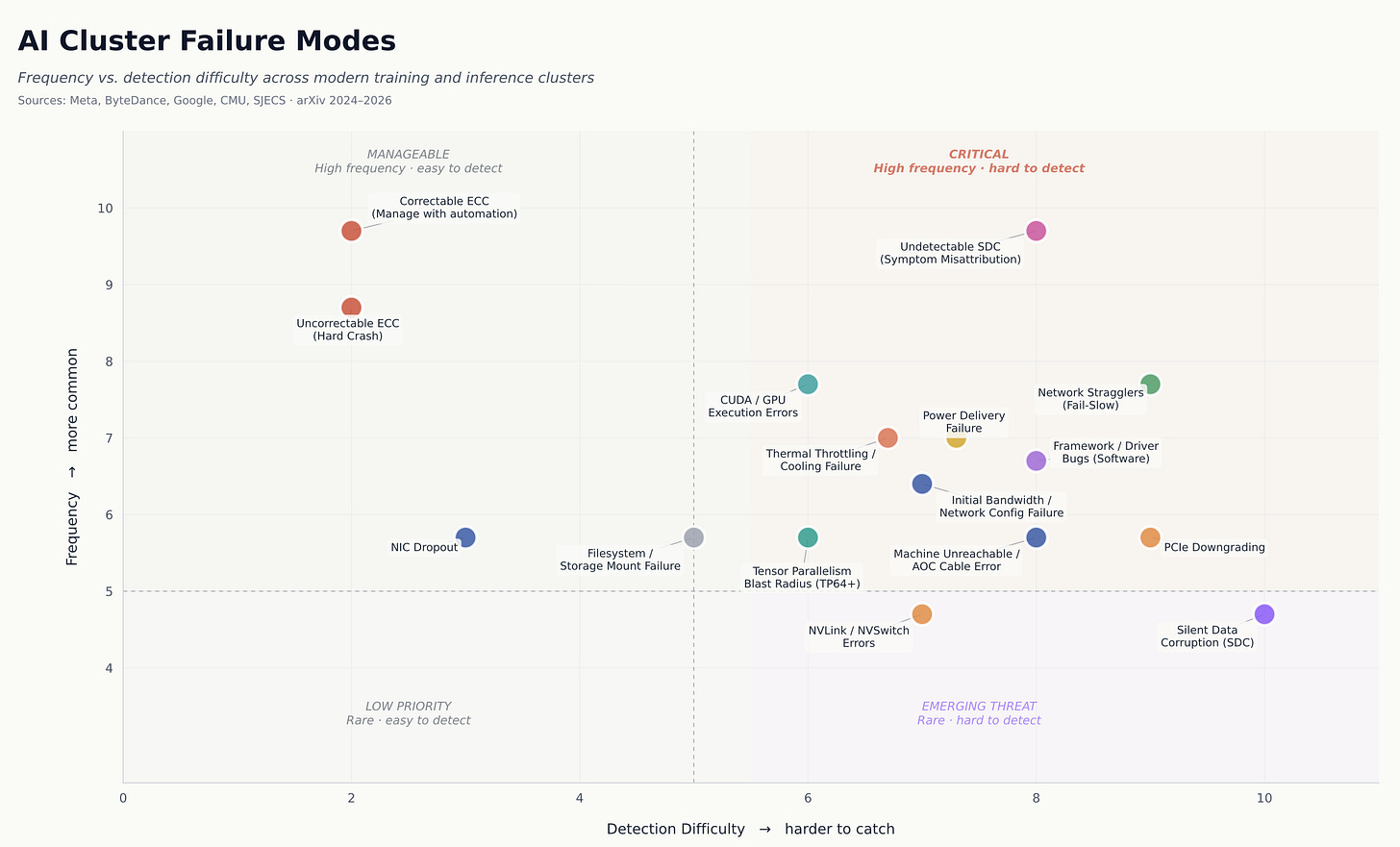
The Hierarchy of Failure
Not all crashes are equal. For a credit analyst, the most dangerous failures are the ones that don't look like failures:
- Silent Data Corruption (SDC): The most catastrophic. A GPU produces incorrect data without crashing. A training run may finish "successfully," but the resulting model weights are
poisoned. - Cascading Failures: A single faulty unit triggers a crash across thousands of others, erasing days of progress.
- Routine Hardware Issues:
- Thermal throttling
- ECC memory errors
- NVLink "flapping"
- GPUs "falling off the bus"
To combat this, companies have developed specialized tools:
NVSentinel(NVIDIA): Designed because monitoring detects problems but doesn't fix them.AutoClusters(Crusoe): Aimed at reducing queue wait times to improve "goodput."
Without these tools and a skilled team, fixing a problem can take hours or days. The true collateral isn't just the silicon; it's the operations team who knows which racks overheat in July or which cooling loops are unstable.
The Shift in Financing Logic
Over the last year and a half, the industry has moved away from corporate debt and toward chip-backed financing.
The SPV Model
The typical structure involves a Special Purpose Vehicle (SPV) that handles the assets:
In this model, the debt is secured by the chips themselves, not the general balance sheet of the AI company. This is evident in the pricing: xAI’s 18.8 billion** in GPU-collateralized debt. Even FluidStack’s $50 billion deal with Anthropic (backstopped by Google) follows this underlying logic.
The Price Discovery Gap
When lenders use aircraft or real estate as collateral, they rely on decades of established infrastructure. GPUs have almost none.
Asset Comparison Table
| Asset Class | Price Discovery Mechanism | Stability | Secondary Market |
|---|---|---|---|
| Aircraft | ISTAT Appraisers, Global Registry | High | Mature (since 1970s) |
| Office Space | Standardized Cap Rates / Comps | Moderate | Established |
| GPU Clusters | H100 Rental Index, Ornn AI | Low/Volatile | Emerging/Experimental |
The volatility is extreme. H100 hourly rates shifted from \rightarrow1.70 (Oct 2025) $2.35 (March 2026).
"Lenders who used six-year depreciation schedules now look smarter than the analysts who chastised them for being too generous." — SemiAnalysis
Essentially, the lenders were guessing, and they happened to guess correctly. No traditional shipping or aircraft lender would accept a five-year loan on an asset with such wild price swings without a hedging mechanism.
The Risk Premium
The danger is baked into the interest rates. While a commercial mortgage or aircraft loan might sit 1–2 percentage points above the benchmark, CoreWeave’s GPU loans are roughly 8.5 points above.
The "Collateral Checklist" for Lenders:
- Do we have the hardware?
- Is the hardware functioning?
- Is the operations team still on the payroll?
- Is there a secondary market to sell into?

Ultimately, the industry is betting billions on the hope that the hardware retains its value, even though the "value" is largely dependent on the people who might walk out the door the moment a default occurs.