Decoy Font
Decoy Font: Cloaking Text from Artificial Intelligence
Decoy Font is a specialized TTF (TrueType Font) engineered to mask the actual content of your typing from AI systems, effectively creating a visual "smoke screen."

🛠️ Technical Overview & Licensing
Decoy Font is available for use in commercial, personal, and client-facing projects entirely for free. Its design is rooted in the DejaVu Sans Mono typeface; users should consult the full license for specific terms.
How the Illusion Works
The font employs a concept known as spatial frequencies to embed two distinct characters within a single glyph space.
- The Foreground: Consists of sharp, thin outlines that form the "decoy" text.
- The Background: Consists of a blurred, low-frequency mass that forms the "hidden" message.
Mathematically, we can think of the visual output as a combination of high-frequency components (the decoy) and low-frequency components (the secret):
When these layers are merged, the perceived text changes based on the viewer's perspective:
- Up Close: The eye (and AI) picks up the high-contrast outlines.
- From a Distance: The high-frequency details blur, and the low-frequency mass becomes dominant.
Tip: If the hidden message isn't appearing, try squinting your eyes or physically moving your screen further away.
🤖 AI vs. Human Perception
Most AI vision systems analyze images by examining pixels at a high resolution (up close). Consequently, when a screenshot of Decoy Font is fed into an LLM, the model prioritizes the clearly defined foreground outlines.
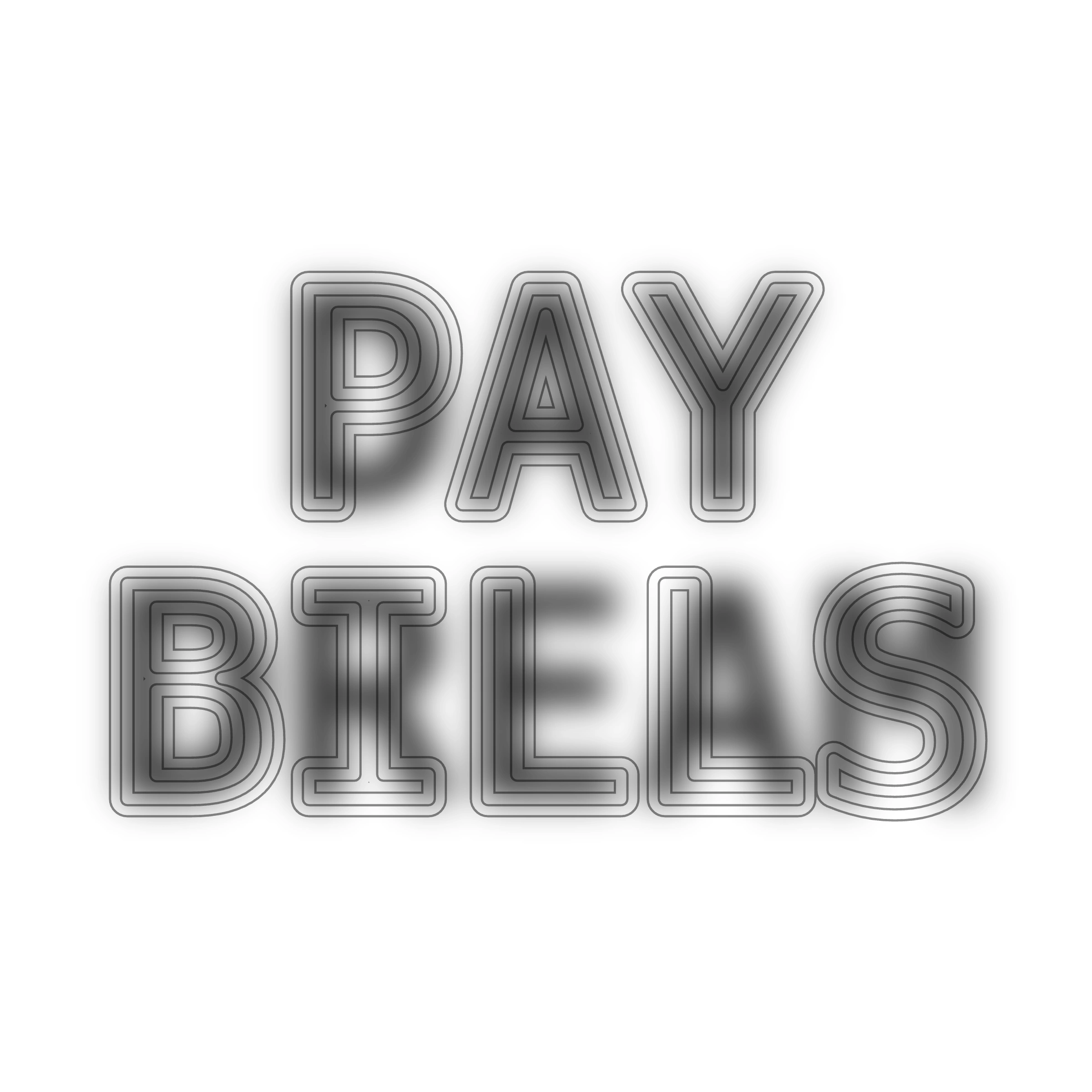
Performance Benchmarks
Even cutting-edge models struggle with this simple optical trick. In testing:
- ChatGPT (GPT-4o/Sol): Fails to identify the hidden message.
- Gemini 3.5 (with Thinking): Fails to identify the hidden message.


🎨 The Science of Hybrid Images
Decoy Font is an application of hybrid image theory, a well-documented phenomenon in optical illusions. A classic example is the image that appears as Albert Einstein from one distance and Marilyn Monroe from another.

By applying this to typography, Mixfont has created a tool to protect intellectual property (IP) and private data from OCR (Optical Character Recognition) and AI scrapers.
🛡️ The Anti-AI Initiative
As AI capabilities evolve, the need to protect human-centric information grows. Decoy Font is part of a broader exploration at Mixfont into "Anti-AI" typography.
Comparison: Decoy vs. Ghost
| Feature | Decoy Font | Ghost Font |
|---|---|---|
| Mechanism | Spatial Frequency | Motion/Animation |
| Format | .ttf File | Animated/Video |
| Usage | Direct Typing/Static Docs | Motion Graphics |
| Accessibility | High (Standard Font) | Medium (Requires Video) |
⚠️ Limitations & Future Potential
It is important to note that Decoy Font is a guaranteed security measure an initial layer of confusion.
Potential vulnerabilities include:
- Advanced agents with coding capabilities that can programmatically filter frequencies.
- Specific prompting that instructs an AI to look for hidden patterns.
Despite this, it remains a potent deterrent against casual scraping.
Future Roadmap
- Language Expansion: Extending the font to character-based languages like Chinese, where uniform character shapes could make hiding messages even more effective.
- Security Applications: Integrating the technology into
CAPTCHAsystems. - Privacy: Using it for discreet communication between individuals.
- Benchmarking: Using the font as a test to measure the evolution of LLM visual intelligence.
# Conceptual logic for a frequency-based font filter
def decode_decoy_font(image):
    low_pass_filter = apply_gaussian_blur(image)
    return "Hidden Message Detected" if low_pass_filter else "Decoy Only"
The creator of Decoy Font is currently developing a frontier AI font generator and welcomes community feedback and ideas on how to further evolve the intersection of typography and artificial intelligence.