Controlling Reasoning Effort in LLMs
Managing the Cognitive Load: Controlling Reasoning Effort in LLMs
By Sebastian Raschka, PhD
Published July 18, 2026

It has been nearly two years since the debut of OpenAI's o1, the model that brought the concept of "reasoning LLMs" into the mainstream. Shortly thereafter—about four months later—DeepSeek-R1 arrived, providing the community with a detailed blueprint for training these models using Reinforcement Learning with Verifiable Rewards (RLVR).
One of the most intriguing aspects of these modern systems is the ability to toggle between different levels of "reasoning effort." As seen in the example of the GPT 5.6 Sol model, users can choose from several settings (typically five or six) to balance speed and depth.

Note: While benchmark data for the "Ultra" setting is currently missing, it is expected to perform similarly to "Max," though it utilizes four subagents to accelerate the process.
Context and Resources
I have previously explored the mechanics of these models in my article Understanding Reasoning LLMs and analyzed the current landscape in The State of Reinforcement Learning for LLM Reasoning and The State of LLM Reasoning Model Inference. I have even expanded these concepts into a comprehensive 440-page guide: "Build A Reasoning Model (From Scratch)."

While those resources focus on the transition from a standard LLM to a reasoning one, this article specifically examines how to implement multiple effort modes. This piece is designed to be standalone, though the other resources provide deeper technical foundations.
1. What Exactly is a "Reasoning Model"?
In AI research, we often use terms that are literally true metaphorically descriptive. For instance, an "artificial neural network" does not function exactly like the biological neurons in a human brain.
Similarly, "reasoning" in LLMs doesn't mean the model is thinking like a human. Instead, it refers to a specific architectural behavior:
Definition: A reasoning model is an LLM that generates an intermediate reasoning trace—a step-by-step internal monologue where the model works through a problem before arriving at the final answer.

2. Scaling Reasoning: Training vs. Inference
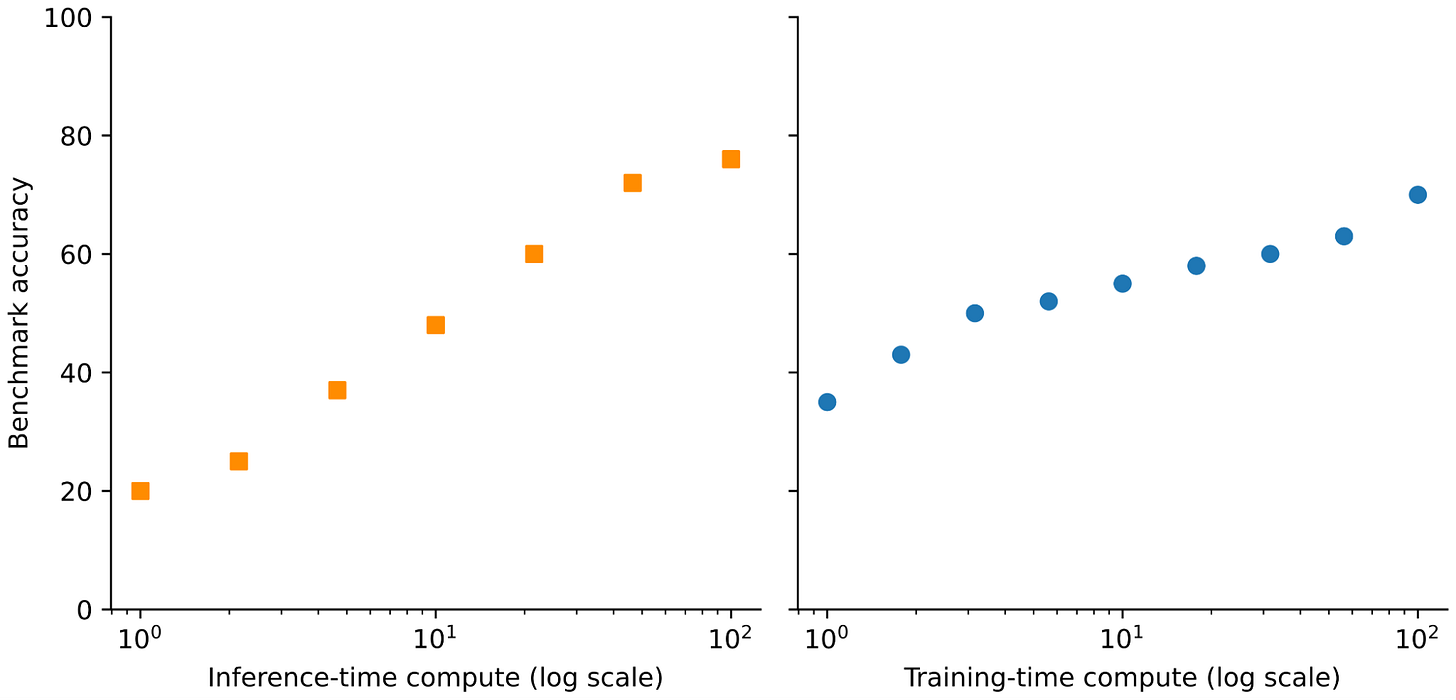
To boost the problem-solving capabilities of a model, researchers generally look at two scaling vectors:
| Scaling Type | Primary Mechanism | Goal |
|---|---|---|
| Training Scaling | Increasing data, compute, and RL iterations during development. | Improving the model's innate ability to reason. |
| Inference Scaling | Allowing the model more "think time" (tokens) during the response phase. | Solving harder problems by extending the reasoning trace. |
2.1 The RLVR Training Process
DeepSeek-R1 popularized Reinforcement Learning with Verifiable Rewards (RLVR). The core idea is to provide a binary reward signal based on the correctness of the final output:
This is particularly effective in domains where the answer can be objectively verified:
- Mathematics: Verified via symbolic checkers like
SymPyorWolframAlpha. - Programming: Verified via compilers, unit tests, or platforms like
LeetCode.

Crucially, the RLVR process ignores the content of the reasoning trace during the reward phase. The model is rewarded for the final answer and the correct format, not for how it got there.

2.2 The Emergence of "Aha" Moments
Surprisingly, by rewarding only the final outcome, the model naturally discovers that writing out its thoughts, backtracking when it hits a wall, and self-correcting leads to higher rewards. These instances of self-realization are known as "Aha" moments.

2.3 Comparing the Pioneers
While DeepSeek-R1 gained the most attention, other models like Kimi K1.5 were released simultaneously. Additionally, the term RLVR was introduced earlier in the Tülu 3 research.
The primary distinction lies in the starting point:
- Tülu 3 & Kimi K1.5: Applied RL on top of a model that had already undergone Supervised Fine-Tuning (SFT).
- DeepSeek-R1-Zero: Proved that reasoning could emerge from pure RL applied directly to a pretrained base model, without any SFT.
While R1-Zero was a powerful proof-of-concept, the full DeepSeek-R1 pipeline is a more sophisticated, multi-stage process.
(The original article concludes by noting that most current LLMs are effectively...)