Most Americans say "not in my backyard" to AI data centers
Public Sentiment: The "Not In My Backyard" Trend Regarding AI Data Centers

A recent investigation reveals a significant divide in how Americans view the expansion of AI infrastructure. While the technology advances, the physical buildings housing it are facing a steep uphill battle with local residents.
The Core Conflict: Public Opposition
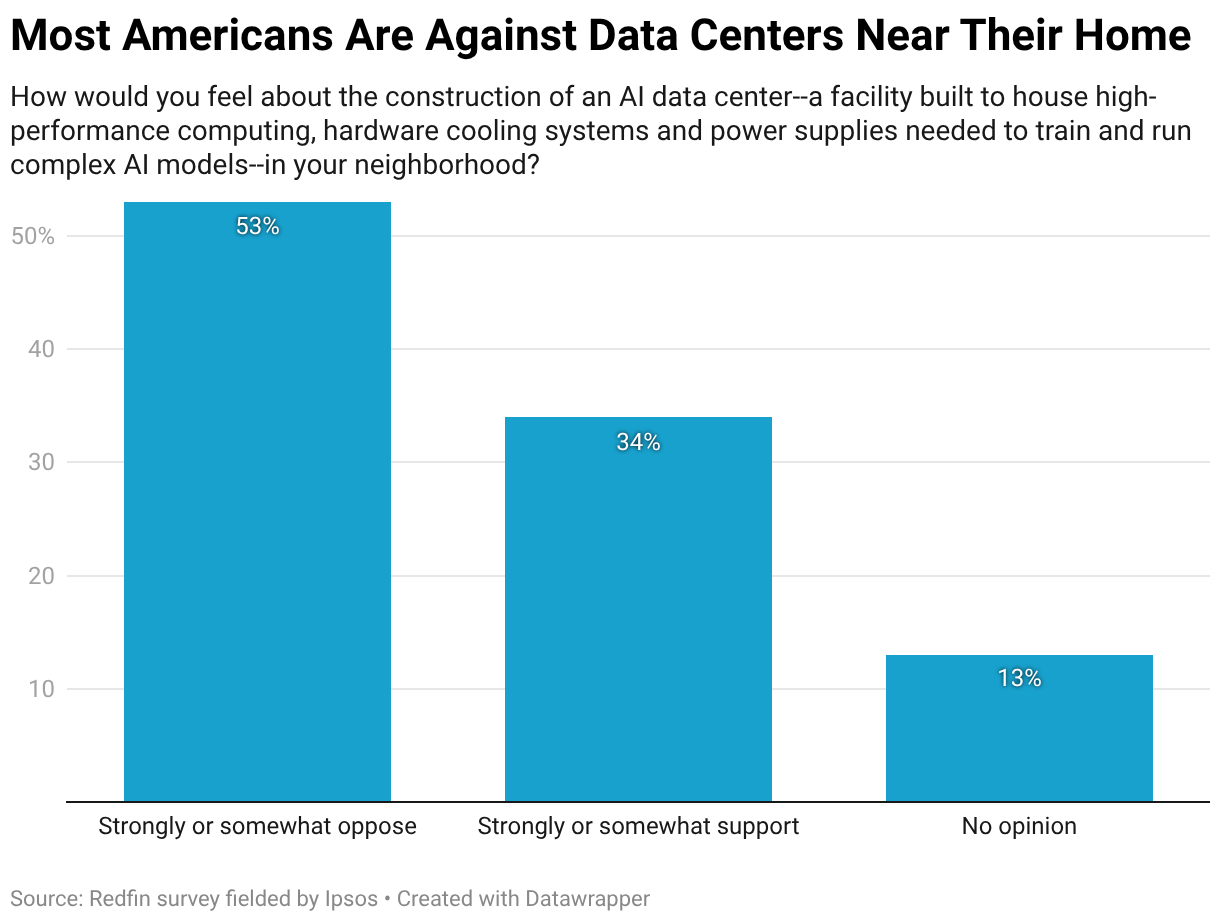
According to a survey commissioned by Redfin and executed by Ipsos in May 2026, a majority of U.S. citizens are not keen on having AI data centers as neighbors.
The Key Statistics:
- Opposed:
53%of residents. - Supportive:
34%of residents.
The survey, which polled 4,000 individuals, carries a credibility interval of percentage points.
Why the Hostility?
The opposition isn't just about aesthetics; it's about resource consumption and community impact. Residents are worried about:
- Resource Strain: Massive consumption of water and electricity.
- Economic Pressure: Potential spikes in local energy costs.
- Environmental Impact: General ecological concerns.
- Community Disruption: Noise pollution and the imposition of massive, industrial-style architecture.
Beyond the physical buildings, there is a deeper existential dread regarding AI. Approximately 58% of respondents believe AI progress will lead to job losses and make housing less affordable.
"A buyer recently asked me, unprompted, to make sure there wasn’t a data center planned near a home she was considering," notes Matt Ferris, a Redfin Premier agent in northern Virginia. He shared another instance of a client in Gainesville, Prince William County, who regretted their move after realizing the density of nearby data centers, citing concerns over traffic, noise, and the general "feel" of the neighborhood.
Comparative Opposition
Interestingly, AI data centers are more disliked than almost any other form of local development.
| Building Type | Percentage Opposed |
|---|---|
| AI Data Centers | 53% |
| Single-Family Multi-Unit Conversion | 48% |
| New Apartment Complexes | 39% |
| Mixed-Use Developments | 32% |
Demographic Divide
The "NIMBY" (Not In My Backyard) sentiment varies significantly by age:
- Baby Boomers: 65% oppose.
- Gen X: 60% oppose.
- Millennials: 43% oppose.
- Gen Z: 42% oppose.
The Paradox: Economic Windfalls in Virginia
Despite the social unpopularity local resistance, these facilities provide a massive financial boon to certain regions. In Northern Virginia, the "industrial eyesores" are effectively funding the future of local education.
The Tax Mechanism
The financial benefit stems from personal property taxes levied on the high-value computer equipment housed within the centers.
Regional Analysis
Loudoun and Prince William counties have seen education spending nearly double over the last decade.
Data Center Density Rankings:
- Loudoun County, VA: 176 facilities (The national leader).
- Santa Clara County, CA: 83 facilities.
- Prince William County, VA: 77 facilities.
Note: Santa Clara was excluded from the education spending analysis as data centers aren't a primary revenue driver there.
Growth in Tax Revenue (15-Year Window)
The surge in personal property tax revenue per resident is staggering when compared to neighboring areas:
While Fairfax County ranks fifth nationally in data center count, its revenue growth is significantly lower than the top two Virginia hubs.
Summary of Findings
The tension surrounding AI infrastructure can be summarized as a conflict between local quality of life and macro-economic benefit. While New York has already implemented a statewide ban on large data centers to protect communities, Virginia is seeing a direct correlation between these hubs and a surge in school funding.
{
  "report_summary": {
    "sentiment": "Majority Opposed",
    "primary_concern": "Resource Consumption",
    "primary_benefit": "Tax Revenue for Education",
    "top_hub": "Loudoun County, VA"
  }
}
Authors: Dana Anderson & Yingqi Xu Published: July 22nd, 2026