Astronomers may have found the first exomoon
Potential Discovery of the First-Ever Exomoon
Date: 22 July 2026
Source: ESO European Southern Observatory Press Release
Subject: New ‘exomoon’ detection challenges cosmic labels
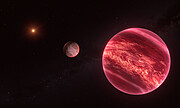
Recent data gathered by the European Southern Observatory’s Very Large Telescope (VLT) has provided compelling evidence of a moon-like entity within the CD-35 2722 system. This discovery is particularly provocative because the object does not follow the traditional "moon" blueprint found in our own Solar System.
A "Super Weird" Cosmic Hierarchy
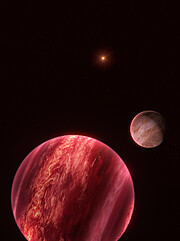
Rather than orbiting a planet, this object circles a brown dwarf, which in turn orbits the primary star, CD-35 2722. If this finding is verified, it would mark the first time a "moon" has been identified outside our own neighborhood.
Kevin Hoy, a lead author of the study published in Nature and a student at ESO in Chile, describes the architecture of this system as "super weird" when compared to our own.
System Architecture
The hierarchy of the CD-35 2722 system can be visualized as follows:
The Definitional Dilemma
The discovery has sparked a debate over terminology. Because the object is so massive, the traditional labels of planet and moon feel inadequate.
"This system is somewhat hard to define using Solar-System-based words like ‘planet’ and ‘moon’," explains Hoy, who is affiliated with the Universidad Diego Portales and the Millennium Nucleus of Young Exoplanets and their Moons (YEMS).
The team has opted for the term exosatellite. The confusion arises from the sheer scale of the bodies involved:
| Object | Classification | Estimated Mass |
|---|---|---|
CD-35 2722 | Star | (Half the mass of the Sun) |
| Companion | Brown Dwarf | (Jupiter masses) |
| Satellite | Exosatellite | (Jupiter mass) |
Hoy notes that while the exosatellite is massive enough to be classified as a planet, its orbital relationship—being the "third wheel" orbiting a brown dwarf—makes "moon" a more intuitive, albeit imprecise, term.
Alice Zurlo, YEMS Director, adds:
"We have a clear delineation between the planets and the Sun in the Solar System... In the
CD-35 2722system, where we are blurring the lines between stars, planets, and moons, the whole thing becomes more complicated to describe."
Detection Methodology
For years, astronomers have hunted for satellites beyond our Solar System. Despite the discovery of over 6,000 exoplanets, confirmed exomoons have remained elusive. A previous attempt by Quentin Kral in the HD 206893 system showed hints of a satellite but lacked firm confirmation.
To analyze CD-35 2722, the team utilized the CRIRES+ instrument on the VLT. They employed the radial velocity method, which detects the gravitational influence of a smaller body on a larger one.
The Logic of the "Wobble"
In simple terms, the detection logic follows this pseudo-code:
if object_A_orbits_object_B:
    detect_gravitational_tug(object_B)
    if wobble_detected == True:
        confirm_satellite_presence()
By observing the small "wobbles" of the brown dwarf, the team found strong evidence for the orbiting exosatellite.
Future Horizons
The discovery of such an exotic system provides a breakthrough in our understanding of how diverse planetary formation and evolution can be.
Upcoming Goals:
- Utilize the Extremely Large Telescope (ELT).
- Leverage the ELT's 39-metre mirror to find smaller, more traditional exomoons.
- Refine the taxonomic labels for non-Solar-System objects.
Technical Notes & Credits
Definitions:
- Satellite: Any object orbiting another.
- Natural: e.g., Earth's Moon.
- Artificial: e.g., a man-made spacecraft.
- Exomoon: A natural satellite orbiting a planet or other object outside our Solar System (though no official definition exists).
Publication Details:
The research, titled "Planetary-Mass Exosatellite Detected Around a Star’s Substellar Companion," appears in Nature (doi: 10.1038/s41586-026-10751-w).
Contributing Authors:
- K. Hoy (Diego Portales; ESO Chile; YEMS)
- A. Zurlo (Diego Portales; CATA)
- J. Desidera (INAF Padova)
- R. D’Orazi (Univ. Roma Tor Vergata; INAF Roma)
- I. Giovannini (Univ. Padova; Diego Portales; INAF Padova; YEMS)
About ESO: The European Southern Observatory (ESO) is an intergovernmental organization established in 1962. It is currently supported by 16 Member States:
- Austria, Belgium, Czechia, Denmark, France, Finland, Germany, Ireland, Italy, the Netherlands, Poland, Portugal, Spain, Sweden, Switzerland, and the United Kingdom.
- Host State: Chile.
- Strategic Partner: Australia.