Should you wash your solar panels?
Is Solar Panel Cleaning Worth It?
By James Stanley | Home Projects Puzzles Notes Date: Tuesday, 21 July 2026 | Category: #science
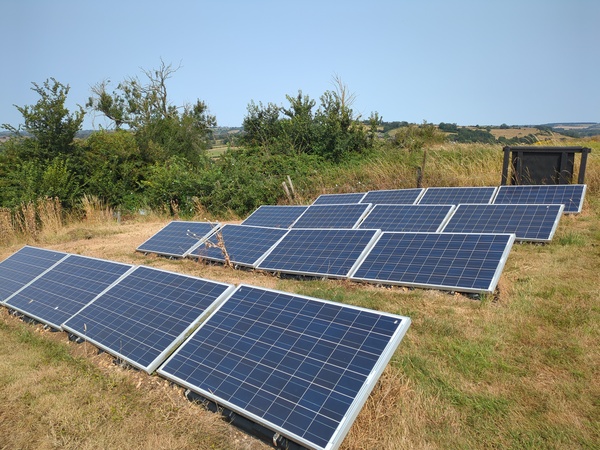
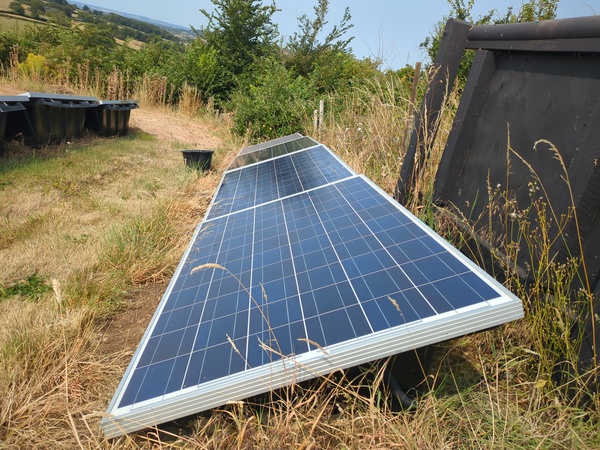
I own a modest solar array that has become visibly coated in dust. It has been at least a year since they were last cleaned—and likely two, as there was little incentive to scrub them right before selling the house.
Executive Summary: I estimate that cleaning my panels resulted in a power output boost of roughly . This translates to an annual gain of approximately £60–£150, though this benefit will diminish toward zero over the next few years as dust accumulates again.
🛠 Methodology
My setup consists of 16 panels divided into two separate banks of 8. Because the inverter tracks the output of each bank independently, I designed an experiment to isolate the effect of cleaning.
Experimental Logic
To avoid "noise" from variables like shifting cloud cover or the angle of the sun, I didn't look at raw wattage. Instead, I monitored the ratio of power between the two banks.
The Process
- Establish baseline power ratio.
- Clean panels in Bank A one by one.
- Record readings between each panel.
- Final reading after full bank is cleaned.
Note on Condition: The panels were "visibly dusty" but not caked in grime. If your panels are significantly filthier than mine, your percentage gains will likely be higher.

📊 Results & Observations
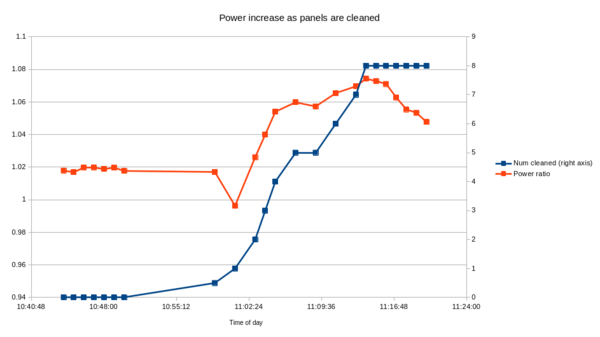
The data showed a stable initial ratio, followed by some erratic behavior during the cleaning process.
| Stage | Observation | Power Ratio Effect |
|---|---|---|
| Baseline | Both banks dusty | Stable |
| Initial Wash | First panel cleaned | Unexpected significant drop |
| Progressive | More panels cleaned | Steady increase (as expected) |
| Completion | All Bank A panels clean | Ratio dropped again while idle |
The "Frosted Glass" Mystery
I noticed that once the cleaning was finished, the ratio dipped again. I suspect this is due to evaporation. When the glass is wet, it is clear; as it dries, it may become slightly opaque—similar to the frosted glass effect. This leads me to wonder if polishing is required for maximum efficiency.
Data Log Snippet:
Reading 1: Baseline (0% washed) -> Ratio X
Reading 2: Partial (50% of 1 panel) -> Ratio X - Delta (Unexpected)
Reading 3: Progressive (1-8 panels) -> Ratio X + Delta (Expected)
Reading 4: Final (Dry) -> Ratio X + Delta - Small Drop
⚡ The "Tingle" Incident
While cleaning, I experienced a strange tingling sensation in my finger.
I initially assumed I had a tiny thistle splinter in my skin. While there was a puncture mark from a thistle, the sensation persisted even after the splinter was gone. I believe the electricity was actually flowing through the point where the skin had already been breached.
According to ChatGPT, this is likely just a minor capacitive leakage common in transformerless inverters. I've decided it's not a cause for alarm.
📈 The Upgrade Dilemma
My system is roughly 15 years old, with a peak output of 3.7 kW across 16 panels. I considered whether a full hardware upgrade makes sense.
The Math
If I replaced the old panels with modern equivalents, the output would increase by .
- Estimated Cost: £5,000
- Payback Period:
At first glance, this seems like a "no-brainer." However, there is a massive financial catch: the Feed-in Tariff (FiT).
The Conflict:
- Old System: I am paid an incredibly high rate based on total generation (not just what I export to the grid). I get paid for electricity I use myself.
- New Capacity: Any additional power generated by new panels would not be covered by the old FiT. It would be subject to current tariffs, which are roughly worse.
Conclusion: The very incentives that made solar attractive 15 years ago now act as a financial barrier to upgrading the equipment today.
If you enjoyed this analysis, consider subscribing via the mailing list (james@incoherency.co.uk) or the [rss] feed.