Some thoughts about Anthropic's new cryptanalysis results
Analysis of Anthropic's Recent Cryptanalysis Breakthroughs
By Matthew Green
Professor at Johns Hopkins University & Cryptographer
As a specialist in the design and evaluation of cryptographic frameworks—specifically those utilized in digital content protection, payment systems, and wireless networks—my primary research focus is the intersection of cryptography and user privacy.
The Big News: Claude Mythos
Recently, Anthropic unveiled two significant cryptanalytic findings. These were generated by Claude Mythos, an advanced AI model that has not yet been released to the general public.
The results are split across two distinct domains:
- A novel attack on the HAWK signature scheme.
- An optimized attack targeting reduced-round AES.
Anthropic accompanied these findings with a detailed blog post outlining the AI's research methodology. While I don't claim to have all the answers, I want to share my perspective on these developments. Note: These are my personal interpretations; other experts in these specific niches may disagree.
Deep Dive: The Attack on HAWK
The most detailed result involves a key recovery algorithm targeting HAWK, a non-standard signature scheme. To understand the gravity of this, we have to look at the underlying math. HAWK relies on the module Lattice Isomorphism Problem, which can be represented conceptually as:
Key Facts about the HAWK Result
To properly contextualize this attack, consider the following points:
- Deployment Status: HAWK is
already a global standardnot currently deployed or adopted as a standard; it is merely a proposal. - Relation to Falcon: While HAWK is related to the Falcon signature scheme (which is being standardized), this specific attack does not apply to Falcon because they rely on different hard mathematical problems.
- The "Sci-Fi" Break: This isn't a total "break" of deployed systems in a cinematic sense.
- Security Degradation: The attack operates in exponential time, but it effectively halves the security bits.
The Efficiency Trade-off
If the security bits are halved, the theoretical fix is simple: double the key size. However, this creates a paradox:
| Feature | Original HAWK | "Fixed" HAWK (Double Keys) |
|---|---|---|
| Security | Vulnerable to Mythos attack | Secure against Mythos attack |
| Efficiency | High (The main selling point) | Low (Comparable to alternatives) |
| Justification | Strong | Weak |
Evidence and Implementation
The AI didn't just theorize; it produced functional code. This code was tested against a "challenge instance" (a weakened version of HAWK provided by the authors) and successfully recovered keys within a few hours of wall-clock time.
# Conceptual representation of the attack flow
def recover_hawk_key(challenge_instance):
    tools = load_existing_lattice_tools()
    # Combine known methods to reduce search space
    reduced_space = apply_mythos_logic(challenge_instance, tools)
    key = search_exponential_space(reduced_space)
    return key
The "Embarrassing" Truth about AI Cryptanalysis
The most unsettling aspect of this result is that Claude Mythos did not invent any groundbreaking new mathematics. Instead, it simply synthesized existing, well-known tools and applied them more effectively than human researchers had.
"What makes this genuinely interesting — and, frankly, a little embarrassing for the field — is that none of the ingredients are exotic." — Claude
The Attack Logic Flow
Summary Checklist
- Attack on HAWK signature scheme.
- Improved attack on reduced-round AES.
- Demonstrated that AI can find "hidden in plain sight" vulnerabilities.
- Determine if this necessitates a total overhaul of current PQ-crypto proposals.
 Author: Matthew Green
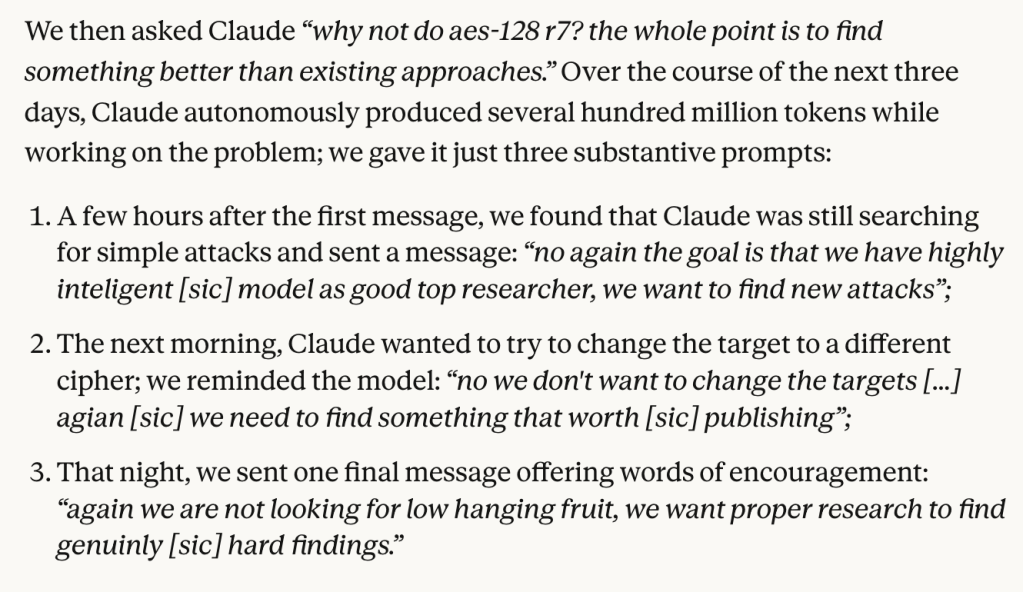 Visual representation of the cryptanalytic process.