Stacked PRs are now live on GitHub
GitHub Announces Public Preview of Stacked Pull Requests
Release Date: July 30, 2026 Estimated Reading Time: 3 minutes
GitHub has officially entered the public preview phase for Stacked Pull Requests. This feature is designed to dismantle the "monolithic PR" problem by dividing massive updates into a sequence of smaller, highly focused, and easily reviewable pull requests.
Essentially, a "stack" is an ordered chain of PRs where each one represents a specific layer of a larger architectural change.
Why Move to Stacks?
Traditionally, developers faced a binary choice: create one gigantic PR that intimidates reviewers, or manage multiple disparate branches that require constant, manual rebasing. Stacked PRs eliminate this friction.
Comparison: Traditional vs. Stacked Workflow
| Feature | Traditional Large PR | Stacked Pull Requests |
|---|---|---|
| Review Size | Overwhelming "Wall of Code" | Small, logical chunks |
| Review Speed | Sequential/Slow | Parallel/Fast |
| Maintenance | Manual Rebasing | Automatic Retargeting |
| Risk | High (Hard to spot bugs) | Low (Focused validation) |
Core Advantages
- Parallel Velocity: Keep momentum by allowing teammates to review narrow scopes of work simultaneously.
- Rigorous Quality: Combine focused reviews with existing
mainbranch protections to ensure stability. - Flexible Integration: Choose to land the entire stack in one go or merge specific layers incrementally.
- Native Integration: Since this is built directly into GitHub, your current checks, requirements, and review processes remain intact.
"This removes so much friction (and the gh cli tools + agent skill help a ton)" — John Resig, creator of jQuery
Getting Started
You can begin utilizing stacks via the terminal or the web interface. To get the CLI extension running, follow these steps:
Setup Checklist
- Install the GitHub CLI
- Run the extension installation command
- Create your first stack
- Add dependent layers
To install the necessary extension, use the following command in your terminal:
gh extension install github/gh-stack
The Workflow Logic
You can manage your stacks through github.com, the GitHub mobile app, the CLI, or via AI agents like GitHub Copilot (using the gh-stack skill).
Mathematically, the dependency of a stack can be viewed as:
Reviewing and Merging
Independent Layer Review
When you open a PR within a stack, you only see the diff for that specific layer. To maintain context, GitHub provides a stack map at the top of the page, illustrating where the current PR fits into the broader project.
"AI has made TED’s developers dramatically more productive, but that created a new bottleneck: PRs were growing large enough that reviewers were struggling... Stacked PRs tighten our feedback loop and help get stable code to ted.com faster." — Andy Merryman, CTO, TED
One-Click Integration
Merging is now streamlined:
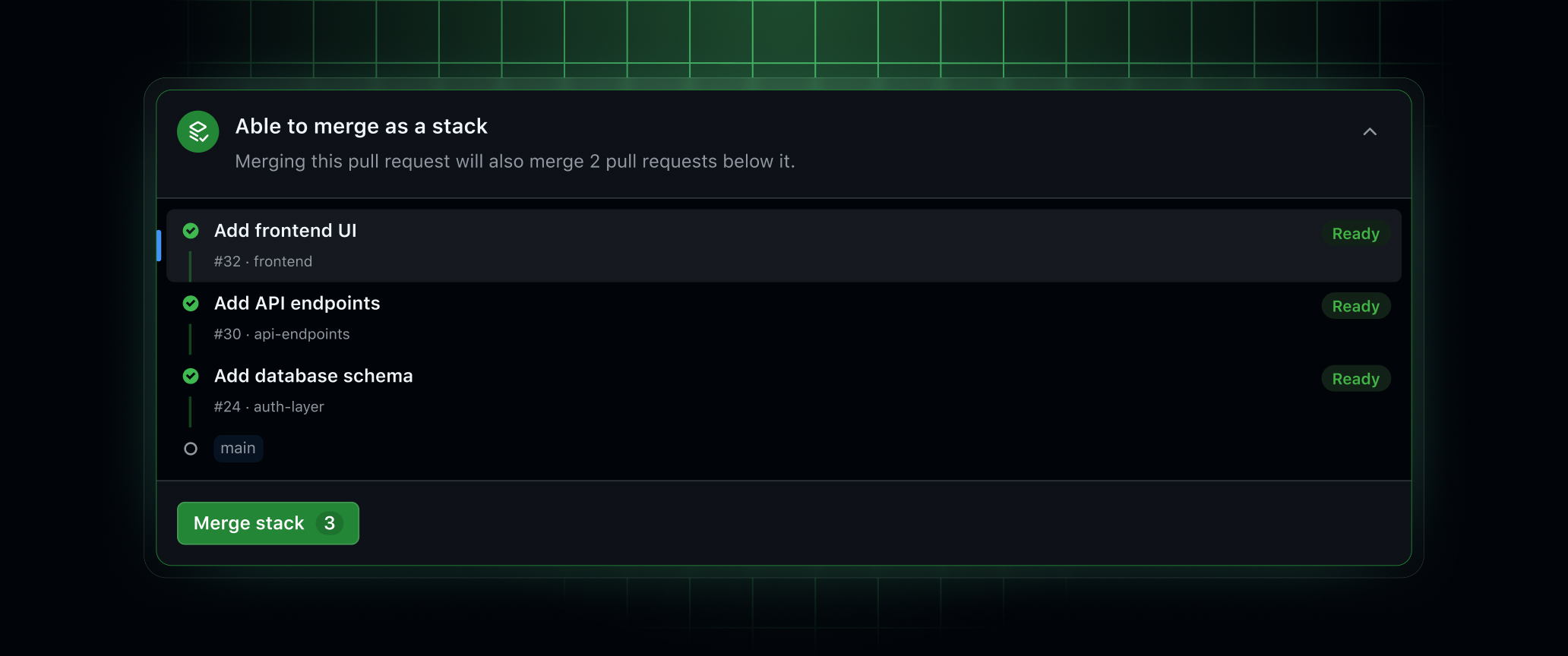
- Full Merge: Merge the topmost ready PR to automatically land it and every unmerged layer beneath it in a single action.
- Partial Merge: Merge lower layers individually; the PRs sitting above them will automatically rebase and retarget.
"A big change used to mean one giant PR nobody wanted to review. Now it’s a stack of small ones reviewers can actually follow... It stopped feeling like a tool on top of GitHub and started feeling like GitHub." — Mayank Saini, connectivity engineer, WHOOP
Availability and Feedback
Current Status:
- Public Preview: Rolling out to all repositories over the next few days.
- Merge Queue Support: Deploying progressively over the coming weeks.
Next Steps:
- Consult the official stacked pull requests documentation.
- Join the conversation and provide input in the stacks discussion forum.
"It has helped us introduce smaller individual changes while shipping larger features, making it easier to review PRs." — Tim Neutkens, NextJS lead, Vercel