The End of an Era
The End of an Era
By Hugh Howey | July 31, 2026
We always knew this moment was inevitable. For some of us, the warning signs appeared decades ago; we’ve been speculating on this shift since the days when Kasparov was defeated at chess and Ken Jennings lost his crown at Jeopardy.
The signs weren't just subtle hints—they were written on the wall, and now, that writing is everywhere.
Artificial Intelligence has reached a point where it can write with a proficiency that rivals humans. Even if it isn't perfect, it is "good enough" to spark widespread confusion and speculation. This has triggered a full-blown existential crisis for authors, left readers bewildered, and ignited a firestorm of legal battles across the publishing industry.
The Luck of the Draw
When I reflect on my career, I often attribute my success to sheer timing. I completed my first novel in 2009, a mere two years after the launch of the Amazon Kindle. By the time I was seeking traditional representation, the ecosystem of self-publishing—via KDP, CreateSpace, and ACX—was already exerting its irresistible pull.
It was a stroke of dumb luck. Without that specific window of time, I would have continued writing for the love of the craft, but I likely would never have made a living from it.
The "Golden Window" of Writing
I recently realized that my lifelong ambition to write novels happened to coincide with a unique 20-year period. This was a time when publishing stories was cheap, but writing them was not.
I could put in the grueling work of drafting a manuscript, utilize professional tools like InDesign and Photoshop to format my files, and upload them to KDP or CreateSpace for free. While marketing and sales remained a separate, difficult struggle, the barrier to entry had vanished.
To understand how revolutionary this was, consider the "Writer's Gauntlet" prior to 2007 (and really, until the stigma faded around 2012-2013):
- Draft endless, soul-crushing query letters.
- Spend months researching agents.
- Collect a mountain of rejection slips.
- Dodge predatory vanity publishers.
- Avoid fraudulent review sites and "writer-help" scams.
-
Spend life savings on bulk-printing books that gather dust in a garage.
A Case Study in Chaos
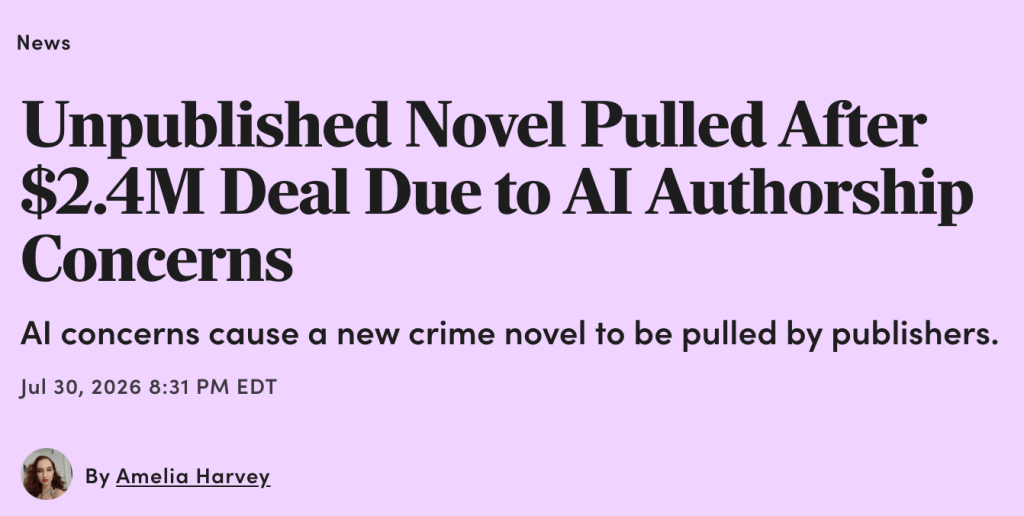
There is a current story circulating that perfectly encapsulates the insanity of our new reality. A debut author—following what was reportedly a fierce bidding war among publishers—found themselves at the center of a scandal.
The book concerned Nigerian cartels. (I'm joking about the subject matter being a giveaway, but really, it's as common as professors writing novels about professors having affairs with students).
Concerns emerged regarding the use of AI. Questions were raised about the prose style and certain "AI fingerprints." Ultimately, the author could not sufficiently prove the book's provenance.
There are two ways to view this tragedy:
- The Human Tragedy: If this was a legitimate human writer, this is the most heartbreaking version of the story. A career-defining moment, life-changing wealth, and potential film/TV deals vanished simply because it is now 2026.
- The Machine Triumph: This was an AI-generated text that was so convincing it fooled professional editors, sparked a bidding war, and secured a $2.4 million advance.
Regardless of which version is true, the implication is the same: No new author can now prove to the world that they worked alone.

The Shift in the Landscape
We enjoyed a brief window—less than two decades—where the act of writing remained difficult (human) while the act of publishing became easy. That window has slammed shut.
I used to pity the authors who worked before 2007 because their options were so limited. Now, I feel for anyone attempting to tell a story post-2026. If you possess a specific stylistic flair—perhaps a love for the — (em dash), a penchant for flowy, run-on sentences, or a soul shaped by the iambic pentameter of sonnets and the prose of Proust—you are in trouble. You will simply sound like a bot.
Comparing the Eras
| Era | Writing Difficulty | Publishing Difficulty | Primary Struggle |
|---|---|---|---|
| Pre-2007 | Hard (Human) | Hard (Gatekept) | Getting a book printed/seen |
| 2007–2026 | Hard (Human) | Easy (Digital) | Marketing and Visibility |
| Post-2026 | Easy (AI) | Easy (Digital) | Proving Human Authenticity |
We can roughly map the transition like this:
2014 (Self-pub legitimacy) $\rightarrow$ 2024 (AI viability) $\rightarrow$ 2026 (The Crisis)
The probability of a reader knowing the origin of a text can be expressed as:
Predictions for the Future
How does this end? I have a few theories:
1. The Corporate Compromise
Publishers will endure a few high-profile scandals, but eventually, the drive for profit will win. They will develop internal tools to "roughen up" the AI slop to make it feel more human. Eventually, "machine-books" will sit on shelves right next to "meat-books."
2. The Apathetic Reader
Most readers won't care about the "meat vs. machine" debate any more than they care about which imprint published a book. They just want a great story. Just as some readers ignored the critics who said, "Don't read that, it's self-published," and instead asked, "Is it any good?"—those are the readers who allowed me to make a living.
3. The Engine Enthusiasts A niche group will actually seek out AI-authored works. We already see this in the chess world, where people become fans of a specific engine's "personality" or "way of thinking." They celebrate when an engine is updated or discovers a new gambit. I suspect a similar community of "machine-book" aficionados will emerge.
Final Thoughts on the Process
If you are a writer today, your workflow might look like this:
def write_novel(idea):
    if year >= 2026:
        return "Suspected AI" if quality == "High" else "Ignored"
    else:
        return "Human Effort"
We have entered a strange new world. Whether we are "meat" or "machine," the story remains the only thing that truly matters.


