Rust All Hands 2026 Retrospective
Looking Back: Rust All Hands 2026
Published July 31, 2026, by Nurzhan Saken on behalf of the Program team.
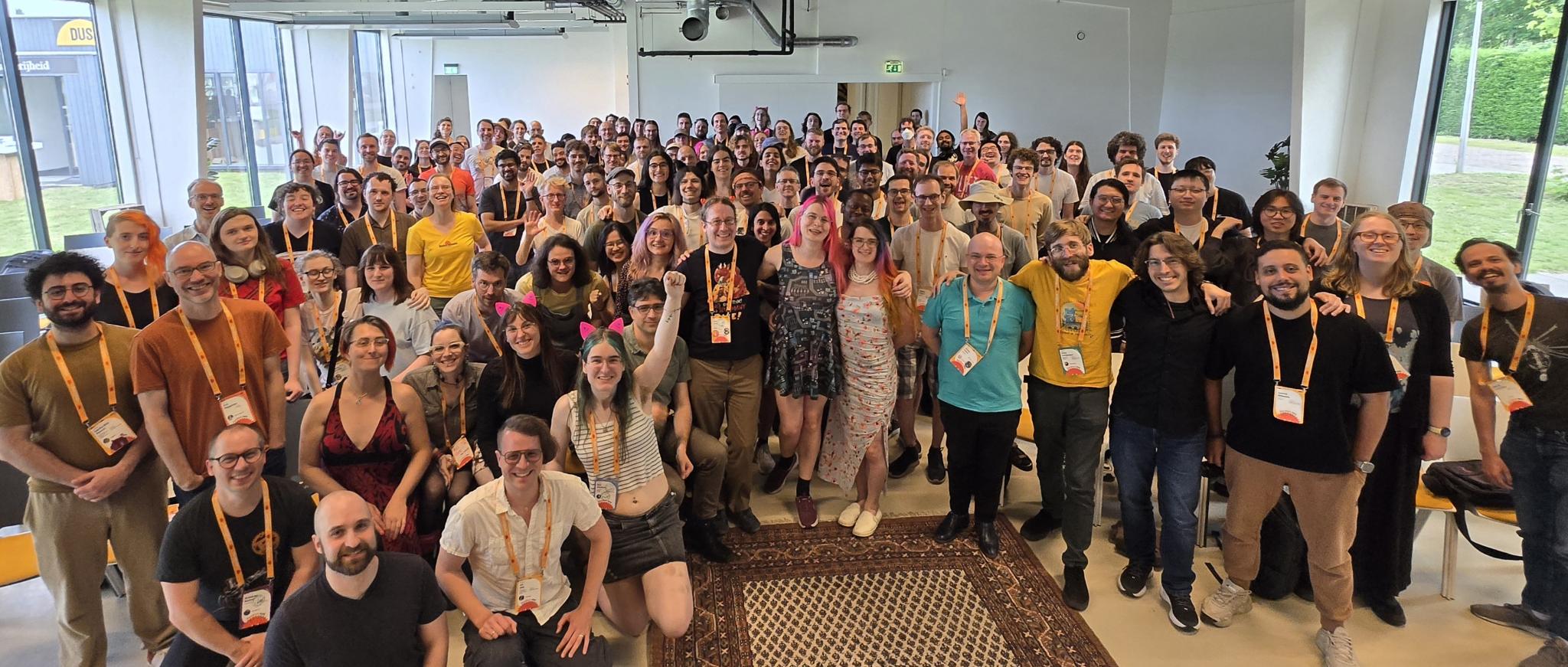
In May 2026, the city of Utrecht played host to 166 Rustaceans for the Rust All Hands. This gathering serves as a vital hub for Project members and guests to collaborate in person. The primary goal is to align on the future of the language, clear technical hurdles, and strengthen inter-team bonds—though it is explicitly not a venue for making final decisions.
This event marked the second time RustNL took the lead in organizing, successfully continuing the revival of a tradition that had been dormant for six years.
Event Structure & Integration
The All Hands was strategically integrated into the broader RustWeek schedule. To visualize the flow of the event:
The Unconference
Running alongside the main event was the RustWeek Unconference. This was a collaborative space where invited contributors and ecosystem maintainers worked with Project members.
| Participating Group | Focus Area |
|---|---|
| Bevy Engine | Data-driven game engines |
| Ariel OS | Operating system development |
| Linebender | GUI and graphics |
| Safety-Critical Rust Consortium | High-assurance systems |
| Rust GPU | GPU programming |
| Rust Embedded | Bare-metal/Embedded systems |
Total Unconference participation: ~60 members.
Additionally, the conference day immediately preceding the All Hands featured a dedicated "Rust Project Track," where members gave presentations that set the stage for the deeper dives occurring during the All Hands sessions.
Session Breakdown
The event was highly productive, featuring 73 sessions conducted over 3 days across 11 different rooms. While many were planned, several spontaneous discussions emerged.
🏛️ Governance and Culture
The event opened with the "State of the Rust teams" session. Much of the remaining time was dedicated to the Project's organizational health:
- Leadership & Oversight: Q&A panels with the Project Directors and the Leadership Council clarified their respective roles and their relationship with the Rust Foundation.
- Moderation: A dedicated panel for moderators, supported by Q (Hachyderm's head moderator), provided a space to discuss the frictions of community management.
- Contributor Experience: Discussions on Project culture focused on identifying and removing sources of disempowerment for maintainers.
- Strategic Planning: Sessions on funding and "north stars" aimed to refine how the Project communicates its trajectory.
Current Project Coordination Goals:
- Improve communication of long-term goals.
- Refine the RFC process (potentially adopting style iterations).
- Optimize funding allocation.
⚙️ Technical Evolution
The bulk of the sessions focused on the language's growth. Key technical areas included:
- Language Features:
const generics,const traits, field projections, and reborrowing. - Memory & Performance: In-place initialization, SIMD, and
allocators. - Compiler & Tooling:
rustcas a library, custom lints, stability attributes for libraries, and the Sized Hierarchy. - Core Internals: Auto traits, codegen, semantics, and infrastructure.
Interoperability and Integration
A significant portion of the dialogue centered on the "C++ problem." Discussions explored:
- The general solution space for Rust/C++ interop.
- The current state of Crubit.
- The potential for safer interop by merging
LLVM IRwithRust MIR.
Furthermore, the Project collaborated with Rust for Linux and Rust for CPython to streamline the integration of Rust into the kernel and the Python interpreter.
Participant Feedback
The overall sentiment was overwhelmingly positive, with an average satisfaction score of:
Personal Reflections
"I had some fantastic conversations regarding effects with Jana Dönszelmann, Tyler Mandry, and Benno Lossin—I'm actually writing blog posts about it now. I also gained a lot from the moderation talk with Q. On the technical side, we may have unblocked
rustc_publicand are coordinating witht-infrato enable static compilation of arustcdriver. I was pleasantly surprised by the level of interest in my workshops." — teor
"Regarding
cargo-semver-checks, we mapped out a path for buildingrustdocJSON with the correct features, which unblocks cross-crate analysis. We also agreed that running this on standard library PRs is essential to prevent painful accidental breakages. We've reached a consensus to ship arustupcomponent with therustdocJSON for the target triple (though the component remains unstable since the JSON format is not yet stable). Most of these 'spicy' details were hammered out in person." — Predrag Gruevski
Predrag also highlighted the "hallway track," noting that a random encounter at the hotel provided the missing piece of an obscure edge case for cargo-semver-checks. This underscores the irreplaceable value of physical proximity.
// Conceptual representation of the "Hallway Effect"
fn event_value(sessions: Vec<Session>, hallways: Vec<Conversation>) -> Value {
    let formal_gain = sessions.iter().map(|s| s.knowledge).sum();
    let informal_gain = hallways.iter().map(|c| c.serendipity).sum();

    formal_gain + informal_gain // The total value of Rust All Hands
}