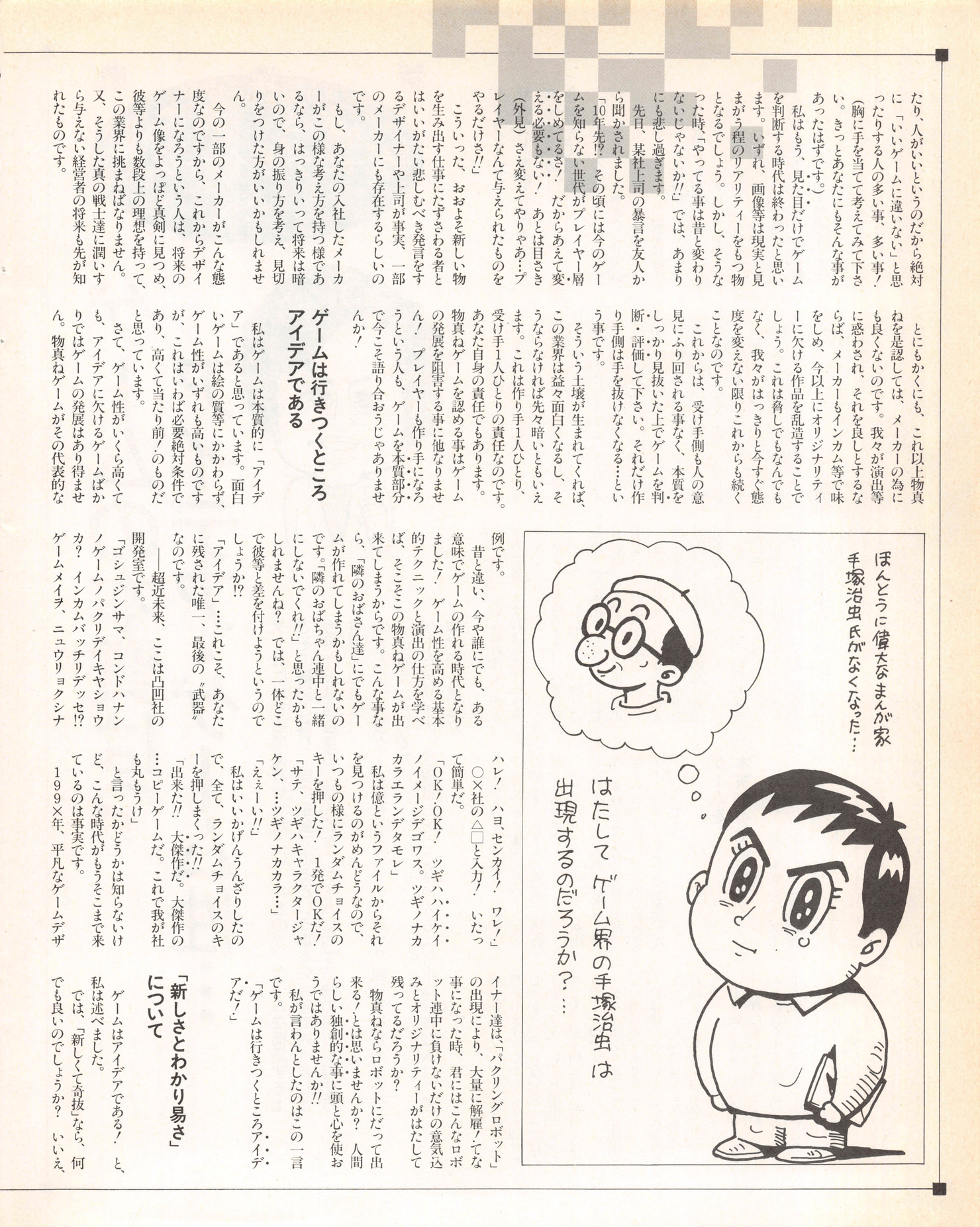
Games at the press of a button: The Rip-O-Bot (1989)
Instant Games: The Legacy of the Rip-O-Bot (1989)
Fukio Mitsuji—better known by the shorthand MTJ (derived from the consonants of Mi-Tsu-Ji) —was a titan of game design. His portfolio includes legendary titles such as:
- Bubble Bobble
- Rainbow Islands
- Syvalion
- Volfied
- Magical Puzzle Popils
Beyond development, MTJ contributed to the Japanese arcade publication GAMEST through a column titled Introduction to Game Design (ゲームデザイン入門), intended to mentor aspiring creators.
The War Against "Rip-offs"
In the April 1989 issue (Issue 31), MTJ expressed his frustration with the prevalence of pakuri (パクリ), or "rip-off" games, and the cynical mindset of the industry. He mocked the belief that players are mindless consumers who only care about surface-level changes:
"Ten years from now!? By then the player base will be a generation that doesn’t even know today’s games! Just tweak the surface—the outside—and… players just play whatever they’re handed!!"
To illustrate the logical conclusion of this laziness, MTJ penned a brief piece of speculative fiction.
The Dekoboko Co. Scenario
Set in the "very near future" (超近未来), the story takes place at the fictional Dekoboko Co., where game creation has been reduced to a conversation with a machine.
The Dialogue:
Robot: “MASTER, WHICH GAME SHALL WE RIP OFF THIS TIME? THE TAKINGS’LL BE SPLENDID!?”
MTJ: “ENTER THE GAME NAME, IF YOU’D BE SO KIND—COME ON, GET ON WITH IT, YOU!”
The process was absurdly simple. MTJ describes the interaction like this:
INPUT: Company ○×’s “△□”
ACTION: Press [RANDOM CHOICE] key
RESULT: Game selected from millions of files
Fed up with the prompts for character selection, MTJ simply hammered the random-choice button until the machine declared the new product a guaranteed financial success.
Analyzing the "Rip-O-Bot"
Looking back, this scenario feels like a prophecy of modern generative AI. However, MTJ wasn't psychic; he simply understood the trajectory of the 1980s industry.
The robot, which MTJ called the Pakuringu Robotto (パクリングロボット), uses a linguistic hybrid: the Japanese slang pakuri (rip-off) combined with an English -ing suffix (similar to sampling). I've translated this as the Rip-O-Bot.
The Prediction and the Warning
MTJ warned that an era of automated imitation was imminent. He posed a chilling question to his readers:
199X年 Actual arrival: 2020s
"When ordinary game designers are laid off en masse thanks to the arrival of the 'Rip-O-Bot'—when that happens, will you still have enough drive and originality left in you to beat robots like those?"
He urged designers to focus on the "original work that only humans can do."
The Philosophy of Design
MTJ's core thesis can be summarized by a simple equation:
He argued that technical skill and visual fidelity are not the true markers of a great game. He believed:
- Graphics would eventually reach a point of total realism, making "looks" a dead end for innovation.
- Basic technical proficiency was already common enough that even "the ladies next door" could create a passable clone.
| Feature | The Imitator's Path | The Designer's Path |
|---|---|---|
| Focus | Surface/Graphics | Core Concept/Idea |
| Method | Random Choice | Human Creativity |
| Outcome | Replaceable/Disposable | Unique/Lasting |
| Weapon | Technique | Originality |
The Search for a Gaming Genius
A touching footnote in the magazine mentioned the passing of Osamu Tezuka, the "god of manga," on February 9, 1989. The page featured a sketch of a hopeful designer wondering: Will the Osamu Tezuka of the game world ever appear?
This question mirrors the Rip-O-Bot dilemma: in a world where imitation is effortless, how do we foster genuine, world-changing originality?
Legacy and "Jinks"
MTJ passed away in 2008 at age 48, never seeing the actual arrival of the Rip-O-Bots. Yet, his insights continue to influence others. This article served as a catalyst for the creation of Jinks, a new game-making methodology.
The goal of Jinks is to automate the "boilerplate" of development so the human can focus on the "Idea."
The Jinks Development Checklist:
- Handle input systems
- Implement scoring logic
- Set up display boilerplate
- Experiment with gameplay rules
- Refine unique systems
- Inject human originality
While automation doesn't guarantee a masterpiece, it frees the creator to wield the "final weapon" MTJ spoke of: the idea.