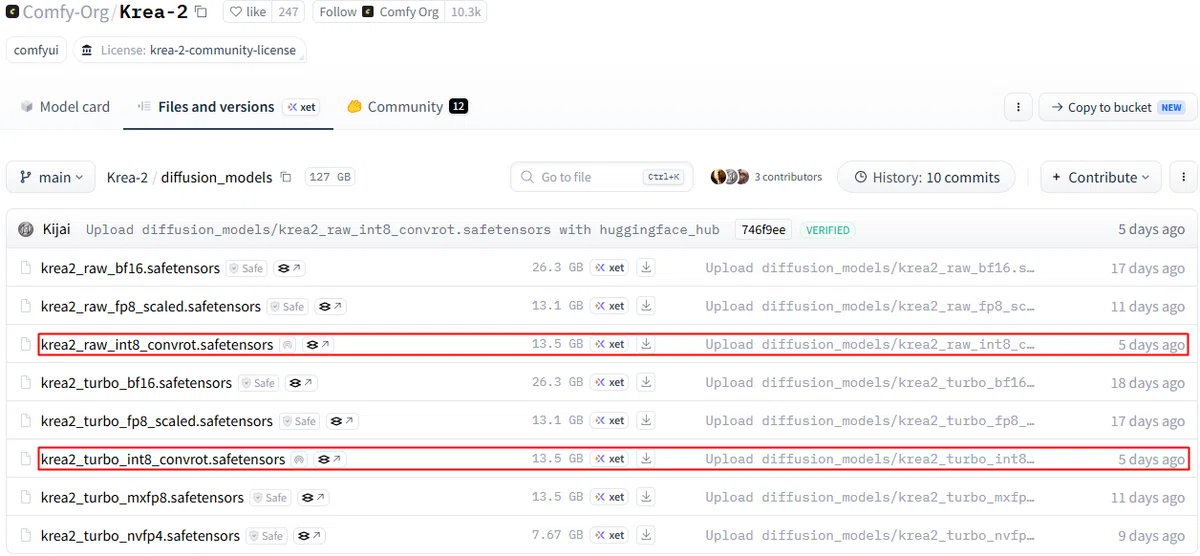
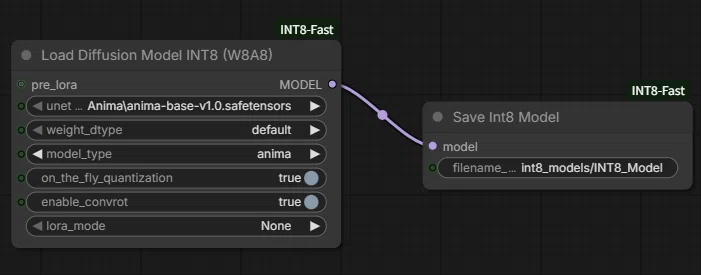
Explanation of INT8 ConvRot (FP8 is no longer needed)
Understanding INT8 ConvRot: The New Standard for 8-bit Quantization
System Notice: This content is a comprehensive rewrite of an article by ひろろひ🐈⬛Forge Neo推し. While the original was AI-translated, this version aims to preserve all technical nuances and the author's original intent.
The release of ComfyUI v0.27.0 on July 1, 2026, introduced native support for a modeling and quantization technique known as INT8 ConvRot. This development has sparked significant interest within the AI community.
While this method is exceptionally beneficial for users with GeForce RTX 20 and 30 series GPUs, reports indicate that it actually outperforms the previous industry standards—namely FP8 and FP8 Scaled—even on the newer GeForce RTX 40 and 50 series.
Consequently, INT8 ConvRot is poised to become the universal standard for all 8-bit quantized models, a transition currently being championed by Comfy-Org. Because there is still some confusion regarding how this differs from other formats, this article serves as a detailed guide.
🗓️ Update Log
- 2026/7/7: Added confirmation that Forge Neo now supports
INT8 ConvRot. - 2026/7/6: Integrated evaluation results provided by Kimama-san.
- 2026/7/5: Clarified the role of
GGUFwithin the "Classification of Modeling Methods." - 2026/7/5: Added technical details regarding
TritonandPyTorchin the usage section.
📦 Fundamentals of AI Model Storage
Before diving into the specifics of INT8 ConvRot, it is essential to understand how AI models are stored and compressed.
Modeling and Quantization
To maintain maximum precision across a wide range of values, AI models are initially developed using FP32 (a 32-bit FLOAT type). However, this results in massive file sizes—for instance, an SDXL model can reach 12GB. To make these models more manageable and faster to process, they are converted to lower bit-counts: 16-bit, 8-bit, or even 4-bit.
While reducing the bit-count shrinks the file size and boosts speed, it also reduces the number of representable values, which can lead to a drop in precision. Therefore, specialized formats and algorithms are employed to minimize the impact on the final output quality.
Hierarchy of Modeling Methods
The following diagram illustrates how different components contribute to the final model format:
To further clarify, here is a structured breakdown:
Note on GGUF: As of July 5, 2026, it's important to note that GGUF is more than just a file format; it also defines specific storage methods for quantized data (e.g., Q4_K_M). To keep this guide simple, I will treat it as a format and focus on the broader classification.
In this context, while the general public often uses the term "quantization" for everything, I will use "modeling" to describe the overall format and "quantization method" specifically for the conversion algorithm.
📊 Comparing Model Formats and INT8 ConvRot
Using the hierarchy established above, we can compare INT8 ConvRot against other common formats.
1. 16-bit Models
These are high-precision models with minimal scaling.
| Layer | FP16 | BF16 (Brain FP16) |
|---|---|---|
| Encoding | FP16 | BF16 |
| Scaling | None (Fixed) | None (Fixed) |
| Quantization | RTN | RTN |
2. 8-bit INT Models
This is where INT8 ConvRot resides, distinguishing itself from standard INT8.
| Layer | INT8 | INT8 Tensor-wise | INT8 ConvRot |
|---|---|---|---|
| Encoding | INT8 | INT8 | INT8 |
| Scaling | None (Fixed) | Tensor-wise | Row-wise |
| Quantization | RTN | RTN | ConvRot |
3. 8-bit FLOAT Models
These were previously the standard, but are now considered secondary to ConvRot.
| Layer | FP8 | FP8 Scaled | MXFP8 |
|---|---|---|---|
| Encoding | FP8 (E4M3/E5M2) | FP8 (E4M3/E5M2) | FP8 (E4M3/E5M2) |
| Scaling | None (Fixed) | Tensor-wise, etc. | Single-layer Microscaling |
| Quantization | RTN | RTN | RTN |
4. 4-bit Models
Ultra-compressed formats for maximum efficiency.
| Layer | NVFP4 | MXFP4 |
|---|---|---|
| Encoding | FP4 (E2M1) | FP4 (E2M1) |
| Scaling | Layered | Single-layer Microscaling |
| Quantization | RTN | RTN |
🔍 What exactly is ConvRot?
INT8 ConvRot is a specific format that utilizes INT8 encoding paired with the ConvRot quantization algorithm. As shown in the tables, it is fundamentally different from standard INT8 or INT8 Tensor-Wise due to its Row-wise scaling and unique algorithm.
The technology is based on a research paper published on December 3, 2025:
"ConvRot: Rotation-Based Plug-and-Play 4-bit Quantization for Diffusion Transformers" (available on arxiv.org)
While the underlying technology can technically be applied to FLOAT types, it was specifically designed to overcome the inherent weaknesses of INT types in AI models.
Technical Implementation Example
While the process is handled internally by ComfyUI and Forge Neo, the logic follows a rotation-based approach to minimize quantization error:
# Conceptual representation of a rotation-based quantization step
def apply_convrot(tensor):
    # 1. Rotate the weight matrix to smooth out outliers
    rotated_tensor = rotate_matrix(tensor, rotation_angle=theta)
    # 2. Quantize to INT8
    quantized = quantize_to_int8(rotated_tensor)
    return quantized