Intelligence Is Not the Main Bottleneck
Intelligence Is Not the Main Bottleneck
By Ruxandra Teslo Originally published July 21, 2026
Disclaimer: I am not suggesting that every single person in the San Francisco tech bubble shares this mindset. Rather, I am addressing a specific, influential core whose perspectives carry an oversized amount of weight in both public discourse and the creation of policy.
The Dinner Party Epiphany
The following exchange happened verbatim at a recent dinner. A representative from a prominent AI laboratory asked me, with striking bluntness, why I dedicate my professional life to the things I do—specifically, my writing on the regulatory hurdles hindering medical advancement and my focus on clinical trial policy.
I shared my core conviction: in an era defined by AI, the true constraints on medicine will be intelligence regulation and the grueling nature of clinical trials. I argued that pouring billions into accelerating pre-clinical research is a distraction because it doesn't address the "unsexy" systemic bottlenecks.
To illustrate, I pointed to the housing crisis:
- We have possessed the technical capability to build superior housing for decades.
- Yet, costs continue to soar.
- Conclusion: Housing is a failure of political will, not a lack of technical capability.
The "Hyperpersuasive" Rebuttal
The response I received was a masterclass in intellectual condescension.
"Surely, a smart person like you realizes that AGI will soon be hyperpersuasive," he countered. He noted that AI already outperforms professional debaters in persuasion benchmarks.
I responded with a skeptical, "Hmm." He replied, "Yes, yes," with the tone of someone possessing esoteric knowledge that "mere mortals" outside of AI labs simply cannot comprehend. He looked at me with a mixture of pity and affection—the way one might view a cute, slightly dim-witted animal moments before it is led to the slaughter.
That night, I spiraled. I wondered if my life's work was pointless or if every major decision I'd made was a fundamental error.
The Naive Hamster's Conviction
As dawn broke, I returned to my original thesis: No matter how "intelligent" an AI becomes, raw intelligence is rarely the primary bottleneck preventing real-world change.
It is difficult to maintain this belief when people who are objectively "smarter" (or at least have access to more privileged data) insist you are wrong. I wondered if my perspective was merely "cope"—the delusions of a naive_hamster awaiting its fate.

However, I remain steadfast. While the world treats the words of AI lab founders as gospel because they successfully bet on "insane" ideas in the past, it does not follow that AI will automatically solve the problems we actually care about. To solve these problems, we must define them accurately—which I believe we are currently failing to do.
Two Primary Observations:
- The social dynamics and rhetoric prevalent in San Francisco.
- The empirical reality of the medical field.
AI and the Medical Mirage
The promise to "cure all diseases" is the standard justification for the risks associated with AI. This narrative is echoed by every major AI CEO and embraced by investors. Consequently, any biotech firm with "AI" in its pitch deck receives a massive valuation, while traditional biotechs struggle to survive.
But the reality is that medical progress is hindered by factors that have nothing to do with raw intelligence.
The Evidence of Systemic Friction
If we treat scientific advancement as a proxy for intelligence, we can see that more "intelligence" does not automatically equal more "progress."
| Phenomenon | Description | Result |
|---|---|---|
| Eroom's Law | The observation that drug discovery becomes slower and more expensive over time. | \text{Drugs per } \ \text{ invested} \downarrow$ |
| Adaptimmune | A company with transformative cancer therapies. | Fighting for survival due to development costs. |
| "Baby KJ" | A child saved by bespoke gene-editing. | Cannot be easily replicated due to manufacturing/regulations. |
Understanding Eroom's Law
While Moore's Law describes exponential growth in computing, Eroom's Law (Moore's spelled backward) describes the decline in pharmaceutical R&D productivity.
def pharmaceutical_productivity(year, investment):
    # Despite better tools, the cost per approved drug increases
    cost_per_drug = calculate_regulatory_burden(year) + clinical_trial_costs(year)
    return investment / cost_per_drug
Since 1960, productivity has dropped despite leaps in basic science. While there has been some recent improvement due to better predictive validity (e.g., genetics) and a focus on rare diseases (where approval bars are lower), the core problem remains.
The True Bottleneck: Clinical Trials
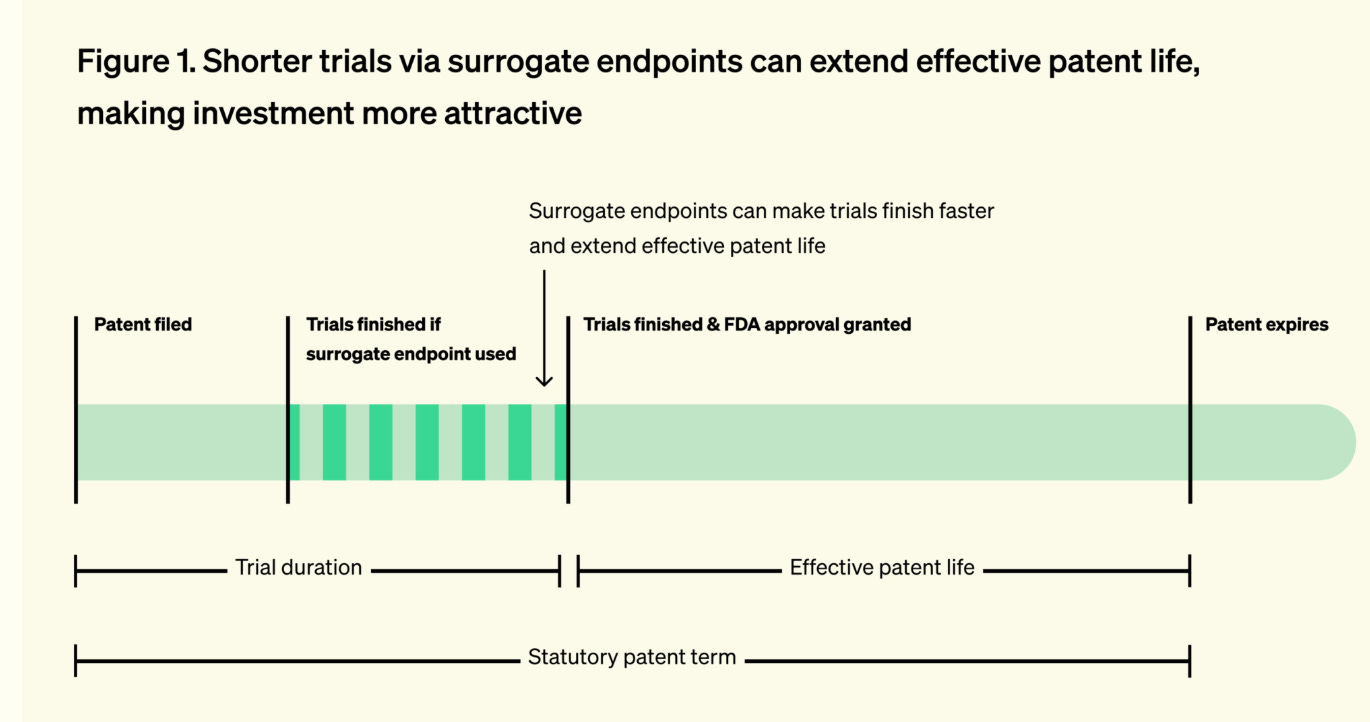
The most significant hurdle in biopharma is the clinical trial process.
- Time: years
- Cost: >\ 1 \text{ billion per drug}$
These trials are the source of the very human data required to train better AI models. Therefore, the data is irreplaceable.
The Impact of Trial Speed
Faster trials don't just get drugs to market quicker; they create a positive feedback loop:
- Increased risk appetite for researchers.
- Better alignment of incentives.
- Faster feedback loops for iteration.
The China Case Study
China is currently positioning itself to overtake the US in biotechnology. A huge portion of Western pharma licensing deals now involve Chinese biotechs.
Crucially, this shift is happening even though China generally lags behind the US in basic science. Their advantage is not "intelligence"—it is the speed of the trial-and-error process.
Final Thoughts
The belief that AGI's persuasiveness or raw cognitive power will magically dissolve regulatory and political barriers is a fantasy. Until we address the structural "grind," the smartest entity in the room will still be stuck waiting for a permit.
