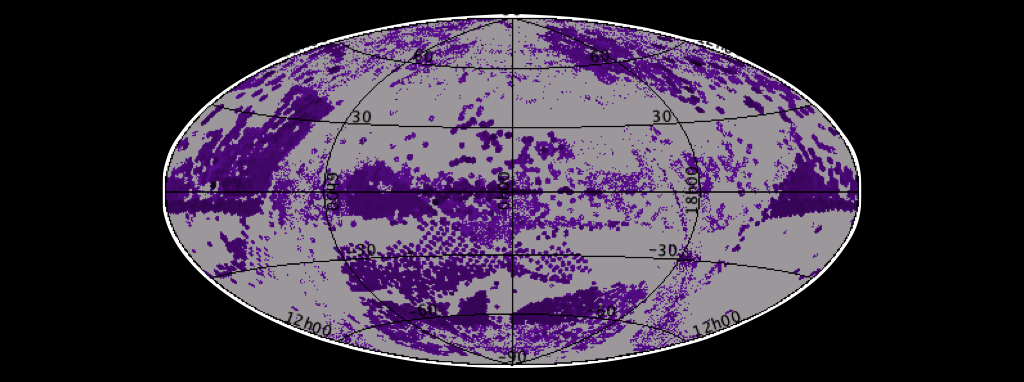
An all-sky map of half a million supermassive black holes
Mapping the Abyss: SDSS-V Data Release 20 Reveals Half a Million Supermassive Black Holes

The Sloan Digital Sky Survey (SDSS) has officially launched Data Release 20 (DR20), a pivotal milestone in our understanding of accreting supermassive black holes (SMBHs). Through the Black Hole Mapper (BHM) program—a cornerstone of the SDSS-V generation—astronomers are gaining an unprecedented look at the evolution, mass, and fundamental physics of active galactic nuclei (AGN) and quasars across the history of the cosmos.
🌌 Expanding the Horizon: Global Observations
DR20 represents a massive leap in geographic and data coverage. For the first time, the survey includes optical BOSS spectra from the southern hemisphere, captured at the Las Campanas Observatory (LCO) in Chile, complementing the ongoing work at the Apache Point Observatory (APO) in New Mexico.
Data Volume Summary
| Category | Quantity |
|---|---|
| Total Optical Spectra | |
| Targeted Galaxies | |
| Targeted Stars |
🛰️ The SPIDERS Project: X-Ray Synergy
A primary engine of the BHM in DR20 is SPIDERS (SPectroscopic IDentification of ERosita Sources). This initiative bridges the gap between high-energy X-ray data and optical spectroscopy.
The Workflow:
By correlating eROSITA's X-ray sky maps with SDSS optical data, researchers have secured optical identifications and precise redshifts for roughly 200,000 X-ray sources. While some of these are star systems or galaxy clusters, the vast majority are quasars or AGN.
🔭 Decoding Cosmic Demographics
X-ray emissions serve as a "beacon," allowing scientists to probe the hot X-ray coronae of black hole central engines. By analyzing the —a statistical census of black hole power across different eras—astronomers can track growth from the local universe back to the "cosmic dawn" at redshifts near .
Key Discoveries:
- Early Giants: The data suggests that
giant black holes were rare in the early universerapidly growing giant black holes were surprisingly common at high redshifts. - The Unseen Population: Many "hidden" black holes were discovered that are invisible to traditional UV or optical surveys, especially those at extreme distances or low luminosities.
- The Dust Veil: Analysis of total mass accumulation indicates that soft X-ray-selected black holes are only a small fraction of the local SMBH mass.
- Finding: to of all SMBH growth occurred while obscured by dense gas and dust, or during phases where X-rays were suppressed.
"This release marks the culmination of more than a decade of joint planning and scientific exchange between the German eROSITA Consortium and the Sloan Digital Sky Survey," stated Dr. Andrea Merloni, BHM Survey Scientist and eROSITA Principal Investigator. "With DR20, we demonstrate... that large, international and diverse collaborations can effectively work together for years towards a common goal."
⏱️ Time-Domain Analysis: Probing the Inner Engine
Since SMBHs are too compact to be imaged directly, the BHM uses variability to measure them.
BHM Sub-Programs
- Reverberation Mapping (RM): Measures the time lag between light from the accretion disk and the broad-line region to calculate geometric mass.
- All-Quasar Multi-Epoch Spectroscopy (AQMES): Monitors tens of thousands of quasars to track:
- Gas outflows.
- Binary SMBH candidates.
- "Changing-look" quasars (objects that transition states).
The "Weirdos" of the Sky
The diversity of the incoming data was so extreme that it actually crashed the standard software.
if spectrum_variety == "extreme":
    pipeline_status = "BROKEN"
    action = "MANUAL_VISUAL_INSPECTION"
    print("Found a weirdo!")
Because some spectra were so anomalous, the team had to manually inspect them—an effort that is now included in the DR20 release. As one team member noted, it was "fun to be part of the team that looked at these weirdos."