Muse Glimmer: 30B-parameter model optimized for always-on local agent workflows
Muse Glimmer: A 30B-Parameter Model Tailored for Persistent Local Agent Workflows
Meta AI Research | August 10, 2026 | ⏱️ 6 min read
Meta Superintelligence Labs has officially unveiled Muse Glimmer, a specialized agentic model. In a commitment to open science, the model weights are being released under the permissive Apache 2.0 license.
Overview
Muse Glimmer is a model featuring parameters, specifically engineered to power always-on local agent workflows. Because of its size, it can operate on a standard PC or Mac equipped with a single consumer-grade GPU. This unlocks a variety of private, on-device applications:
- Autonomous local agents and complex function calling.
- On-device software engineering and coding assistance.
- Utilizing the model as a local "LLM-as-a-judge" for evaluations.
"Running models locally enables you to use AI anywhere, anytime, with or without an internet connection."
While frontier models have mastered reasoning and tool use, most deployments are tethered to cloud infrastructure and constant network access. The open-source community has proven that smaller, strategically trained models can rival the performance of massive frontier models on specific, targeted tasks.
To support the developer ecosystem, Muse Glimmer is available on Hugging Face. Integration for llama.cpp, MLX, and ExecuTorch is arriving shortly, ensuring a seamless transition from download to deployment.
The Engineering Behind Muse Glimmer
Creating an agent capable of managing files, drafting correspondence, and learning user habits requires a synergy of several high-level capabilities:
- Long-horizon execution
- Precise tool invocation
- Multimodal perception
- Expansive context memory
- Strict instruction adherence
Training Methodology
To balance raw power with the memory limits of consumer hardware, Meta employed a sophisticated training pipeline:
The model was trained using logit distillation from the larger Muse Spark model, utilizing a similar data mixture but emphasizing richer reasoning traces and agent-specific data. The final version was vetted via Meta’s Advanced AI Scaling Framework to ensure safety and quality before its open-weight release.
Agentic Capabilities: What it Can Do
Muse Glimmer is designed to function as the "brain" of an autonomous system. Its capabilities include:
- End-to-End Task Completion: High success rates on benchmarks like
DeepSearch QA,MCP-Atlas, , andSWE-Bench. - Robust Tool Use: Capable of invoking functions with strict schema adherence across multi-step workflows.
- Persistent Planning: Maintains coherent goals over long horizons.
- Self-Correction: Instead of crashing upon a tool failure, the model is trained to diagnose the error and retry.
- Multimodal Input: Uses a dedicated perception encoder to process interleaved text and images (e.g., analyzing charts or screenshots).
- Orchestration: Compatible with
OpenClawand other agentic frameworks. - Flexible Reasoning: Supports adjustable reasoning strengths to trade off speed for quality.
- Global Reach: Trained on data spanning over 100 languages.
Performance Benchmarks
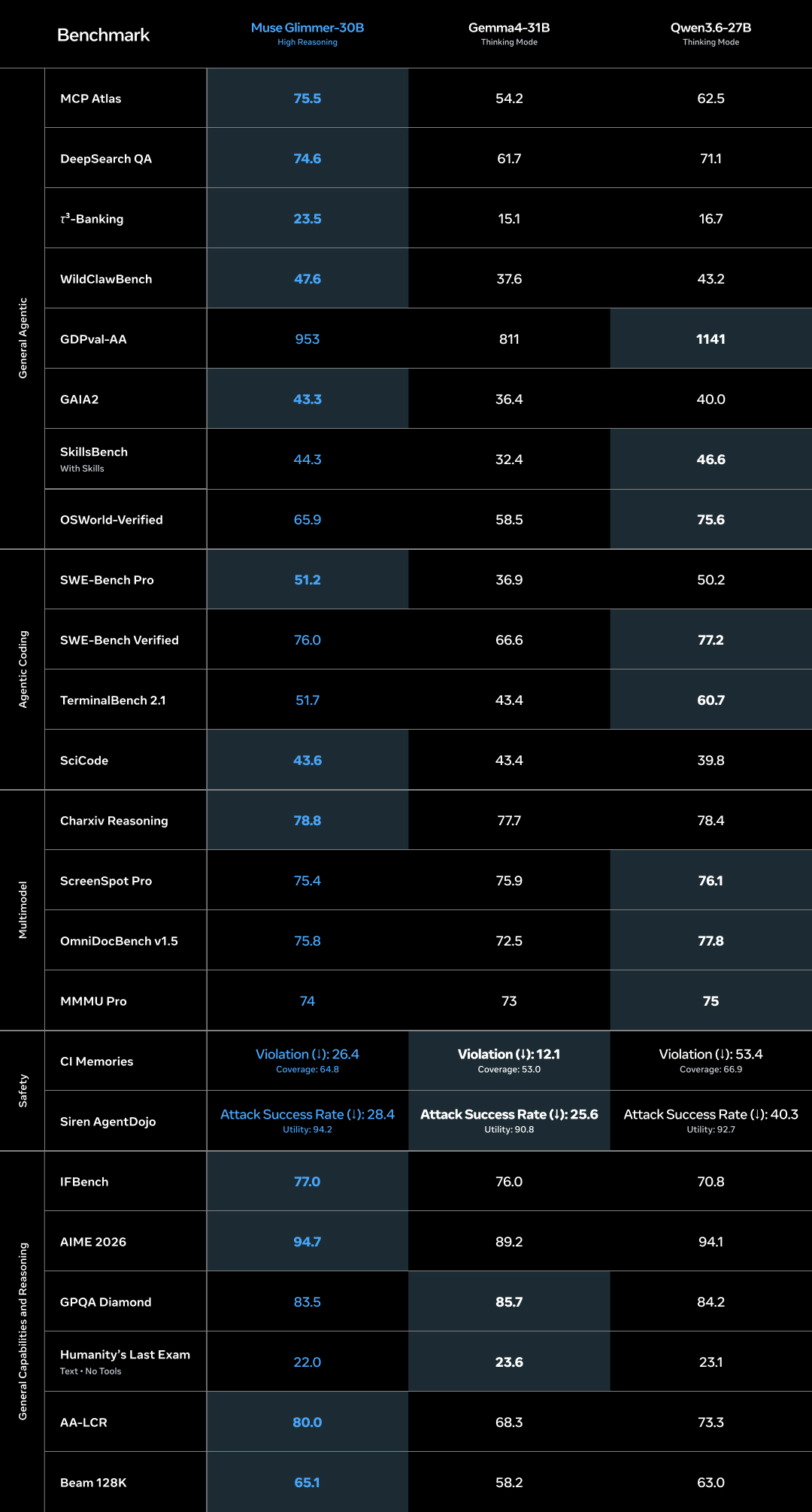
When measured against other models in its weight class, Muse Glimmer shows strong competitiveness.
| Benchmark Category | Muse Glimmer 30B | Gemma4-31B | Qwen3.6-27B |
|---|---|---|---|
| Agentic Tasks | High | Competitive | Competitive |
| Coding | Strong | Strong | Strong |
| Multimodal | Optimized | Variable | Variable |
| Reasoning | High | High | High |
Optimizing for the Local Edge
For a local agent to be viable, it must be responsive. Meta implemented two primary optimizations to ensure the model doesn't "break the flow" of work.
1. Advanced Quantization
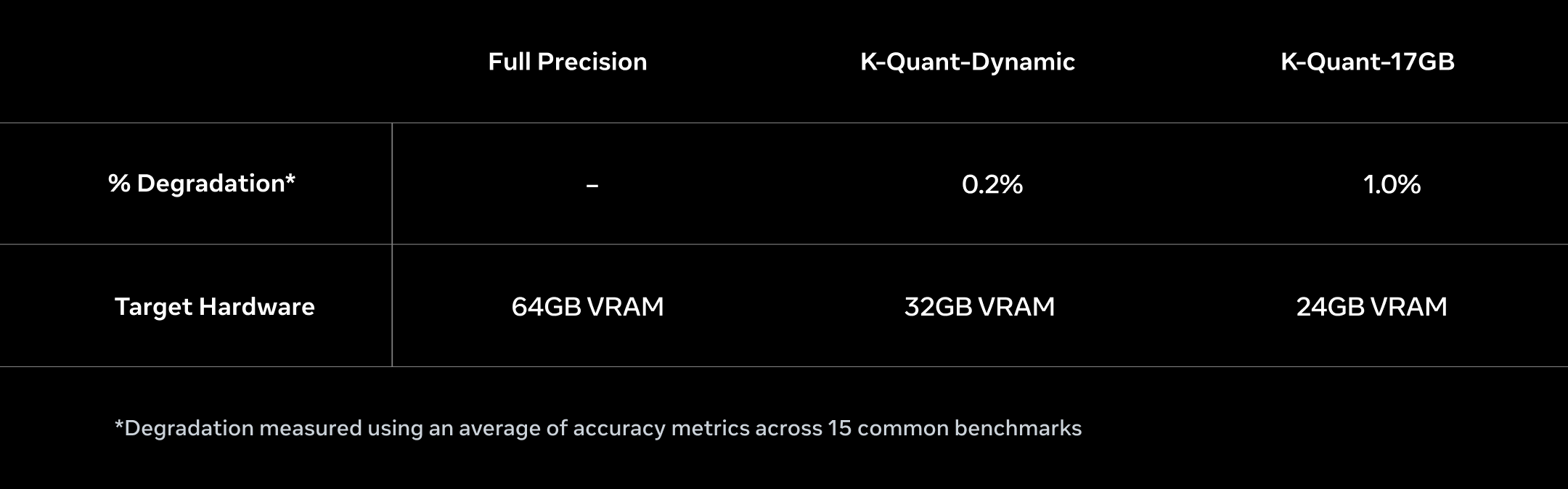
A full-precision 30B model would require of VRAM, which exceeds most consumer GPUs. By compressing weights to 4-bit precision, the footprint is reduced to .
This leaves critical headroom for:
- KV Cache (Working memory)
- Perception Encoder (Vision)
- Speculative Drafter (Speed)
This allows the model to fit comfortably within a or memory envelope with negligible loss in accuracy.
| Precision Level | Accuracy Loss | Target Hardware Memory |
|---|---|---|
| Full Precision | 0% | |
| K-Quant-Dynamic | Minimal | |
| K-Quant-17GB | Low |
2. Speculative Decoding via DFlash
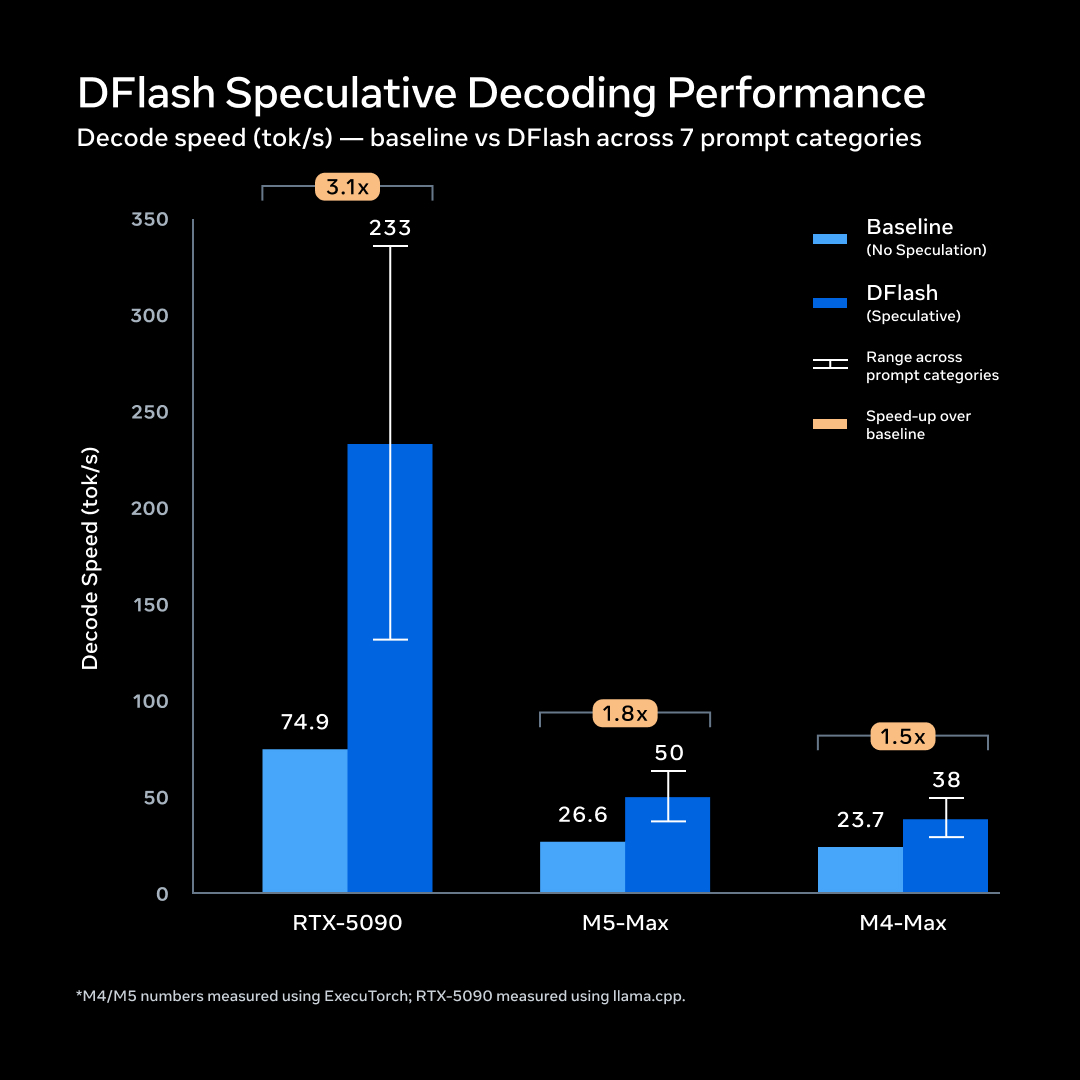
To solve the "one-token-at-a-time" bottleneck, Muse Glimmer uses a DFlash-based drafter. This is a tiny companion network that predicts blocks of tokens, which the main model then verifies in parallel.
# Conceptual Speculative Decoding Flow
tokens = drafter.propose_block(input_context)
is_valid = main_model.verify(tokens)
if not is_valid:
    tokens = main_model.correct(tokens)
This results in massive speed increases across different hardware:
- RTX 5090: faster
- M5 Max: faster
- M4 Max: faster