2D Gaussian Splatting for Bézier Spline Line Art Vectorization
Vectorizing Line Art via 2D Gaussian Splatting and Bézier Splines

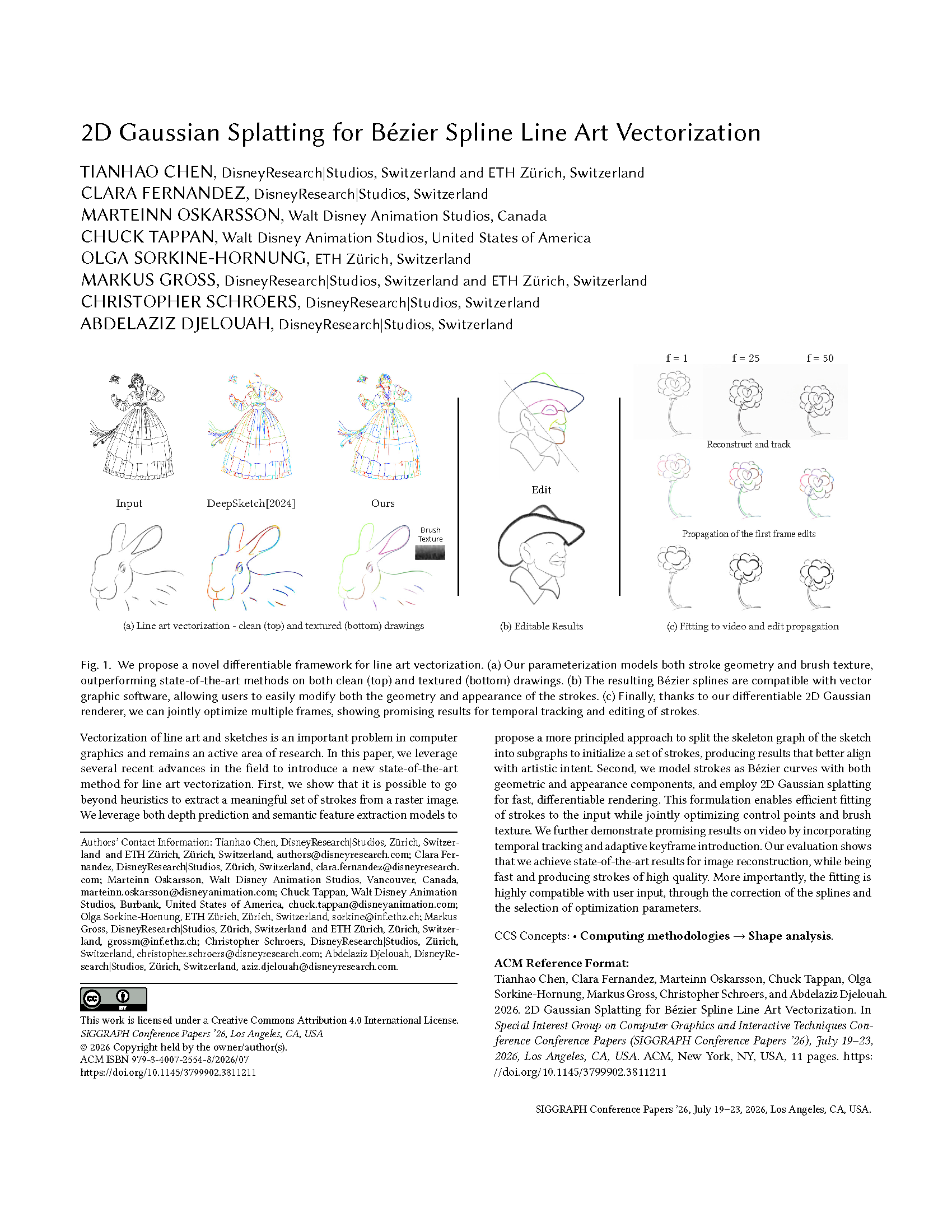
Presented at SIGGRAPH (2026) on July 16, 2026, this research introduces a cutting-edge methodology for converting rasterized line art and sketches into high-quality vector formats.
📋 Project Overview
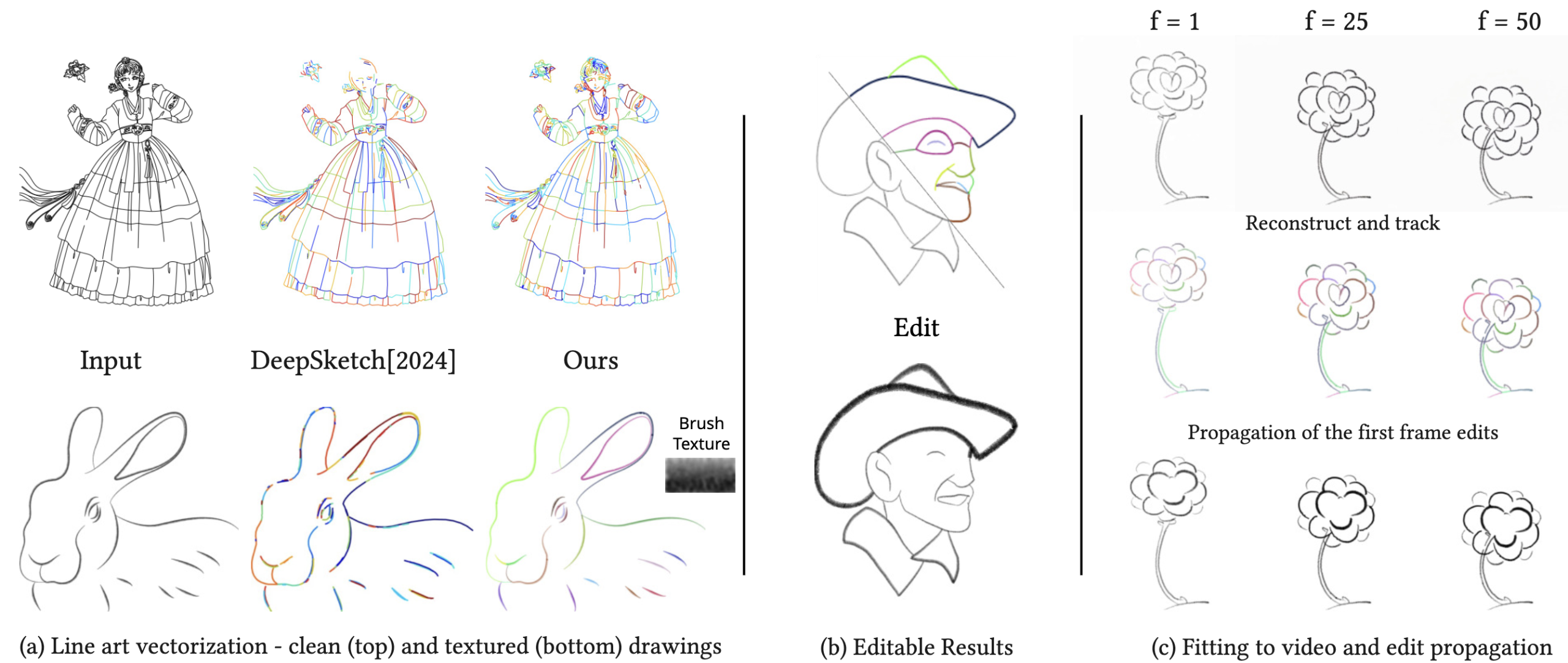
The objective of this work is to advance the field of line art vectorization by moving away from traditional, rigid heuristics and toward a more principled, differentiable framework.
The Research Team
| Author | Affiliation |
|---|---|
| Tianhao Chen | DisneyResearch|Studios / ETH Zurich |
| Clara Fernandez | DisneyResearch|Studios |
| Marteinn Oskarsson | Walt Disney Animation Studios |
| Chuck Tappan | Walt Disney Animation Studios |
| Olga Sorkine-Hornung | ETH Zurich |
| Markus Gross | DisneyResearch|Studios / ETH Zurich |
| Christopher Schroers | DisneyResearch|Studios |
| Abdelaziz Djelouah | DisneyResearch|Studios |
🚀 Technical Methodology
The authors propose a two-stage pipeline to transform pixels into artistic vectors.
1. Intelligent Stroke Extraction
Rather than relying on simple heuristics, the system utilizes a more sophisticated approach to identify individual strokes:
- Skeleton Graph Analysis: The raster image is first converted into a skeleton.
- Semantic & Depth Integration: By employing
depth predictionandsemantic feature extractionmodels, the system splits the skeleton graph into logical subgraphs. - Artistic Intent: This ensures that the resulting strokes mirror the original artist's intent more accurately than previous methods.
2. Differentiable Rendering & Optimization
The strokes are modeled as Bézier curves, which are defined mathematically as:
To render these efficiently, the team employs 2D Gaussian Splatting. This allows for:
- Joint Optimization: The system simultaneously refines the control points (geometry) and the brush texture (appearance).
- Speed: Differentiable rendering enables rapid fitting of the vector strokes to the source image.
🛠️ Conceptual Workflow
🎬 Video & Temporal Extension
The framework isn't limited to static images. By integrating temporal tracking and the adaptive introduction of keyframes, the method can be applied to video sequences, maintaining consistency across frames.
Implementation Logic (Pseudocode)
def optimize_vectorization(raster_frame, prev_frame_splines):
    # Initialize strokes via semantic skeleton splitting
    strokes = extract_subgraphs(raster_frame)

    # Jointly optimize geometry and texture
    while not converged:
        loss = compute_diff_render_loss(strokes, raster_frame)
        strokes = gradient_descent(loss, strokes)

    return strokes
📊 Results and Evaluation
The researchers have achieved several key milestones:
- State-of-the-Art (SOTA): Superior image reconstruction compared to existing tools.
- Efficiency: High-speed processing and fitting.
- Quality: Production-grade stroke aesthetics.
- User Control: High compatibility with manual adjustments (e.g., tweaking splines or optimization settings).
⚖️ Legal & Copyright
Copyright Notice: The documents provided are shared by the authors for the purpose of timely, non-commercial dissemination of technical and scholarly work. All rights are retained by the authors or respective copyright holders. Users must adhere to the terms and constraints set by the authors; reposting without explicit permission is prohibited.
Explore More: [Research at Disney] | [People] | [Careers] | [Publications] | [Outreach] | [About Us] | [Legal]