GPT 5.6 Sol is the best "vision" model OpenAI ever released
GPT 5.6 Sol: OpenAI's New Vision Powerhouse

Recently, OpenAI unveiled the GPT-5.6 family, consisting of three distinct models: Sol, Terra, and Luna. While the official launch stream emphasized computer use—specifically the ability to navigate desktop environments, manage UI agents, and generate 3D visualizations—these features are fundamentally built upon a foundation of superior visual comprehension.
To verify these claims, we put the new lineup through our upcoming VLM benchmark.
Benchmark Objectives
- Object Detection
- Object Counting
- Optical Character Recognition (OCR)
- Targeted Data Extraction
The Bottom Line: GPT-5.6 Sol is the most capable vision model OpenAI has ever produced. The improvement is most staggering in counting and detection, areas where GPT-5.5 previously struggled compared to top-tier VLMs.
🎯 Object Detection
The most dramatic leap in performance occurred in detection. We measured this using (mean Average Precision).
| Model | mAP@50 Score | Status |
|---|---|---|
| GPT-5.6 Sol | 46.2 | 🚀 Massive Jump |
| GPT-5.6 Terra | 44.7 | Significant Gain |
| GPT-5.6 Luna | 43.3 | Significant Gain |
| Former Weakness |
Key Findings in Detection
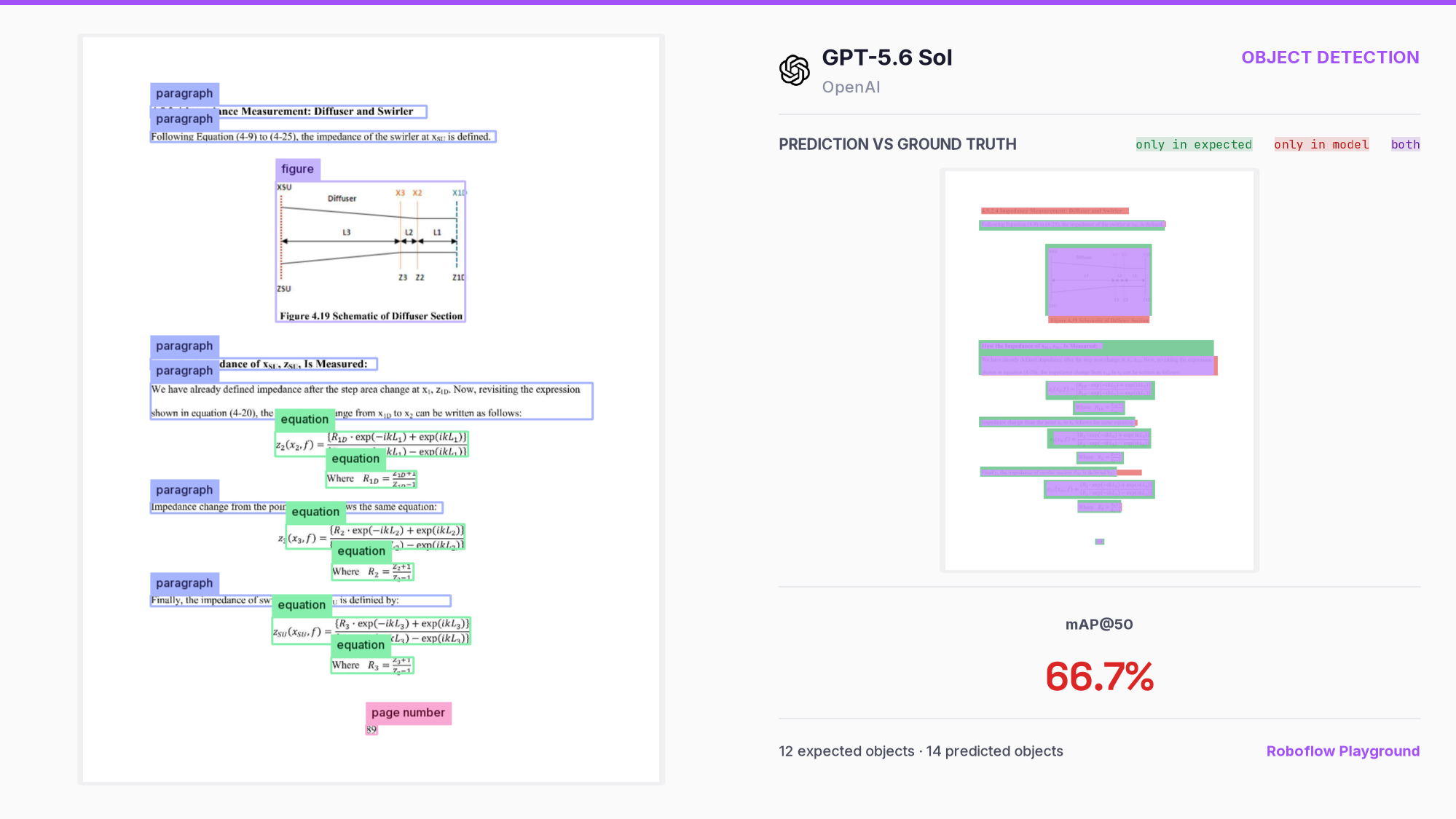
- Document Intelligence: Sol excels at identifying layout elements like signatures, tables, paragraphs, and titles.
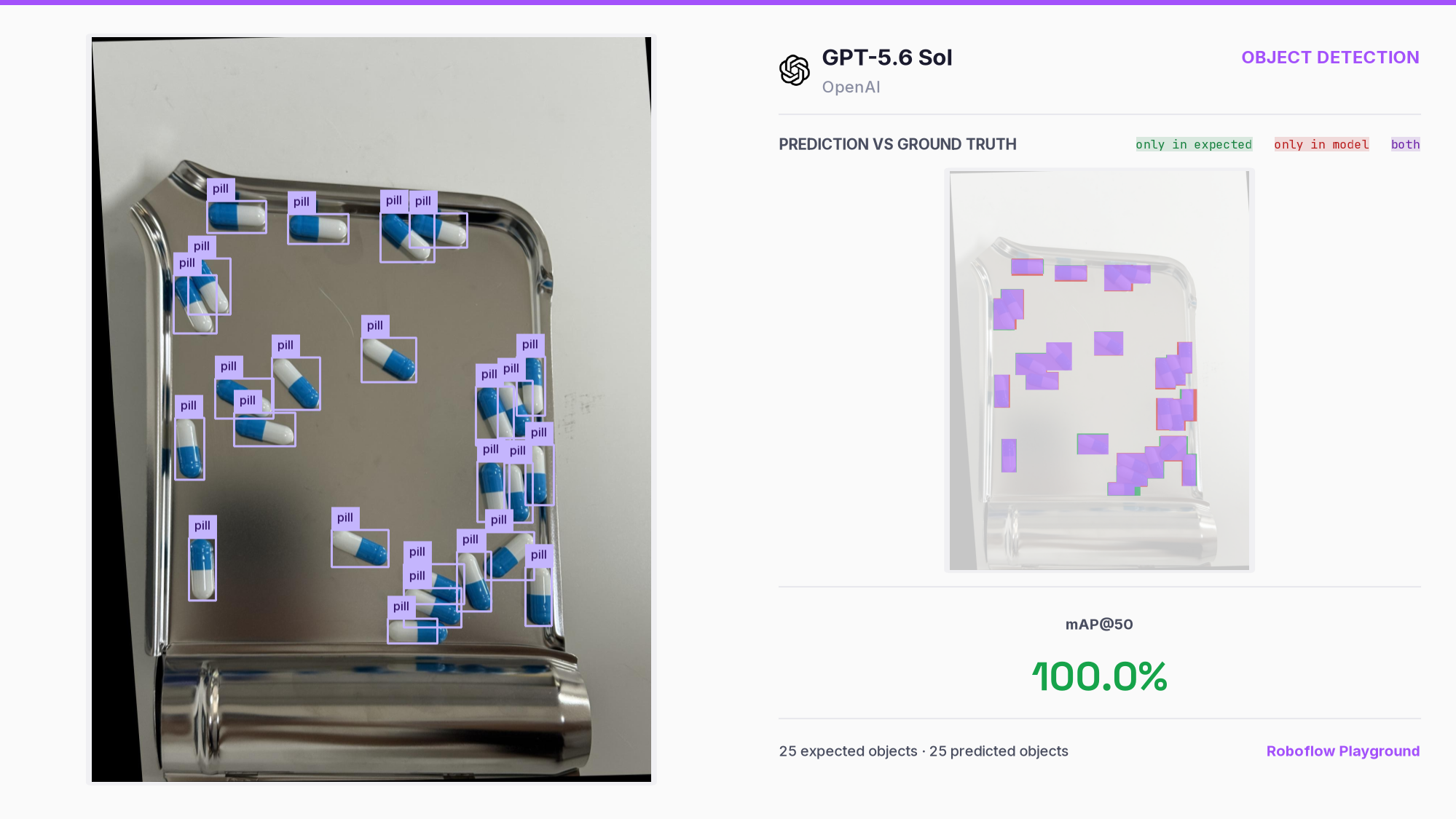
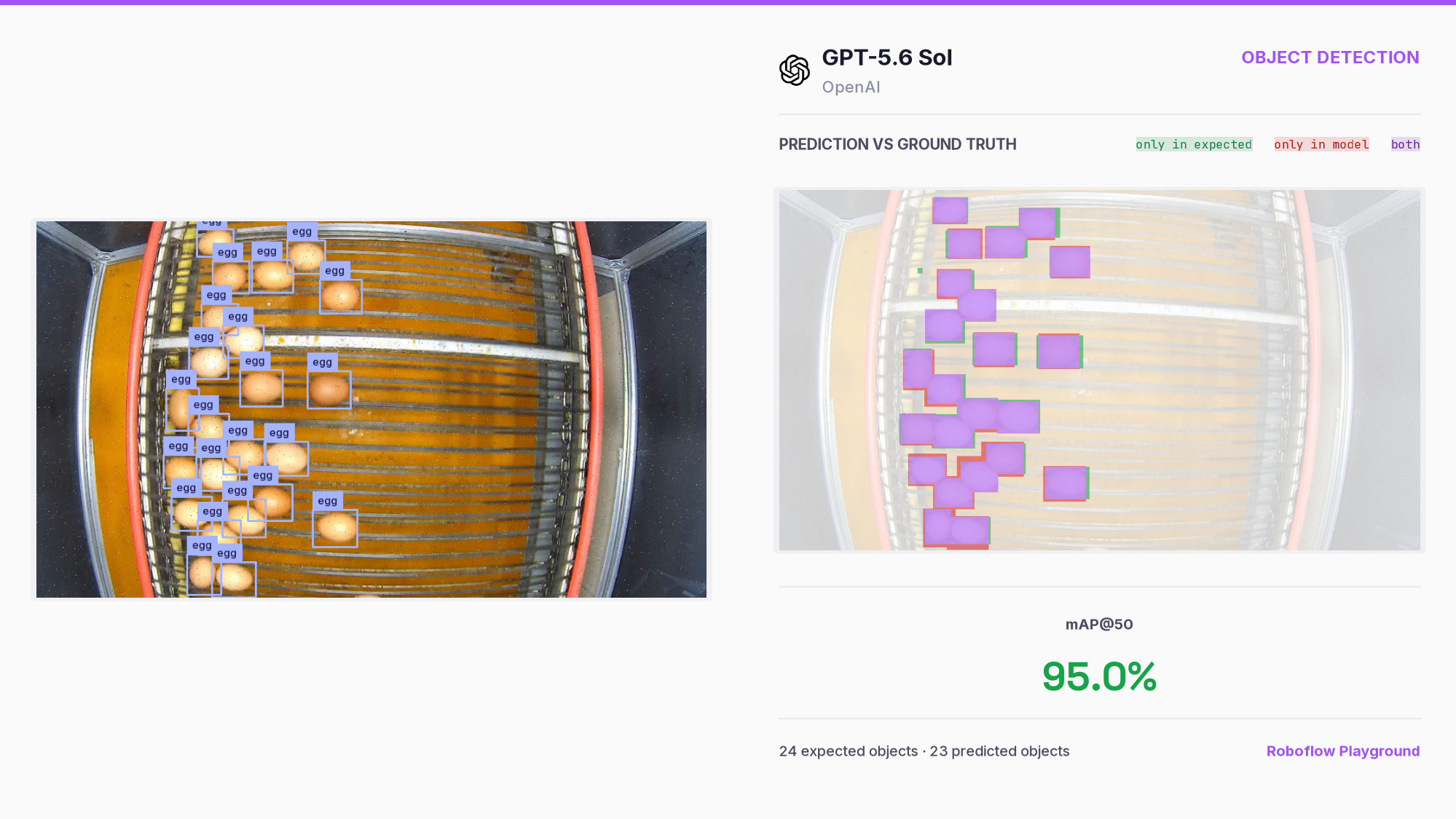
- Dense Environments: The model was tested on images of eggs and pills (see below), which typically trip up VLMs due to the high density of similar objects.
- The Coordinate Challenge: Unlike standard detectors, VLMs output coordinates as text. As the number of objects increases, the risk of hallucinations or coordinate drift rises.
🛠️ Implementation Tip: Coordinate Formats
To maximize accuracy, you must use the correct coordinate system.
- GPT-5.6: Use absolute
XYXYcoordinates in pixels. - Gemini 3.5 Flash: Use normalized
YXYXcoordinates (range ).
Using the wrong format for GPT-5.6 resulted in a performance drop of mAP points.
# Example of the preferred GPT-5.6 coordinate output
# [xmin, ymin, xmax, ymax]
detection = [120, 450, 300, 600]
Stability Issues
We noticed that Sol can become unstable with images pixels. In these cases, it may generate "ghost boxes" in unnatural, evenly spaced grids.
- Fix A: Increase "reasoning effort" (increases cost/latency).
- Fix B: Resize or crop images before API submission (recommended).
🔢 Object Counting
Counting accuracy saw a universal lift across the 5.6 family.
- Sol: 73.0% (up from 64.9% in GPT-5.5)
- Terra: 67.6%
- Luna: 66.2%
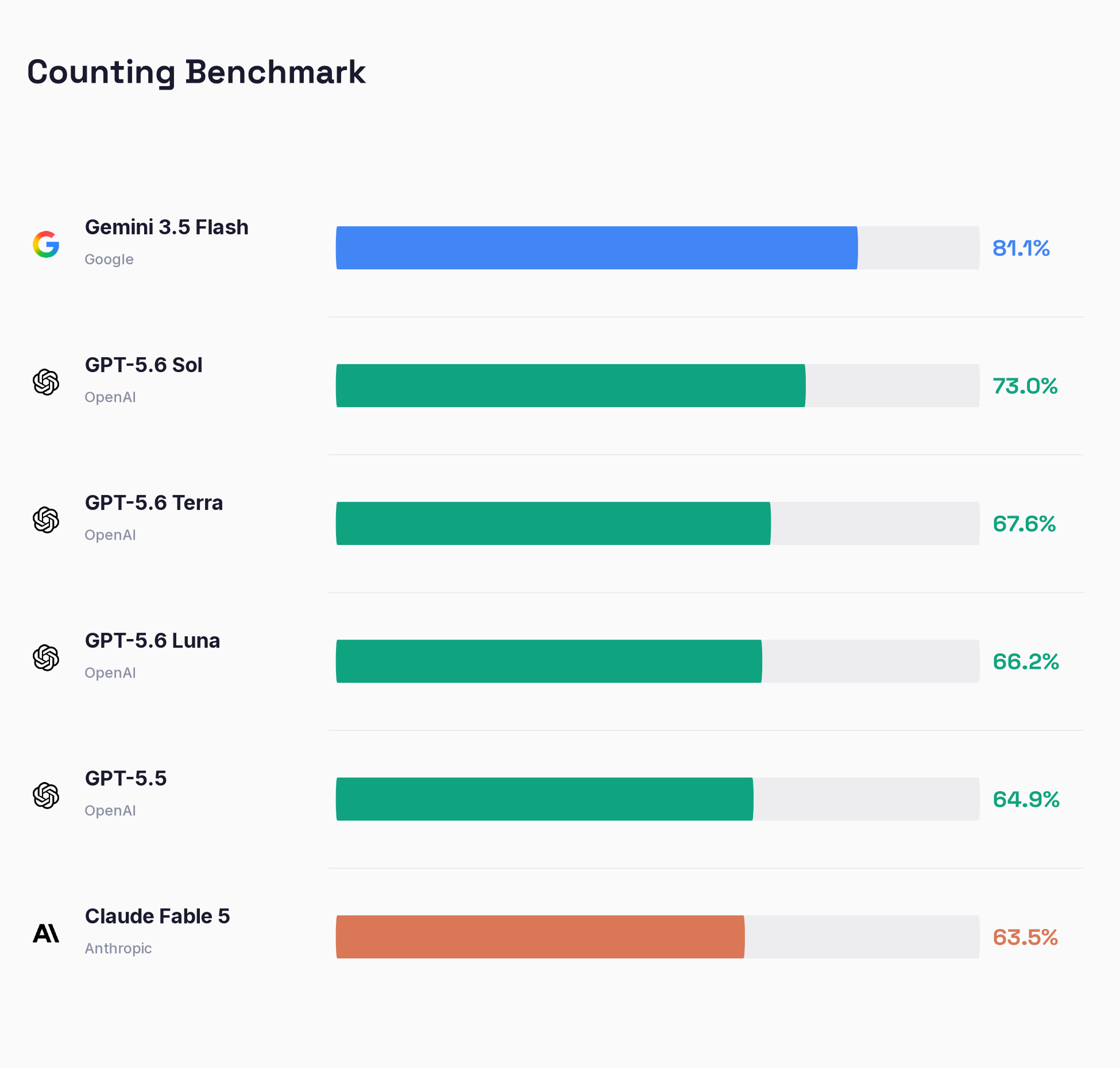
Complex Scenarios Sol Handled:
- Overlapping Objects: Successfully counted metal brackets that were partially obscured.
- Conditional Counting: Counted bullet holes only within specific scoring zones.
- State Differentiation: Distinguished between filled and empty slots in a pill package despite reflections.
Note: Sol did fail on an "abnormal candy" test, though it's unclear if this was a counting error or a category misunderstanding.
✍️ OCR and Data Extraction
Interestingly, OCR performance remained relatively flat compared to the previous generation.
| Metric | GPT-5.5 | GPT-5.6 Sol |
|---|---|---|
| Mean Similarity | 91.2% | 90.7% |
| Text Extraction | 87.6% | 82.5% |
Performance Nuances
We distinguished between Full Transcription (all text) and Targeted Extraction (specific data).
- Wins: Sol successfully read handwritten notes, extracted live hockey scores, and read tire size sequences from curved, dirty surfaces.
- Losses: It failed to read a blister pack expiration date due to low contrast, vertical orientation, and glare.
⚖️ Trade-offs: Cost, Speed, and Tokens
The increase in visual intelligence is not free. The GPT-5.6 models consume more tokens, which impacts the bottom line for high-volume users.
Latency Comparison:
- Luna: seconds (Best balance of speed/quality; similar to Gemini 3.5 Flash).
- Terra: seconds.
- Sol: Highest latency and cost.
Financials: In our tests, Sol cost approximately $0.025 per image.
You can experiment with these models via the Roboflow Playground to compare Sol, Terra, and Luna against competitors like Claude Fable 5.