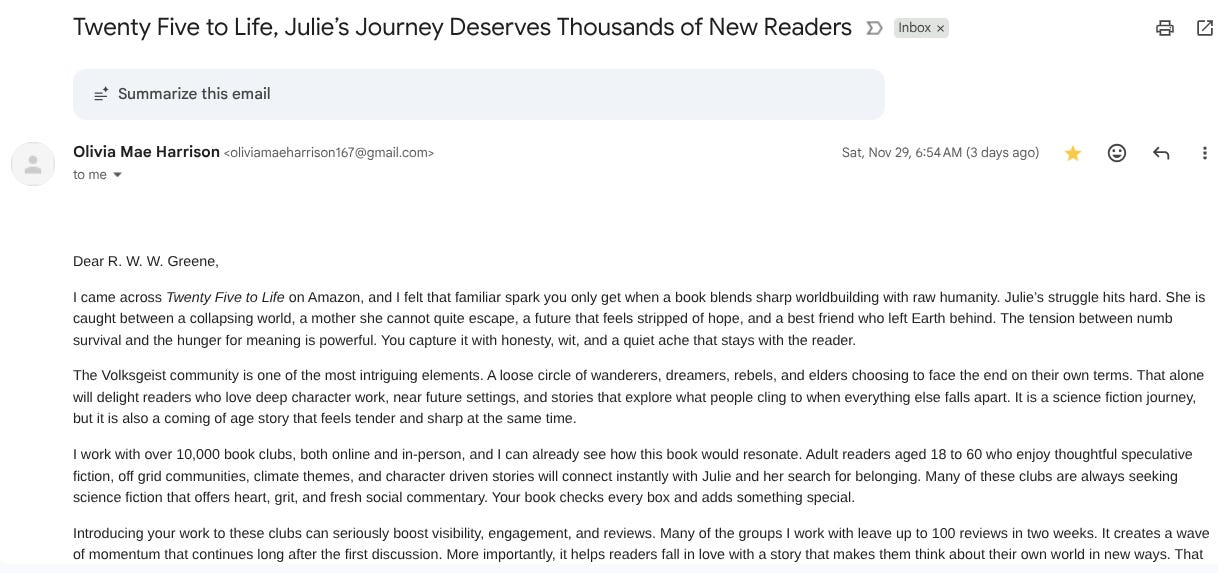
I set a trap for a book-marketing scammer (2025)
I Set a Trap for a Book-Marketing Scammer (2025)
Or, the tale of how a scammer mistook me for a 400-year-old playwright... and then things got weird.
By Rob Greene (He/Him/His) | December 02, 2025
This is a chronicle of a traditionally published science fiction author who became the target of over fifty fraudulent book-marketing pitches within a mere thirty-three days. These predators were banking on one thing: the desperation of a writer eager to move copies and secure a future publishing contract.
It is also a narrative featuring a confused yet persistent AI named Veronica and a con artist who masquerades as legitimate authors to lower the defenses of their victims.
Ultimately, however, it is a story about an industry in freefall, where the people offering "life preservers" are actually the ones pulling you under.
1. The First Ripple
The onslaught began with a woman calling herself Mercy Gold (a name more suited for a supernatural monster hunter than a marketer). Her approach was a classic "compliment sandwich":
“You’ve already laid a great foundation with your blurb and keywords that’s a strong start.”
The formula is simple: You're doing great, BUT there is a hidden problem you aren't aware of.
She proposed managing a "simple email marketing" strategy and a "light social presence" to ensure the book remained visible to "real readers." She wanted to know if I was open to seeing how this could enhance my "author journey."
Within the first three weeks of November, twenty-three more pitches arrived.
The Rogue's Gallery
The offers were as varied as they were vague:
- Isaac Michael: Specialized in Goodreads and Pinterest.
- Halfdaytravel: Promised TikTok features (sent at 1:28 AM).
- Pratibha Malav: Provided a tiered price list for paid reviews.
- Janet: Pitched cinematic trailers and website design.
- "Dr. Sandra Maria Anderson": Contacted me via
abbyamazonalirah@gmail.com.
Whether it was Google indexing, Amazon optimization, or video production, they all shared the same hallmarks: generic Gmail accounts, nebulous promises of "visibility," and a keen understanding of author anxiety.
2. The Brutal Math of Publishing
These scammers are dangerous because they target a very real vulnerability. For mid-list or lower-tier writers, the financial reality of traditional publishing is grim.
Estimated Royalties per Unit
| Format | Estimated Earnings |
|---|---|
| Ebook | \approx \0.25 - $0.40$ |
| Print Book | \approx \0.65 - $1.00$ |
| Audiobook | \approx \1.30 - $5.00$ |
If a scammer charges a flat fee of \500$ for "marketing," the math for the author is devastating. To simply break even on that investment, the calculation looks like this:
I would need to sell up to 2,000 additional books just to recover the cost of the scam.
If a major publisher like Angry Robot—with their professional PR teams, retail co-op deals, and established budgets—cannot get a book onto a specific Pinterest board, why should I believe a random person with a Gmail account can? Yet, in a moment of weakness, every author asks: What if it actually works?
3. An Industry in Crisis
To understand the rise of these scams, one must look at the systemic collapse of the publishing ecosystem.
The environment is a perfect storm:
- Overproduction: A surge in self-publishing and traditional houses chasing revenue.
- Attention Deficit: Fewer readers and more competition from other media.
- The Mid-List Death Spiral: Publishers can no longer afford to market every title, leaving authors feeling abandoned.
This created a goldmine for AI-driven fraud. In 2025, as publishers quietly declined "next options" and articles about the "publishing crisis" went viral, scammers launched coordinated campaigns to hit authors at their lowest point.
Victoria Strauss, co-founder of Writer Beware (supported by the SFWA), has noted that this is not an isolated incident. She has tracked this wave since June 2025, tracing the operations back to Nigeria, where AI is used to generate highly personalized pitches at an unprecedented scale.
4. The Floodgates Open
Then came the deluge. In a single day, five separate pitches hit my inbox:
- Green Link (1:22 AM): Promised "real organic" engagement in reading communities.
- Sylvester Josh (9:48 AM): Offered 3D cinematic trailers.
- TikTok Specialist: Promised viral features.
- Review Bot: Offered paid reviews (which explicitly violate Amazon's Terms of Service).
- Optimization Expert: Claimed to fix "problems" my book didn't have.
A sixth pitch from "Dr. Sandra Maria Anderson" was thankfully intercepted by the spam filter.
The Scammer's Workflow
- Identify traditionally published author.
- Use AI to scrape "blurb" and "keywords."
- Send "Compliment Sandwich" email.
- Use a name that sounds trustworthy (e.g., Mercy Goldcrown).
- Request payment via non-refundable methods.
Over the following weeks, the emails became a daily occurrence. The senders changed—Naphy Expertt, Ophelia, Bella, Emmanuel, Evelyn, KAMBIO—but the script remained the same. Prices varied from a "low" $20 to "contact me for a quote."
 The current state of the mid-list author.

def scam_detection(email):
    if "Gmail" in email.sender and "organic engagement" in email.body:
        return "SCAM"
    elif "cinematic trailer" in email.body and "contact for quote" in email.body:
        return "SCAM"
    else:
        return "PROBABLY_STILL_A_SCAM"