Wi-Fi 8 is the first wireless upgrade in years that isn't chasing speed
Wi-Fi 8: Shifting the Focus from Raw Speed to Rock-Solid Stability
For the better part of a decade, wireless upgrades have followed a predictable script: more speed, wider bandwidth, and extended range. However, as Wi-Fi 7 begins its gradual rollout into our homes, a new paradigm is emerging. Wi-Fi 8 is currently being developed, and for the first time in years, the goal isn't to make the internet faster—it's to make it better.
The IEEE has officially labeled this upcoming standard as "Ultra High Reliability." While "reliability" might sound less flashy than "gigabit speeds" on a marketing brochure, it is an upgrade that users will likely notice far more in their daily lives.

The End of the "Speed Race"
Since the arrival of Wi-Fi 4 (802.11n) in 2009, every single generation has chased a higher theoretical maximum data rate. Wi-Fi 5 saw a massive 10x jump, and while subsequent versions have seen smaller percentage gains, the trend was always upward.
Goal: Maximum Theoretical Speed Goal: Effective Real-World Throughput
With Wi-Fi 7 already capable of a theoretical throughput of 23Gbit per band, we have reached a point of diminishing returns. Most home internet connections cannot even saturate that bandwidth, making further speed increases largely redundant.
Wi-Fi 7 vs. Wi-Fi 8: A Technical Comparison
On paper, the "raw" specs of Wi-Fi 8 look almost identical to its predecessor.
| Feature | Wi-Fi 7 | Wi-Fi 8 |
|---|---|---|
| Max Data Rate | High (23Gbit/band) | Same as Wi-Fi 7 |
| Spatial Streams | Same | Same |
| Modulation | 4096-QAM | 4096-QAM |
| Channel Bandwidth | 320MHz | 320MHz |
| Frequency Bands | Same | Same |
"The focus is shifting from how fast a connection can be in a vacuum to how stable it actually is in a crowded, noisy environment."
The Roadmap to Reliability
The IEEE is targeting specific, measurable improvements to ensure that Wi-Fi 8 handles "non-ideal" conditions—like walls, interference, and dozens of connected devices—more gracefully.
The Wi-Fi 8 Performance Checklist:
- Increase throughput by across various
SINR(Signal-to-Interference-and-Noise Ratio) levels. - Lower latency by for the 95th percentile of worst-case scenarios.
- Reduce
MPDU(MAC protocol data unit) loss by .
The Technical Engine: What's Actually Changing?
To achieve these goals, Wi-Fi 8 introduces several sophisticated mechanisms to manage how data is transmitted and received.
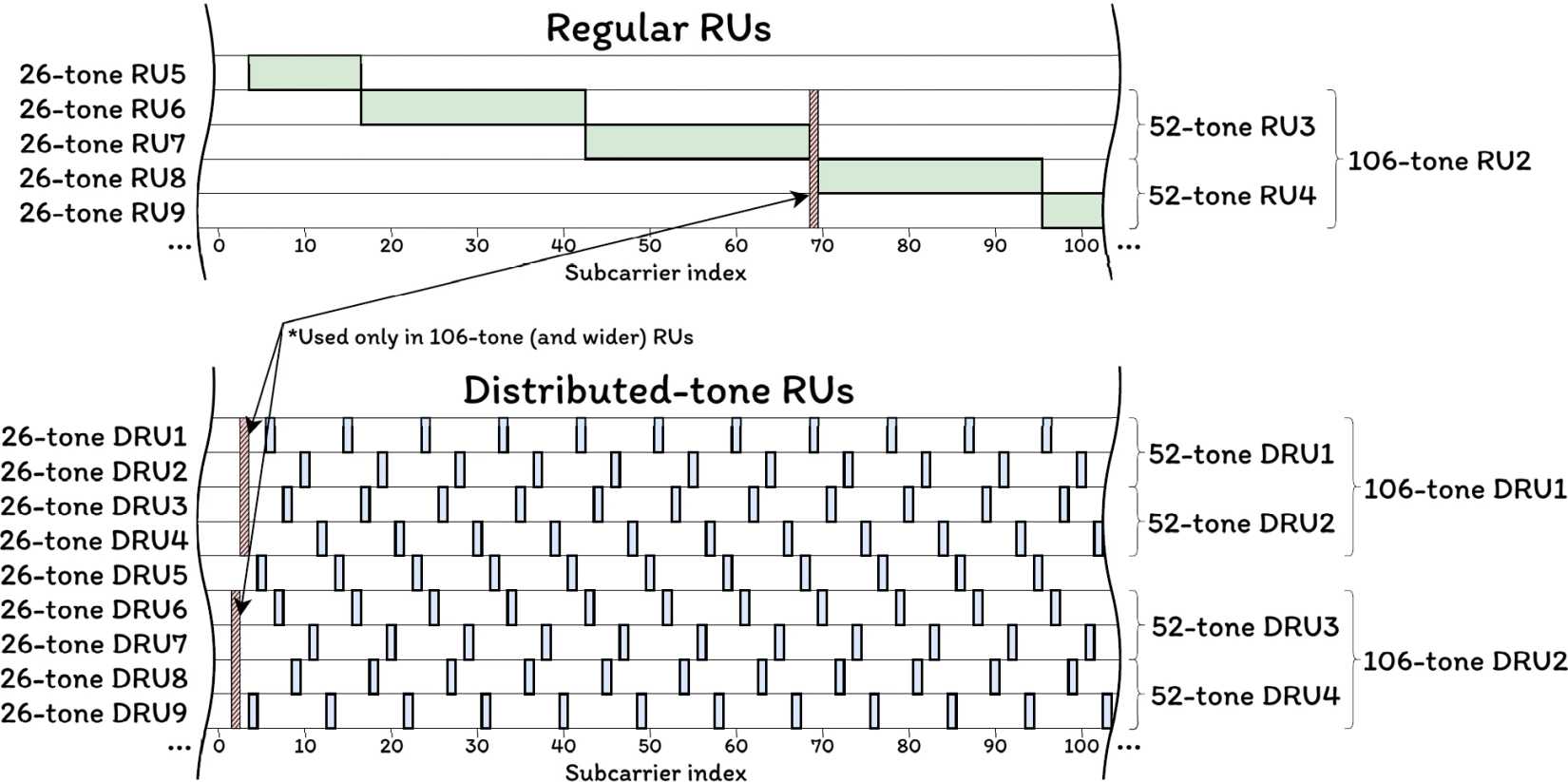
1. Distributed-tone Resource Units (DRUs)
Instead of bunching transmissions together, DRUs allow a device to spread its signal across a wider bandwidth. This allows for higher transmit power without breaking regulatory limits.
- Benefit: This is a game-changer for low-power smart home gadgets with weak antennas, providing them with a much more stable connection.
2. Interference and Modulation Tweaks
- Interference Mitigation Pilots: These act as "scouts" to help the network resist unexpected noise, especially in unlicensed frequency bands.
- Unequal Modulations: Rather than applying one setting to all, Wi-Fi 8 can adjust the modulation for each spatial stream individually based on its specific
SINR. - Enhanced MCS: New Modulation and Coding Schemes are being added to squeeze more efficiency out of the existing bandwidth.
3. Latency and Traffic Management
- P-EDCA: This feature prioritizes critical devices to speed up channel access without completely starving non-priority devices of bandwidth.
- Non-Primary Channel Communication: Devices can now communicate on non-primary channels even if the primary one is congested, preventing wasted airtime.
Seamless Mobility and Multi-AP Coordination
Wi-Fi 8 isn't just about the connection to a single router; it's about the entire ecosystem.
- Seamless Roaming: The standard aims for near-zero downtime when your device hops from one access point (AP) to another.
- Multi-AP Coordination: By leveraging new coordination features, Wi-Fi 8 improves the experience when a device is connected to multiple access points simultaneously.
The Big Picture: Wi-Fi vs. 6G
Wi-Fi 8 is positioning itself to compete with the next generation of cellular tech.
- Wi-Fi 8 Finalization: Expected
- 6G Arrival: Expected Early 2030s
Cellular networks are designed to handle thousands of devices in dense urban areas. By adopting a "reliability-first" mindset, Wi-Fi 8 is attempting to bring that same level of robustness to the home and office.

In a world where we have more connected devices than ever, the ability to maintain a steady, low-latency connection is far more valuable than a theoretical speed limit we will never actually reach.