RAG Is Simpler Than You Think
RAG Is Simpler Than You Think

By Rafael Pierre | June 10, 2026
"Nowadays, most people seem to over-engineer their RAG stack."
Many developers immediately dive into the deep end with vector databases, complex reranking pipelines, and embeddings. However, the end-user often just needs a simple answer, like "How do I reset my password?" The key to successful engineering is selecting the correct tool for the specific problem, rather than the most complex one.

🛠 Decision Factors
Before choosing a "recipe," evaluate your system based on these five criteria:
| Factor | Preference for Simple (Full-Text) | Preference for Advanced (Embeddings) |
|---|---|---|
| Data Freshness | Real-time updates/News | Stable corpus (Monthly/Quarterly) |
| Corpus Churn | High churn (>10% daily change) | Low churn |
| Query Style | Keyword-heavy | Semantic/Conceptual |
| Scale | queries per day | High volume |
| Team Skillset | General Software Engineering | Specialized ML Expertise |
Recipe 1: The MVP — Full-Text Search Only
This approach relies on the classic BM25 algorithm. It is highly effective when:
- Users search using specific keywords (e.g.,
"pandas merge dataframe"). - Your data contains highly specific, proprietary terminology.
The Advantage: You bypass the "chunking nightmare." When you start with embeddings, you are immediately forced to solve the chunk_size and overlap puzzle. With full-text search, you don't.

Recipe 2: Agentic Query Rewriting
Many "semantic search" failures are actually just query formulation problems. Users might say "fix bugs," while the documentation uses the term "debugging."
The Strategy
Use a lightweight LLM (like GPT-4o-mini) to transform a messy user query into a clean, keyword-optimized search string.
Capabilities of the Rewriter:
- Stopword Removal: "How do I..."
- Synonym Expansion: "car" "car automobile vehicle"
- Domain Translation: "speed up code" "optimize performance"
- Decomposition: "read CSV and plot"
["read CSV", "plot data"]
Cost: \approx \0.001$ per query.
The Agentic Loop
Instead of a single pass, you can implement a feedback loop:
def agentic_search(query, max_iterations=3):
    for i in range(max_iterations):
        # Rewrite query for optimization
        optimized = query_rewriter.rewrite(query, iteration=i)
        # Execute keyword search
        results = bm25_search(optimized)
        # Evaluate the quality of the retrieved docs
        quality = evaluate_results(results, query)

        if quality > threshold:
            return results

        # Learn from failure and try again
        query = refine_based_on_feedback(query, results, quality)
    return results
The "Proprietary Terminology" Problem
General embedding models are trained on the open web. If your company has a tool called "Atlas," a general model sees: (Similarity )
By using a system prompt for query rewriting, you can force exact matches:
system_prompt: "Preserve these internal terms exactly: Atlas (data framework), Mercury (messaging), Zeus (auth)."
Result: Atlas batch jobs Perfect BM25 Match
Recipe 3: Hybrid Search (Sparse + Dense Reranking)
This is a two-stage pipeline: use BM25 to grab a wide net of candidates (top 50-100), then use embeddings to rerank the top 10.
When to deploy this:
- Users are asking conceptual questions (e.g., "find alternatives to X").
- You have data proving that query rewriting isn't enough.
- Your corpus is relatively stable.

The Math (Cost):
Using text-embedding-3-small at \0.02 per 1M tokens:
$$\text{50 docs} \times \text{500 tokens} = 25,000 \text{ tokens}$$
$$\text{Cost} = 25,000 \times \0.00002 \approx $0.0005 \text{ per query}$$
Note: The primary trade-off here is latency, not cost. Also, the chunking problem returns.
Recipe 4: On-The-Fly Embedding
Pre-embed everything and store it in a vector DB.
Instead: Embed only the candidates retrieved by the search engine at runtime.
When to use this:
- High Churn: More than 10% of your documents change daily.
- Experimentation: You want to test different embedding models without re-indexing.
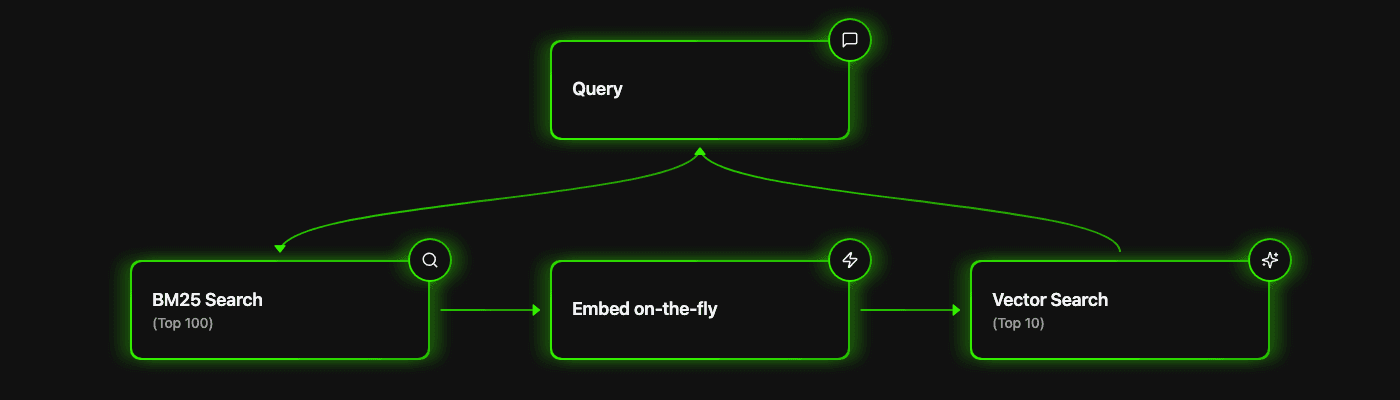
The Economics (1,000 queries/day, 50 docs/query):
- Monthly Cost: \approx \15$
- Storage: \0$ (Text only)
- Latency:
- Freshness: Instant
The "Model Deprecation" Nightmare:
When OpenAI moved from text-embedding-ada-002 to text-embedding-3, anyone who pre-embedded 10 million documents had to:
- Re-embed all 10M docs.
- Update the vector database.
- Run regression tests.
- Manage the cutover period.
With On-The-Fly Embedding, you simply change one API call.
