The Teaser Period: Why the AI Boom Is Hitting a Reset Wall
The Teaser Period: Why the AI Boom Is Hitting a Reset Wall
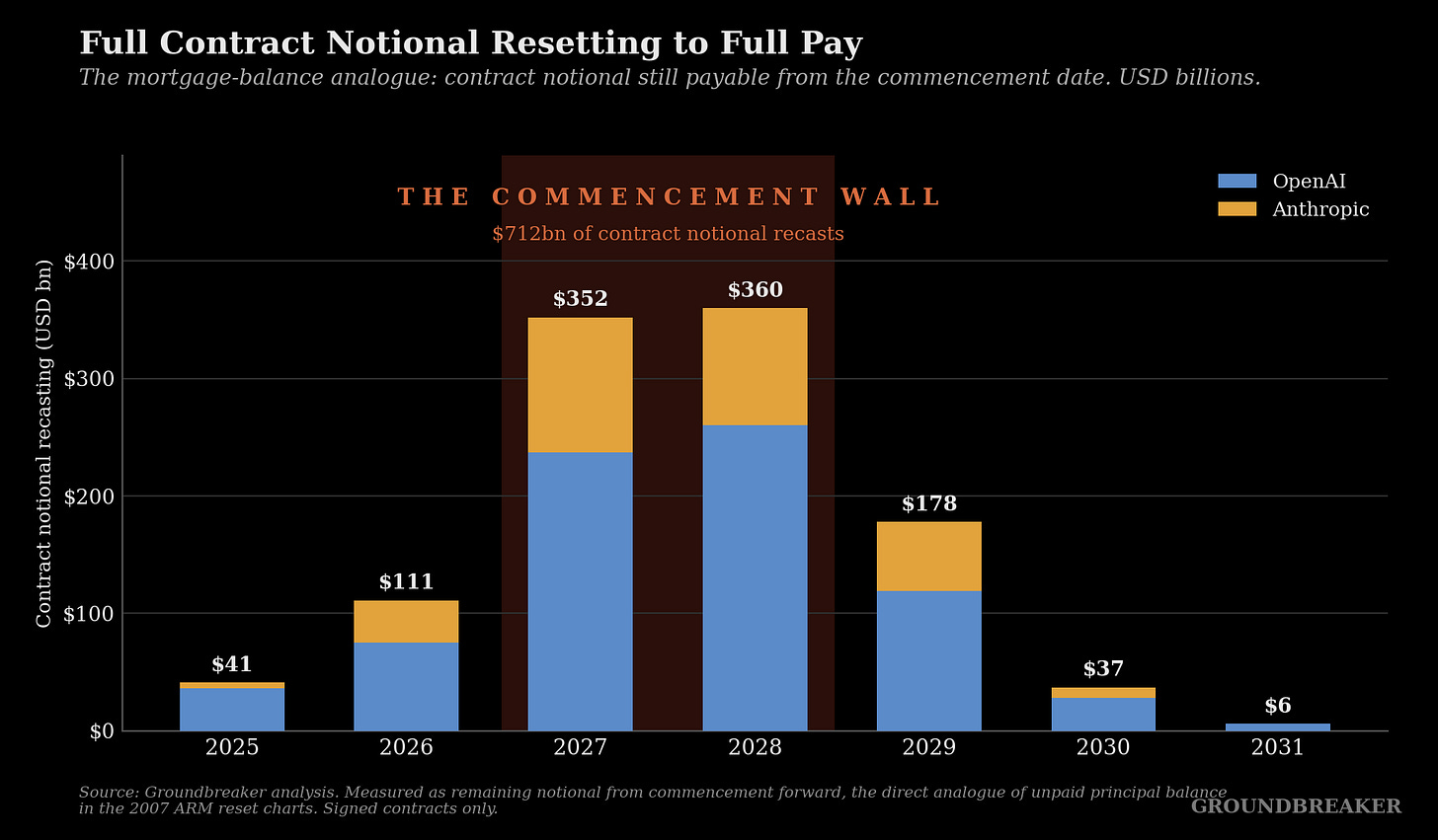
Trillions in compute commitments are scheduled to come due between 2027 and 2028.
The underlying mechanics of the current AI surge reveal a structural fragility—a "reset wall"—that dictates exactly how and when the boom could break.
I. The Ghost of 2006
In the summer of 2006, the surface of the financial world looked pristine. Credit spreads remained tight, ratings were stable, and the machinery of securitization was operating at peak efficiency. If you had polled a trading desk on whether the US mortgage market was on the verge of collapse, the response would likely have been laughter.
The danger was hidden in the 2/28 ARM (Adjustable Rate Mortgage). These loans featured:
- A low, fixed "teaser" rate for the first two years.
- A subsequent reset to a payment that was to higher.
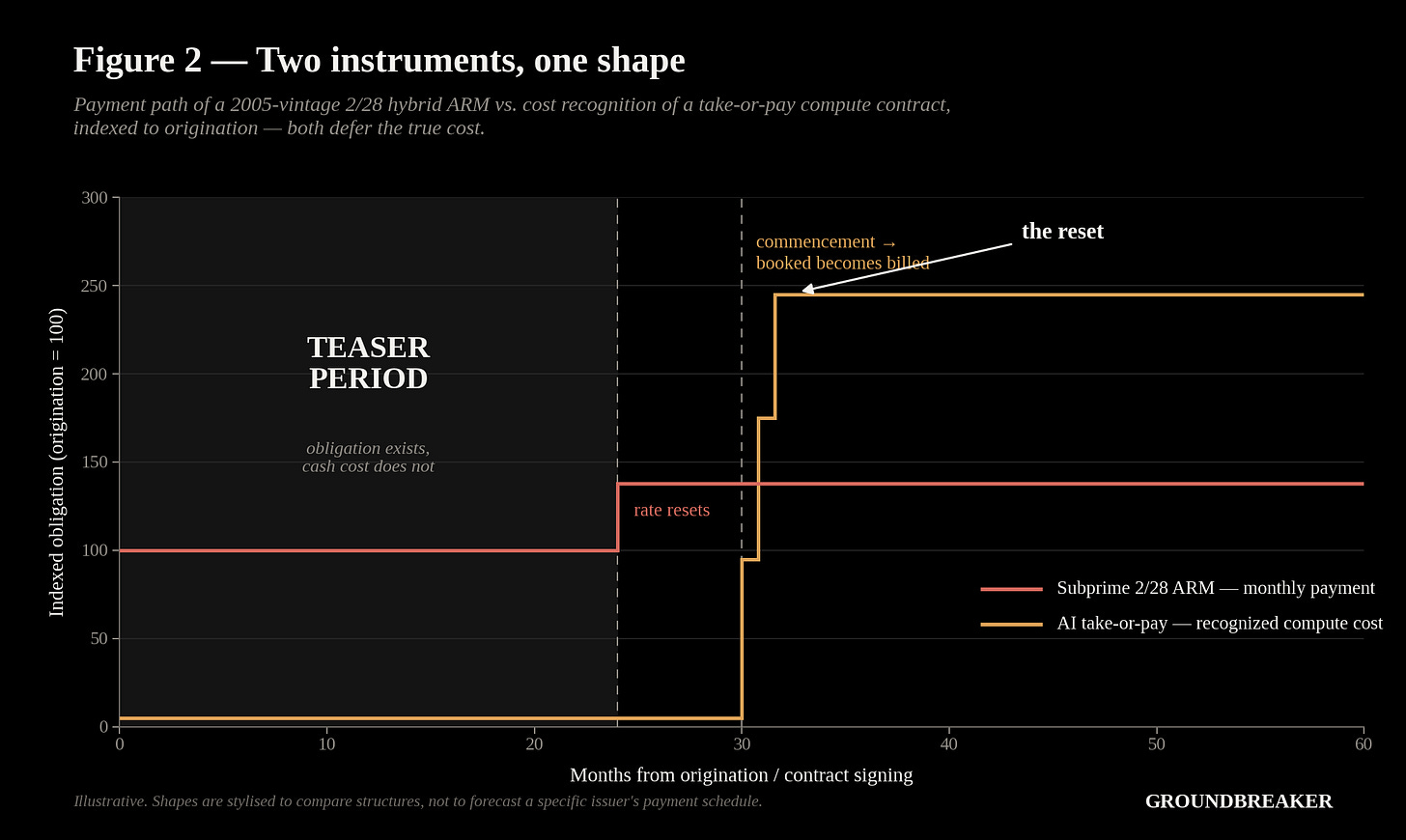
During the initial 24 months, these loans looked like gold: borrowers paid, servicers collected, and bonds paid their coupons. The entire ecosystem—housing, lending, and securitization—was operating within the teaser period.
The Reset Wall
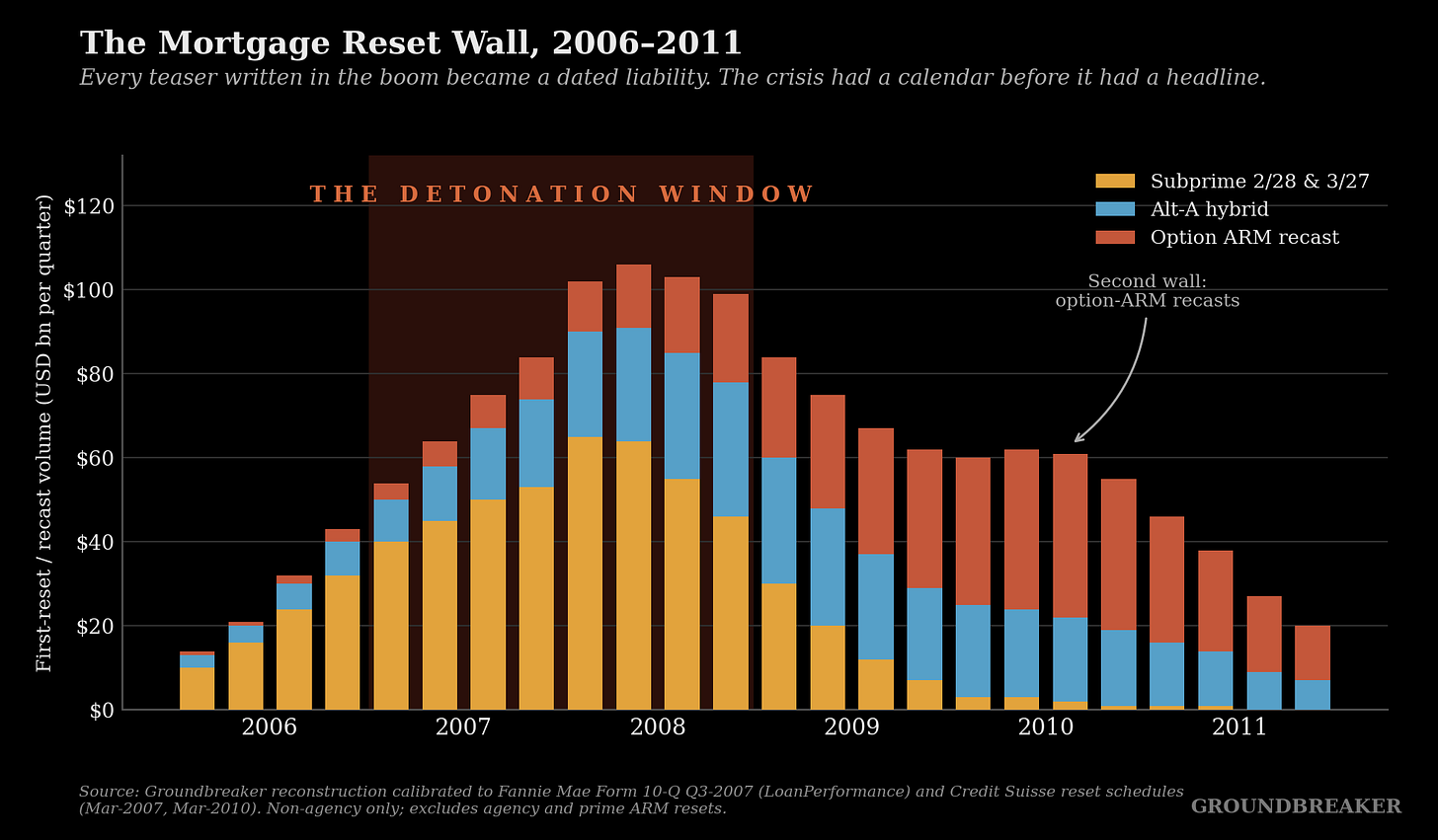
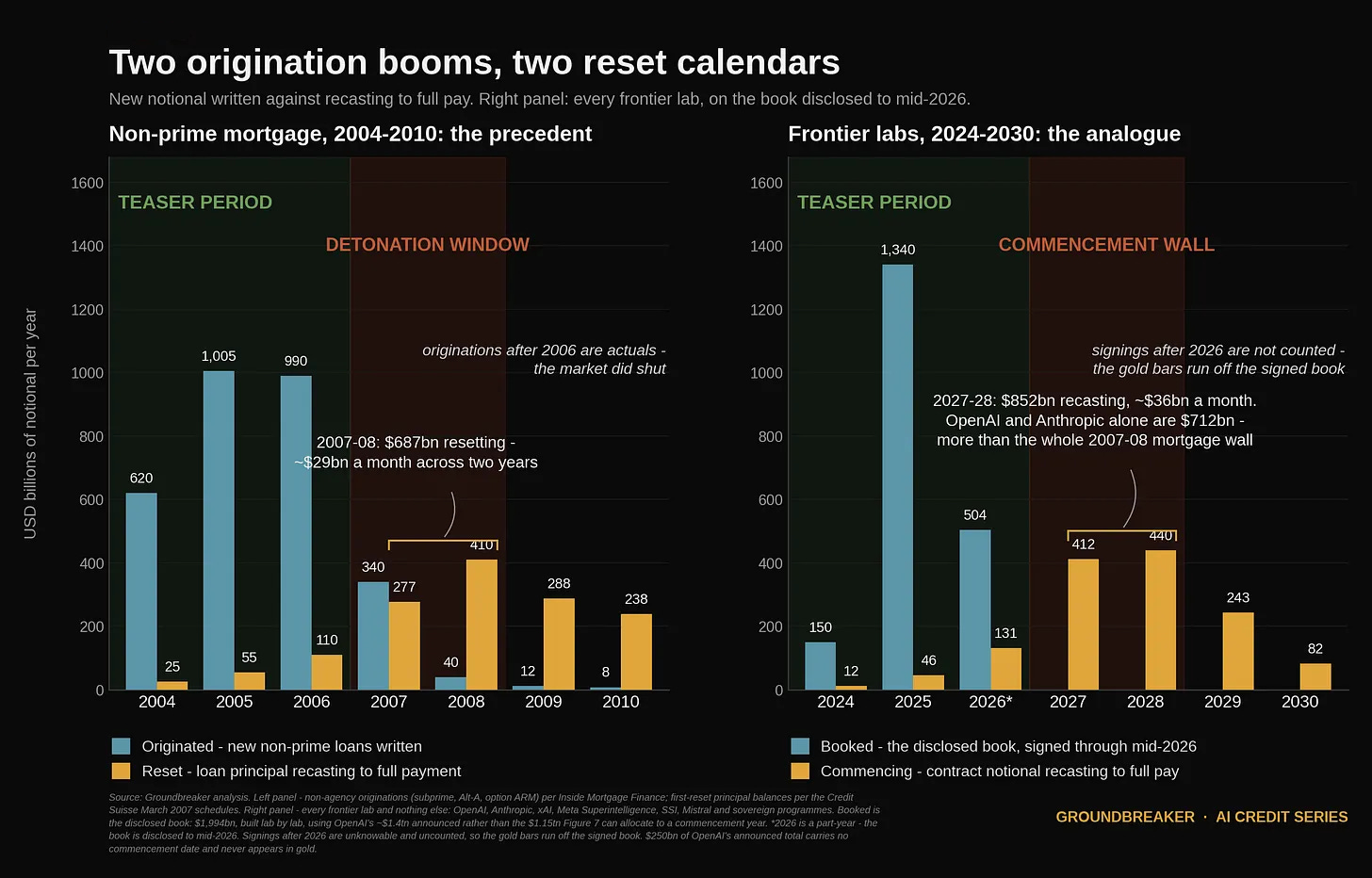
Every single reset was a contractual certainty from the day the loan was signed. When you aggregate these schedules, you find the "reset wall." Roughly **1 trillion** in subprime mortgages were slated to reset in 2007 and 2008, peaking at \30–$40 billion per month.
"Over 80% of recent subprime originations... were two- or three-year adjustable-rate products. The average subprime borrower’s mortgage payments already consumed roughly 40% of their gross income at the teaser rate." — Comment letter to the FDIC
The math was simple: . Almost no borrower could afford the new rate. Yet, the market kept buying because of a shared delusion: home prices would rise, allowing borrowers to refinance into a new teaser before the old one expired.
We often describe the 2008 crash as a black swan or a "hundred-year flood." In reality, it was a scheduled mathematical consequence.
II. The AI Parallel: Compute as the New Subprime
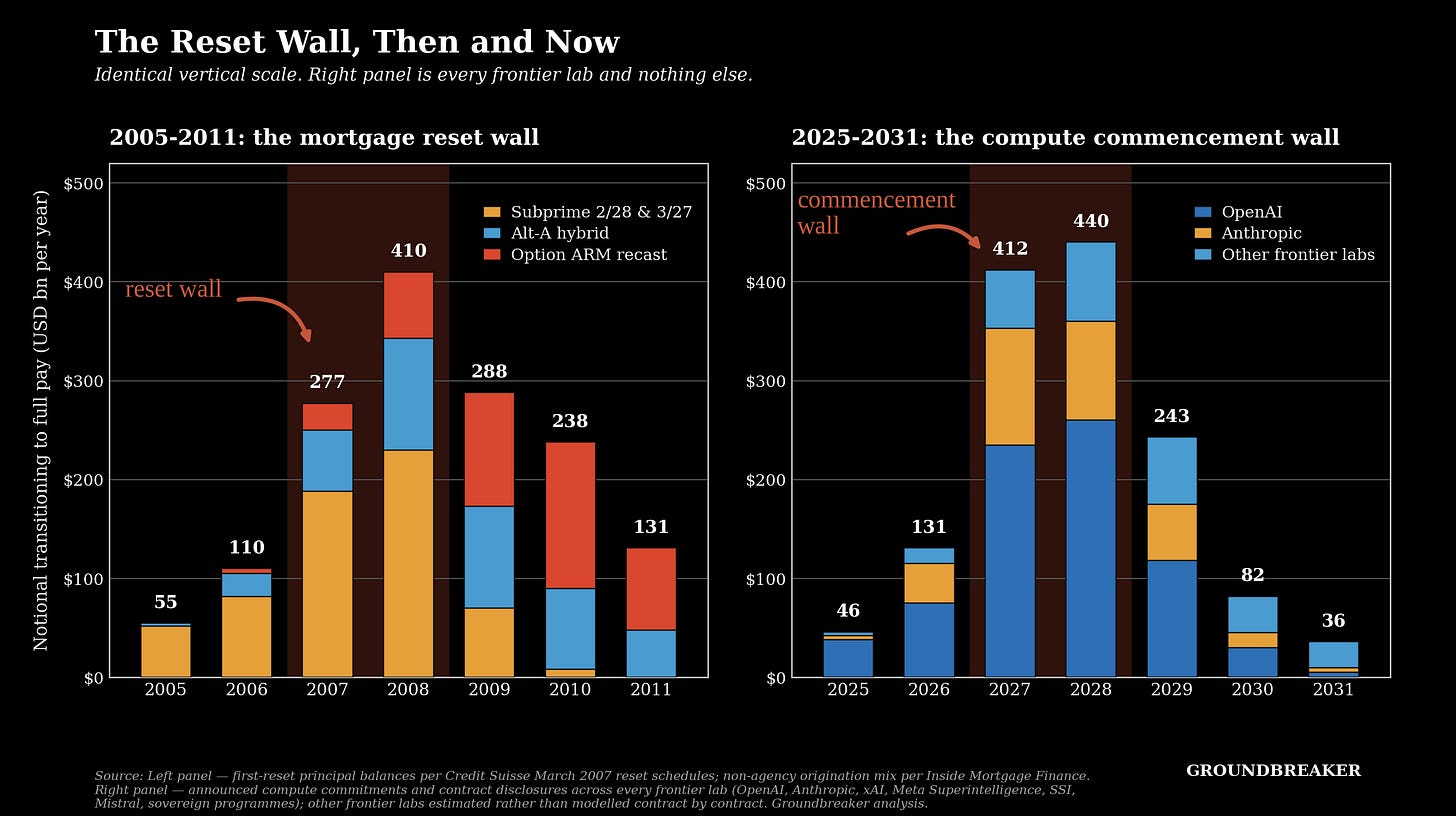
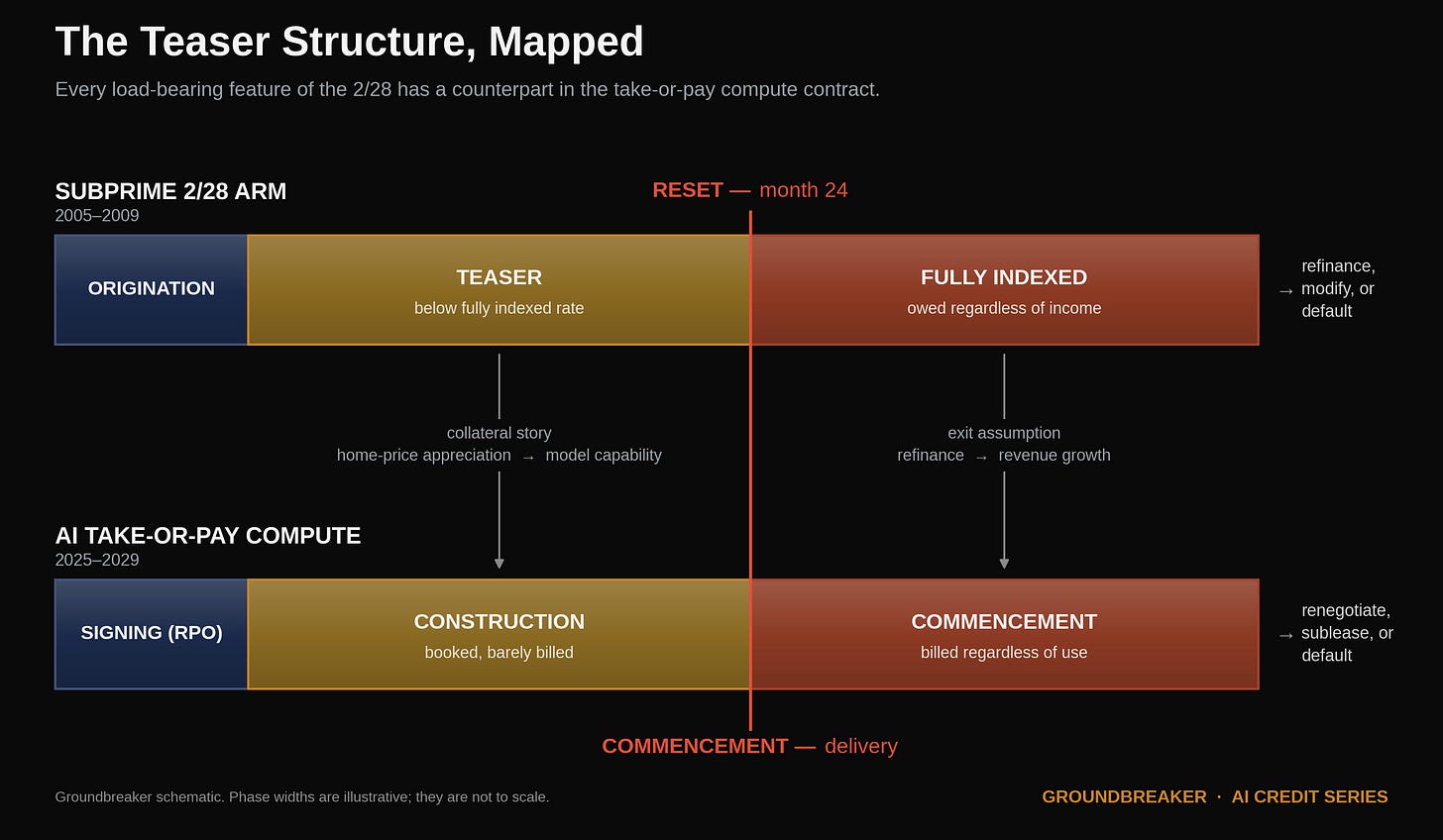
The AI boom has replicated this exact financial architecture. The market is once again underwriting a "teaser," hiding a reset wall within the trillions of dollars in compute contracts signed by frontier labs (like OpenAI) since 2024.
The "Take-or-Pay" Instrument
The core of the AI build-out is the take-or-pay compute contract. This instrument has a critical, unpriced feature: payments do not start at signing.
The timeline looks like this:
- Signature: Lab commits to multi-year capacity.
- Construction: A 24-to-36 month gap for siting, powering, and building gigawatt-scale campuses.
- Commencement: The data center is energized, capacity is accepted, and billing begins.
This construction interval is the modern teaser period.
The Financial Disconnect
Currently, the four largest US cloud providers hold over $2.3 trillion in remaining performance obligations (RPO) and contracted backlogs.
| Entity | Metric | Observation |
|---|---|---|
| Cloud Providers | RPO Growth | Oracle's RPO grew by in one fiscal year. |
| Frontier Labs | Expenses | No current expense is booked because the capacity doesn't exist yet. |
| The Market | Valuation | Capitalizes "booked" numbers as revenue; ignores "billed" numbers. |
The Absurdity of Scale
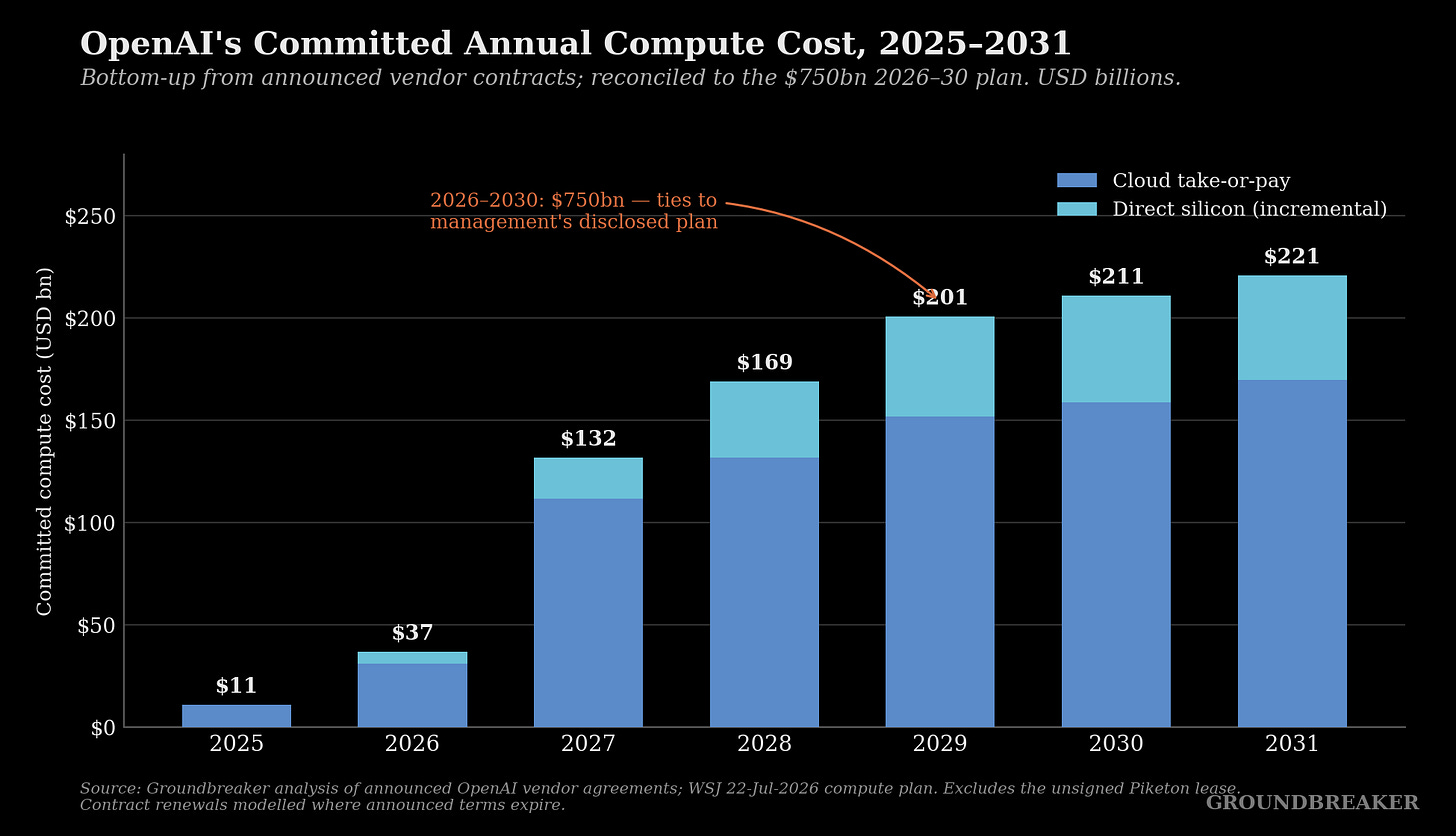
How can OpenAI, with roughly \40\text{B}$1.4\text{T}$ in compute?
It is the same logic as a household earning \60,000$600,000$ mortgage:
- The Borrower's Logic: "I don't have to pay the full amount yet."
- The Market's Logic: "Growth will arrive before the payment does."
The lab's defense is: By the time the capacity is delivered, my revenue will have scaled to meet the obligation.
III. Anatomy of a Teaser Contract
To understand the lifecycle, consider this hypothetical (yet representative) arrangement based on deals between OpenAI, Oracle, Anthropic, Google, Meta, and CoreWeave.
# Hypothetical Compute Contract Structure
contract_value = 12_000_000_000  # $12 Billion
duration_years = 10
construction_lag = 2 # The "Teaser" period in years

def calculate_payment_status(current_year):
    if current_year <= construction_lag:
        return "Status: Booked (No Billing)"
    else:
        return "Status: Billed (Take-or-Pay Active)"

# Year 1: Market celebrates the $12B RPO
# Year 3: The 'Reset Wall' hits; payments become mandatory regardless of use.
The Critical Risks
For the AI boom to avoid the fate of 2008, the following must be achieved before 2027:
- Massive scaling of AI-driven revenue.
- Sustained demand for compute that exceeds the "take-or-pay" minimums.
- Avoidance of a "compute glut" where capacity exceeds utility.