Dad's Custom Atari Peripherals – By Jim Trageser
Engineering a Childhood: Dad's Custom Atari Peripherals
By Jim Trageser
Originally published as a guest post for Goto 10: Retro Computing.
For more insights from the author, visit his Substack, Lost in Cyberspace.
🛠️ The Engineering Pedigree
Jim's father wasn't your average hobbyist; he was a high-level engineer for an Air Force contractor during the '60s and '70s. His professional achievements included:
- Designing the inaugural air-collision avoidance system (for which he held the patent).
- Developing an early version of a transonic airspeed indicator.
Given this background, it was entirely expected when a computer kit appeared in the family basement.
The First Machine: CMOS KIM-I
The "kit" wasn't a box of parts in the modern sense. Instead, it consisted of a check sent to the company and a massive blueprint schematic detailing how to construct the 6502-based computer.
To make the machine functional for the home, Dad added:
- An RF output connected to a small 11-inch RCA television.
- A serial port connected to a surplus Teletype machine.
 Jim Trageser with the CMOS KIM-I kit computer.
🕹️ The Evolution of Home Gaming
The family's journey into gaming followed a specific trajectory:
Fairchild Channel F Atari 400
The Fairchild was a milestone as the first system to utilize software cartridges. However, after moving to California, the family upgraded to the Atari 400. Initially, this system relied on a cassette drive, characterized by its distinctive, loud beeping during program loads. One early favorite was an unlicensed Star Trek game where players scanned sectors for Klingons.
Once a floppy drive was integrated, Jim began investing his own money—earned from flipping burgers—into a growing library of software.
The "Joystick Killer"
While many games were fun, Epyx’s Summer Games presented a physical challenge. The 1,500-meter race was particularly brutal. To maintain top speed, the player had to rock the joystick left and right incessantly.
"It took 3.5 to 4.5 minutes to finish this game, by which time your hand was bruised and your arm numb."
The physical strain can be thought of as a function of frequency () and force () over time ():
Even a Wico Command Control "batstick" couldn't solve the problem; as the arm fatigued, the player would accidentally push the stick vertically, breaking the rhythm.
🔧 The Custom Hardware Solutions
To combat the "Joystick Killer," Jim's father utilized his engineering skills to create custom interfaces.
Comparison of Custom Controllers
| Controller | Origin | Key Features | Result |
|---|---|---|---|
| Arcade Stick | Surplus Game Cabinet | Red metal ball, 2 red buttons, rubber feet | Success: No more blisters! |
| Mercury Stick | Industrial/Work Surplus | Honeycomb plastic, mercury tubes | Failure: Too slow to react |
| Fairchild Mod | Fairchild Channel F | Rewired for Atari | Failure: Too fragile |
The Arcade Conversion
Dad found a joystick from an old cabinet at a surplus shop, complete with its original panel (approx. 14" x 4"). He built a dedicated case with rubber feet and wired it to an Atari plug. This "bad boy" sat firmly on the table, allowing the kids to conquer Decathlon and Summer Games without needing to brace the controller between their legs.
The Motion Controller
Another experiment involved a black, honeycomb-patterned device that used mercury tubes to detect tilt. While technically impressive, its latency made it impractical for gaming. (A later comment by Brian Hall identified this as the "Le Stick" by Datasoft).
The Keyboard Masterpiece
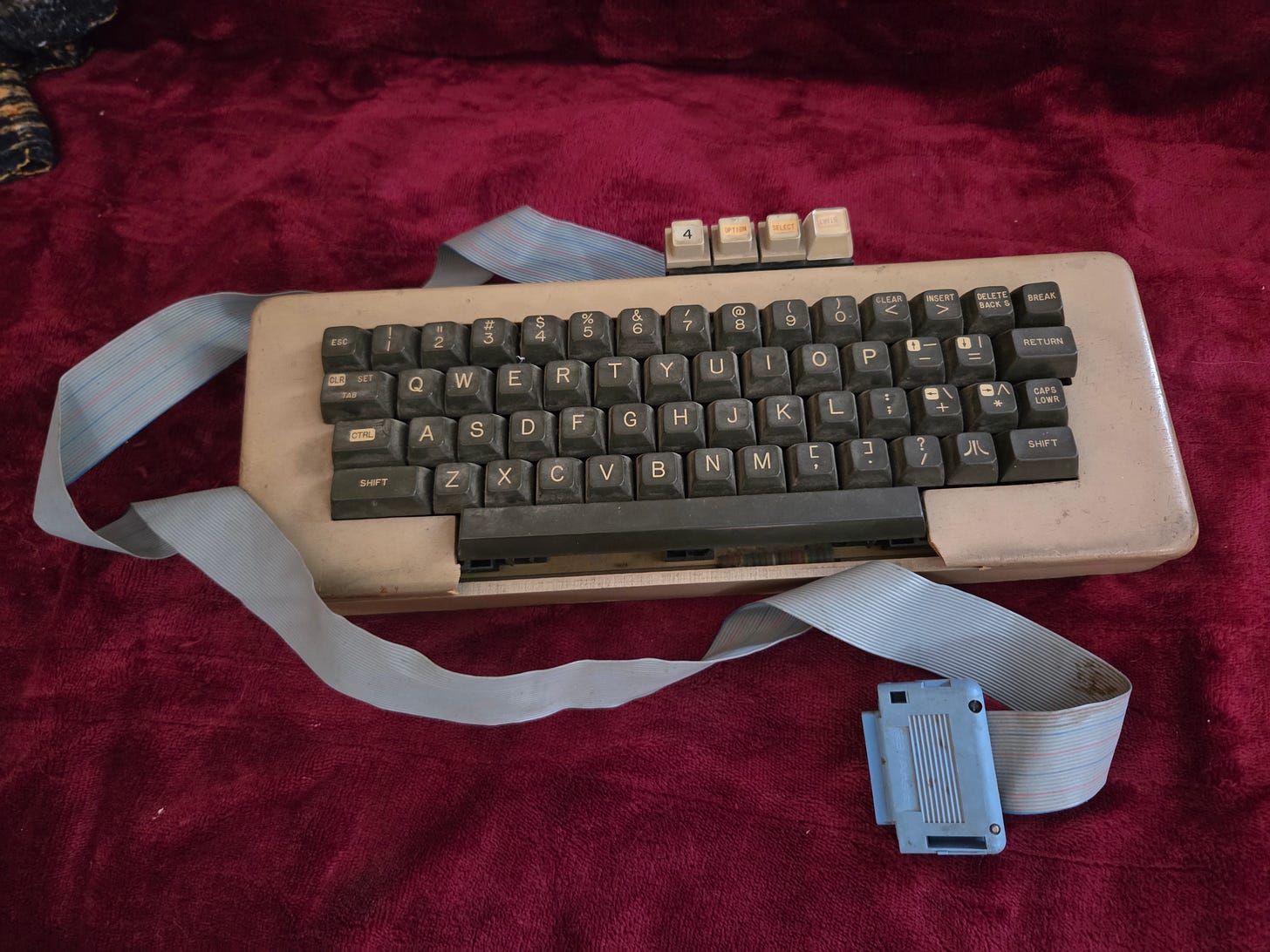
The most ambitious project was the keyboard modification. Dad took a surplus Atari 800 keyboard, crafted a custom housing, and linked it to the Atari 400 using a Centronix 24-pin parallel cable.
To achieve this, he performed "surgery" on the Atari 400 chassis:
# Conceptual modification steps:
1. Cut hole in left-side chassis
2. Install serial connector on motherboard
3. Connect 24-pin parallel cable to custom 800 keyboard
Jim used this custom setup to type the majority of his college assignments during his first two years.
🏛️ Legacy and Preservation
Today, these unique pieces of hardware are stored within the Computer Museum of America collection at San Diego State University (SDSU).
Current Status of the Collection:
- Locate the custom arcade joystick
- Find the mercury motion controller
- Retrieve the Atari 800 keyboard mod
- Photograph all items for documentation
If Jim finds them during his cataloging efforts, he intends to share photos.
💬 Community Reflections
The story sparked a conversation among retro enthusiasts:
Sung J. Woo:
"I don't know whether your dad was the greatest dad or the greatest engineer... the membrane keyboard was the reason why I didn't get a 400."
Brian Hall:
"The mercury stick was called Le Stick by Datasoft... that was my secret weapon for [Decathlon]."