Aging Brains Blend Memories Together Instead of Just Forgetting Them
Memory Fusion: Why Aging Brains Blend Details Instead of Just Forgetting
When an elderly relative is absolutely certain they left their keys with a specific grandchild in a specific room on a specific Tuesday—yet every single detail is wrong except for the fact that keys were involved—it feels like a lapse in memory. However, it might actually be something more complex.
"That kind of confident mix-up may not be simple forgetfulness."
Recent neuroimaging research suggests that as we age, the brain's mechanism for securing memories doesn't just fail; it begins to blend unrelated experiences together.

The Core Discovery: Blending vs. Blanking
A study published in Cerebral Cortex explored how the hippocampus—the brain's primary memory hub—functions across different age groups. The researchers found that memory accuracy for pairing faces with objects or scenes drops significantly after young adulthood. Interestingly, the decline isn't a steady slope; middle-aged and older adults performed similarly.
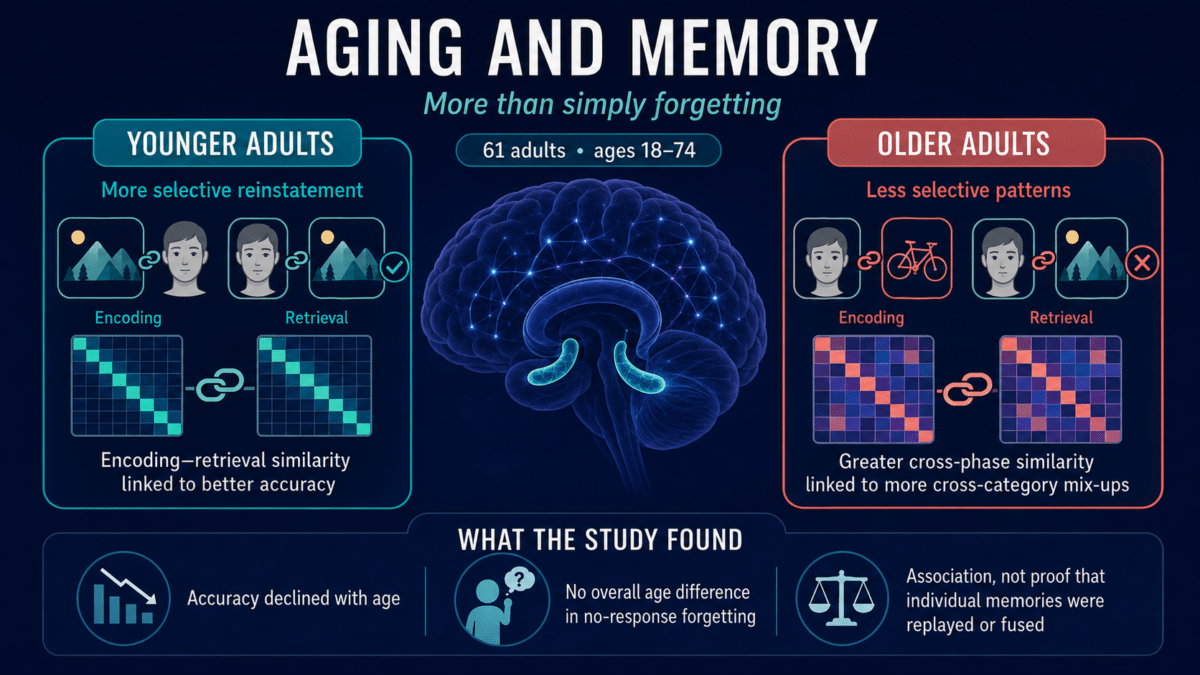
The most striking finding was the nature of the errors. While younger brains either remember correctly or forget, older brains often experience cross-category confusion. This means they don't just forget a detail; they replace it with a detail from a completely different category (e.g., recalling a scene when the original memory was an object).
Memory Processing Comparison
Experimental Design: How the Study Worked
Researchers led by Ian M. McDonough (Binghamton University) utilized MRI scans to track "activity fingerprints" in the hippocampus.
Participant Demographics
| Age Group | Age Range | Number of Participants |
|---|---|---|
| Younger Adults | 18–30 | 17 |
| Middle-Aged Adults | 50–60 | 21 |
| Older Adults | 61–74 | 23 |
| Total Analyzed | — | 61 |
The Testing Protocol
The participants underwent a rigorous multi-stage process:
- Baseline Scan: A resting state scan with eyes closed.
- Learning Phase: Participants viewed a face paired with either an object or a scene. To enhance encoding, they were told to imagine the person interacting with the item.
- Post-Learning Rest: A second period of stillness inside the scanner.
- Recall Test: A face was shown alongside four options (two objects, two scenes). The participant had to identify the correct original pair.
Analyzing the "Brain Fingerprint"
The scientists looked at the similarity between brain activity during the learning phase and the recall phase. In mathematical terms, they were looking for a correlation where:
The Divergent Results
The impact of this similarity differed wildly based on age:
- Younger Adults: High similarity High Accuracy. The brain faithfully replayed the specific memory.
- Older Adults: High similarity Increased Errors. Specifically, it predicted "cross-category" mistakes.
Essentially, the older brain was retrieving information too broadly. Instead of a laser-focused retrieval, it was like a wide-net cast that pulled up unrelated fragments of experience and stitched them into a false connection.
# Conceptual logic of the aging brain's retrieval error
def retrieve_memory(age, pattern_similarity):
    if age == "young":
        return "Accurate Memory" if pattern_similarity == "high" else "Forgot"
    elif age == "older":
        return "Cross-Category Blend" if pattern_similarity == "high" else "Forgot"
Beyond Simple Brain Shrinkage
One might assume that this blending is simply a result of the brain getting smaller. While it is true that hippocampal volume declines with age, the researchers found that volume alone did not explain the shift.
Even when accounting for brain shrinkage and differences in attention, the trend remained: older adults' brains were using the same "similarity" patterns that helped young people, but those patterns were now triggering the wrong types of memories.
Summary of Findings
- Accuracy: Drops sharply after young adulthood.
- Error Type: Older adults are prone to blending categories (Object Scene).
- Mechanism: The hippocampus retrieves too broadly rather than failing to retrieve.
- Physicality: Brain volume is a factor, but not the primary cause of the "blending" phenomenon.