The race to engineer new knobs for the human brain
The Race to Engineer New Knobs for the Human Brain
By Patrick Mineault | September 02, 2026
I was genuinely stunned to discover that chemogenetics had already entered the realm of human clinical trials.
At its core, chemogenetics is a sophisticated methodology that allows scientists to modify particular neurons, enabling them to be manipulated remotely via drugs that are otherwise biologically inert.
During the BRAIN Initiative conference on August 13th, Bryan Roth—one of the pioneers of this technology—revealed that he had identified seven active clinical trials utilizing chemogenetics within China. This announcement sparked a wave of excitement across trade publications: the idea that "sci-fi" neuroscience tools are finally being transitioned to human patients to treat conditions like Parkinson’s disease, epilepsy, and chronic pain.
Understanding the Tech: DREADDs vs. Optogenetics
To understand chemogenetics, it helps to compare it to its cousin, optogenetics. While both involve engineering neurons, their "triggers" differ:
| Feature | Optogenetics | Chemogenetics (DREADDs) |
|---|---|---|
| Trigger | Light | Designer Chemicals |
| Mechanism | Light-sensitive microbial genes | Synthetic receptors |
| Delivery | Requires implanted light source | Systemic drug administration |
| Control | High temporal precision | Titratable via dosage |
DREADDs (Designer Receptors Exclusively Activated by Designer Drugs) function by expressing a synthetic receptor in a neuron. Once present, the neuron can be either excited or inhibited by a specific designer chemical. This creates a genetically targeted therapy where the effect can be "dialed in" by adjusting the amount of the chemical administered.
The Brain Manipulation Toolbox
Since my graduate school days, our ability to intervene in the human brain has expanded significantly. We can categorize these tools as follows:
- Non-Engineering Interventions:
- Small molecule drugs
- Electrical/Magnetic stimulation:
DBS,tDCS,TMS,ECT - Sensory environment shifts (e.g., anti-CGRP for migraines)
- Focused ultrasound (Ablation High intensity; Modulation Low intensity)
- Neuronal Engineering (Changing the cells):
- Optogenetics (currently limited to the retina)
- Chemogenetics
- Gene-editing therapies
- Cell therapies
The Current Frontier: Clinical Trials in China
Based on Bryan Roth's research into Chinese clinical databases, the current landscape looks like this:
- Total Trials: 7
- Target Indications:
- Pain
- Parkinson’s Disease
- Epilepsy
- Patient Scale: patients (some trials are still in pre-recruitment).
Case Study: Tackling Epilepsy
Epilepsy is characterized by focal runaway excitation—essentially an electrical storm in a specific part of the brain. For those with refractory epilepsy, the results are devastating:
- Risk of personal injury.
- Inability to drive or maintain employment.
- Potential for sudden unexpected death.
Traditional treatments are coarse. Current first-line treatments, such as benzodiazepines (e.g., Valium), work by potentiating GABA receptors globally. This suppresses activity across the entire brain to stop the seizure.
The Chemogenetic Alternative: Instead of a global shutdown, we can target only the focal point of the seizure.
The Workflow of a DREADD Intervention:
In these trials, the synthetic receptor used is hM4Di. This is a modified version of the human muscarinic receptor type 4 (which usually handles acetylcholine). Instead of acetylcholine, hM4Di binds to CNO or clozapine, triggering a G-protein-mediated cascade that inhibits the neuron.
Safety, Precision, and Logic
While we await the results of these human trials, the underlying logic is supported by pre-clinical data. In non-human primates, a similar system successfully attenuated seizures in the motor cortex induced by bicuculline (a GABA antagonist).
The primary advantage of chemogenetics over permanent gene editing is reversibility.
"By placing the circuit modulation under the control of an exogenous ligand, chemogenetics mitigates the potential risk of overdosage intrinsic to viral-vector mediated gene therapy." — Towards Precision Medicine (2026)
Essentially, if the treatment causes adverse effects, the clinician can simply stop the medication.
Summary of Potential
Any neurological disease that could be solved by precisely or in is a candidate for this technology. While the current trials are a start, they are not yet as precise as the technology allows.
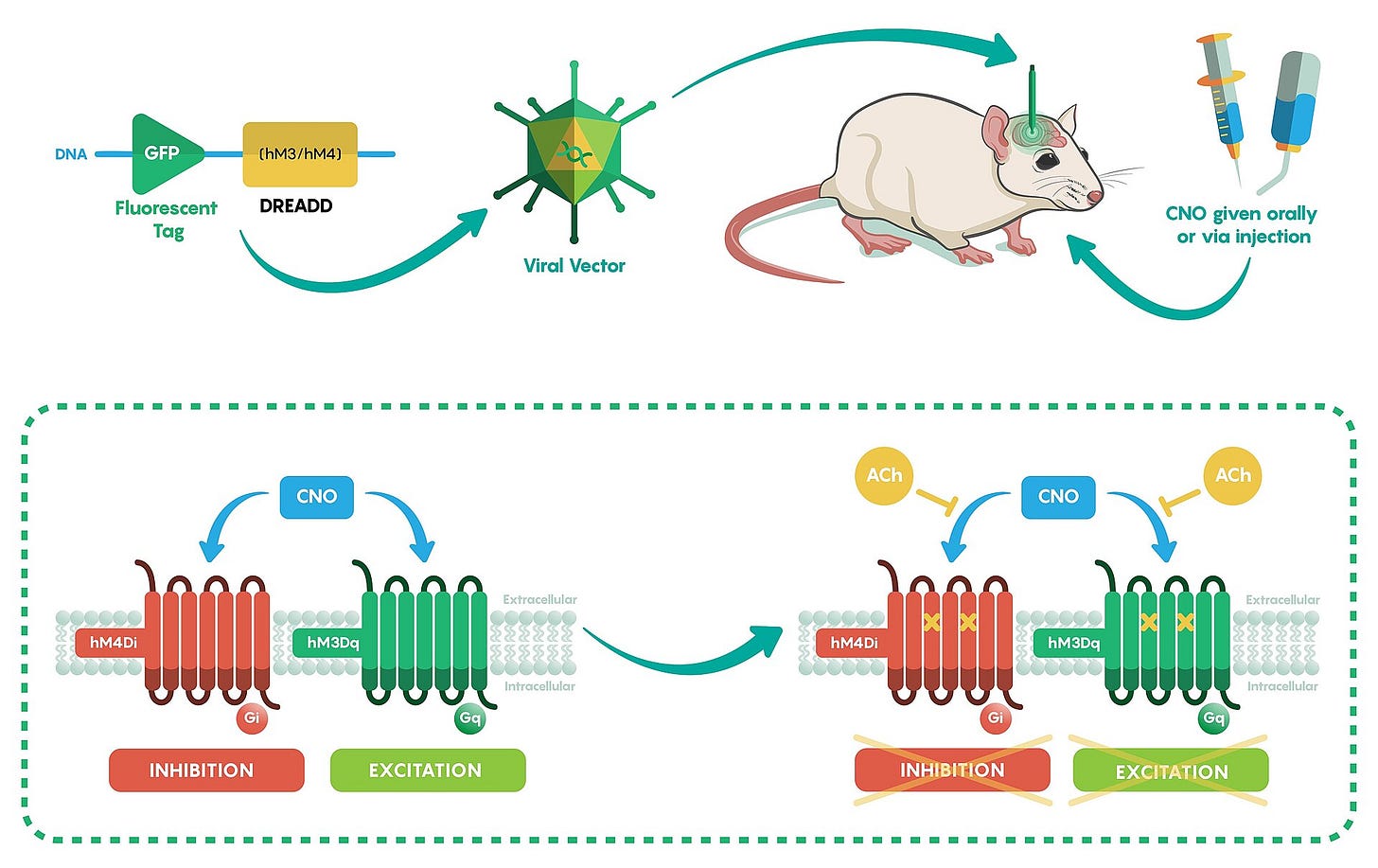 An illustration of DREADDs in basic research.
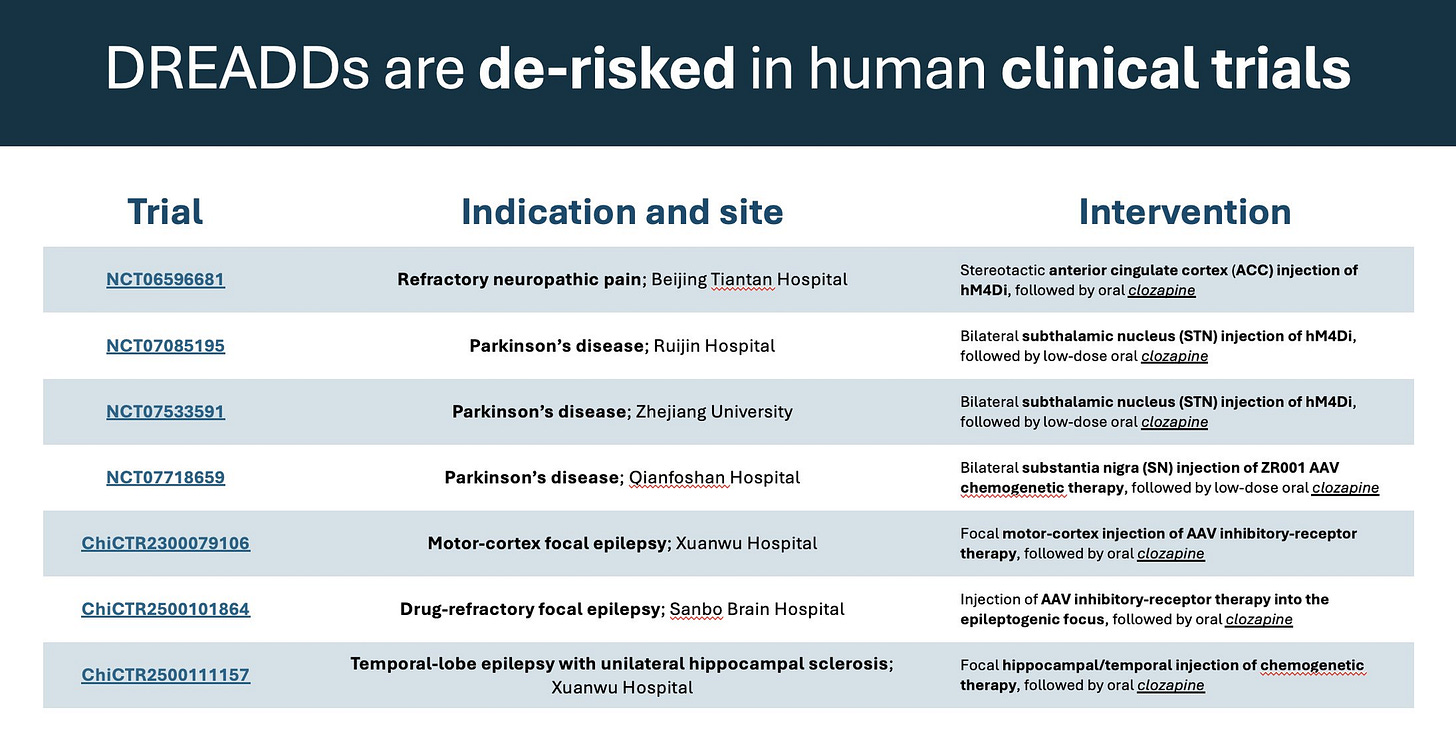 Data shared by Bryan Roth at the BRAIN Initiative meeting.
Coming Next: I will explore a competing approach to CNS treatment: cell therapy.