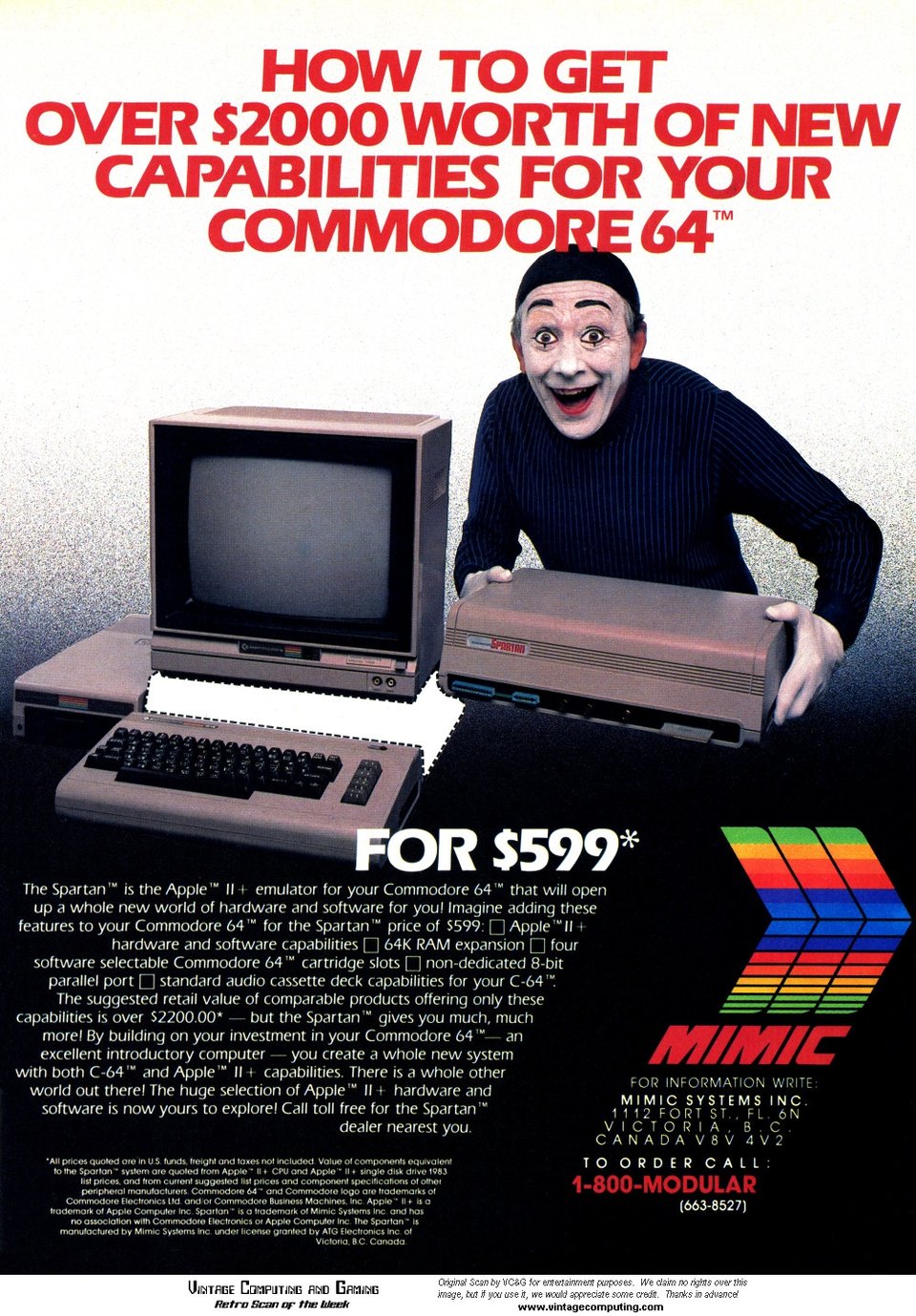
A bizarre Commodore 64 peripheral, a mime, and some pretty bad ads
The Surreal Saga of the Spartan: Mimes, Bad Ads, and a C64 Oddity
For two full years, the tech world was subjected to a series of unsettling advertisements featuring heavy makeup and vacant smiles—all before the public ever touched the actual hardware from Mimic Systems Inc.
"Sir, we don’t have a prototype or a price for the Spartan ad." "But we do have a mime." — TPUG Magazine, Nov '84

🤡 The Marketing Nightmare
Mimic Systems began a relentless advertising campaign across nearly every Commodore 64 (C64) publication. The strange part? They had nothing to sell yet. For nearly two years, the only thing they offered was a mime.
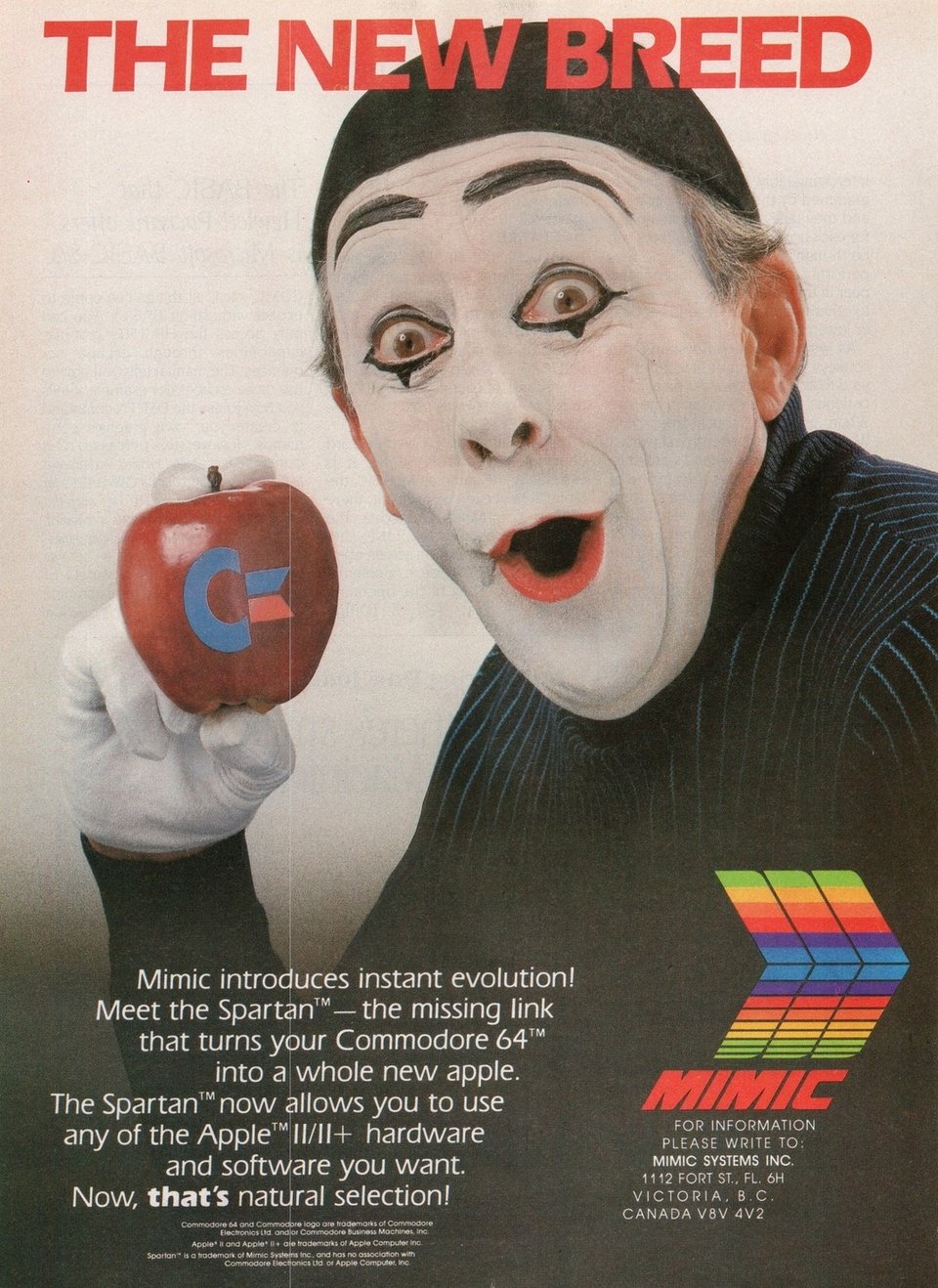
The ads grew increasingly bizarre. One particular campaign featured:
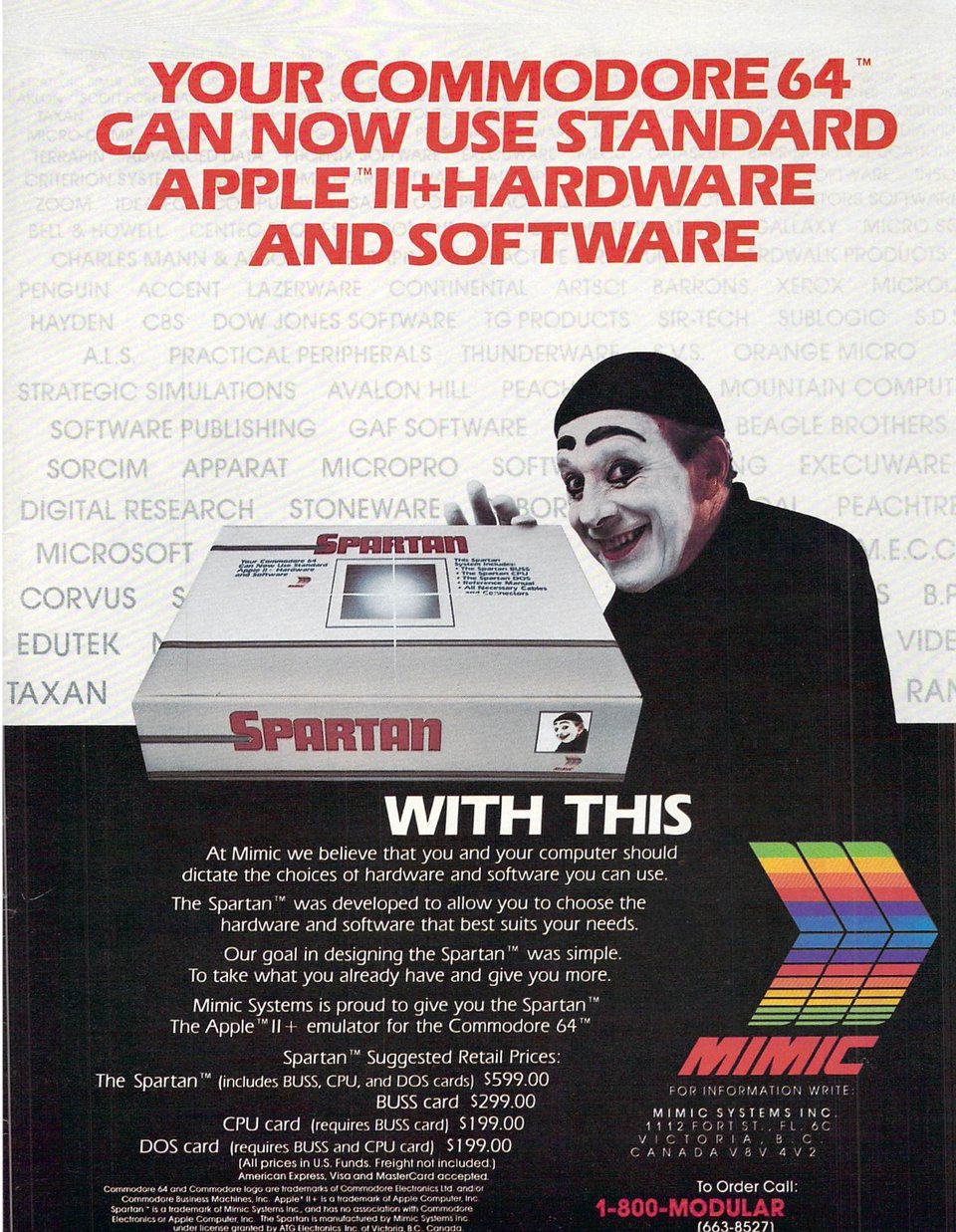
- Jarring Layouts: Poor alignment and a lack of ellipses in the red header text.
- Visual Choices: A mime in whiteface posed against a stark white background.
- Confusing Context: Semi-transparent grey text listing a random assortment of competitors and peripherals (including Corvus hard drives).
- The Final Touch: The mime's face was actually printed on the product packaging.
(Note: Extensive research confirms the mime is not Billy Scudder, the IBM Charlie Chaplin impersonator.)
🍏 What Exactly Was the "Spartan"?
When the product finally arrived in 1986, it was revealed to be an Apple ][+ emulator designed for the Commodore 64.
The Economic Logic
To understand why this existed, we have to look at the market in the early '80s:
| Feature | Commodore 64 (1982) | Apple II+ | The Spartan Solution |
|---|---|---|---|
| Price | Very Affordable | \approx \1,195$ | C64 + Spartan Module |
| Software | Limited (initially) | Thousands of titles (e.g., VisiCalc) | Access to both libraries |
| Hardware | Standalone | Standalone | Shared Monitor/Printer |
The financial appeal was simple. By using the Spartan, a user could avoid buying a separate Apple machine. The estimated savings were:
The Fatal Flaw: Timing
The problem was that Mimic Systems was moving in slow motion. The Apple ][+ was discontinued by 1983—before the first mime ad even appeared and two years before the product shipped. By 1986, the C64 had its own massive software library, rendering the Spartan's primary purpose obsolete.
🛠️ Technical Specs & "Frankenstein" Design
The Spartan wasn't just a simple peripheral; it was essentially a full Apple ][+ clone.
- Hardware: Similar to the Franklin Ace machines.
- ROM: Slightly modified to remain compatible while avoiding the lawsuits that plagued Franklin.
- Compatibility: It struggled with
Applesoft BASIC, which was the foundation for most software of that era.
Physical Integration
The device was a "C-64-gray" plastic box (12" deep, 5" high) that had to be physically "mated" to the Commodore 64.
- Connect cartridge port
- Connect printer port
- Connect power input
- Align backplate of C64 with frontplate of Spartan

Because the Spartan used the C64's keyboard, one user on Lemon64 joked that it was the only peripheral that turned the main computer into a peripheral.
📉 Reception and Legacy
The critical response was cold. Mark Brown of INFO (Issue 12) gave it two stars, calling it a "noble experiment" that arrived too late, comparing it to a quest for Don Quixote.
On the comp.sys.cmb USENET group, a user named Phil was less poetic:
"I used it for a month was constantly on the phone for tech support until I got tired of all the bugs called it quits"
Despite the bugs and the "Frankenstinian" nature of its software development (as recalled by lead dev Brent Marykuca), the Spartan has become a high-value curiosity. In October 2024, a fully equipped model fetched over $5,500 at auction.
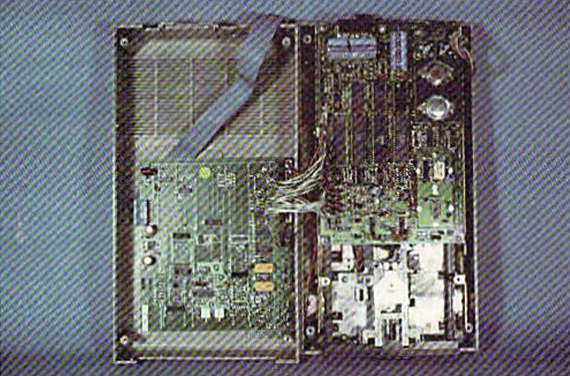
Final Hardware Quirks
The device featured a manual button to toggle the monitor output between the C64 and the Spartan, indicated by a DIY LED that hung loosely outside the chassis. For those seeking more power, Mimic offered an optional DOS card that had to be installed internally.