We accidentally built a synthetic cell factory
The Unintentional Creation of a Synthetic Cell Factory
By Akshay Maheshwari, CEO
Our journey at b.next began with a modest academic ambition: to tackle the fragmented nature of synthetic cell research. We wanted to solve the issues of integration and interoperability, providing the community with the tools necessary to unlock the true potential of synthetic cells. To achieve this, we developed Nucleus.
However, we soon discovered a harsh reality: software and specifications are insufficient. Synthetic cells cannot evolve without a robust, dedicated physical supply chain.
"Building industrial-grade infrastructure wasn’t necessarily what we expected, but it is the essential bridge required to move synthetic cells from academic curiosity to global-scale solutions."
Consequently, we transitioned into operating a manufacturing facility that produces Cytosol—the fundamental building blocks of cells—engineered according to the open specifications of Nucleus.
The Catalyst: A 2023 Challenge
In 2023, we were contracted to create a basic synthetic cell sensor. The requirement was strict: it had to be built from fully open and specified components. This was intended to spark a new era of collaborative engineering.
Our strategy centered on creating an open PURE system with accessible construction protocols, drawing inspiration from the OnePot PURE system. While the synthetic cell community had already adopted PURE as its primary platform, they were trapped using commercial formulations that were neither modifiable nor extensible.
The Timeline Shift
We initially estimated the project would take a few months. Instead, it evolved into a multi-year odyssey as we encountered systemic failures in the synthetic cell infrastructure.
Deconstructing the PURE System
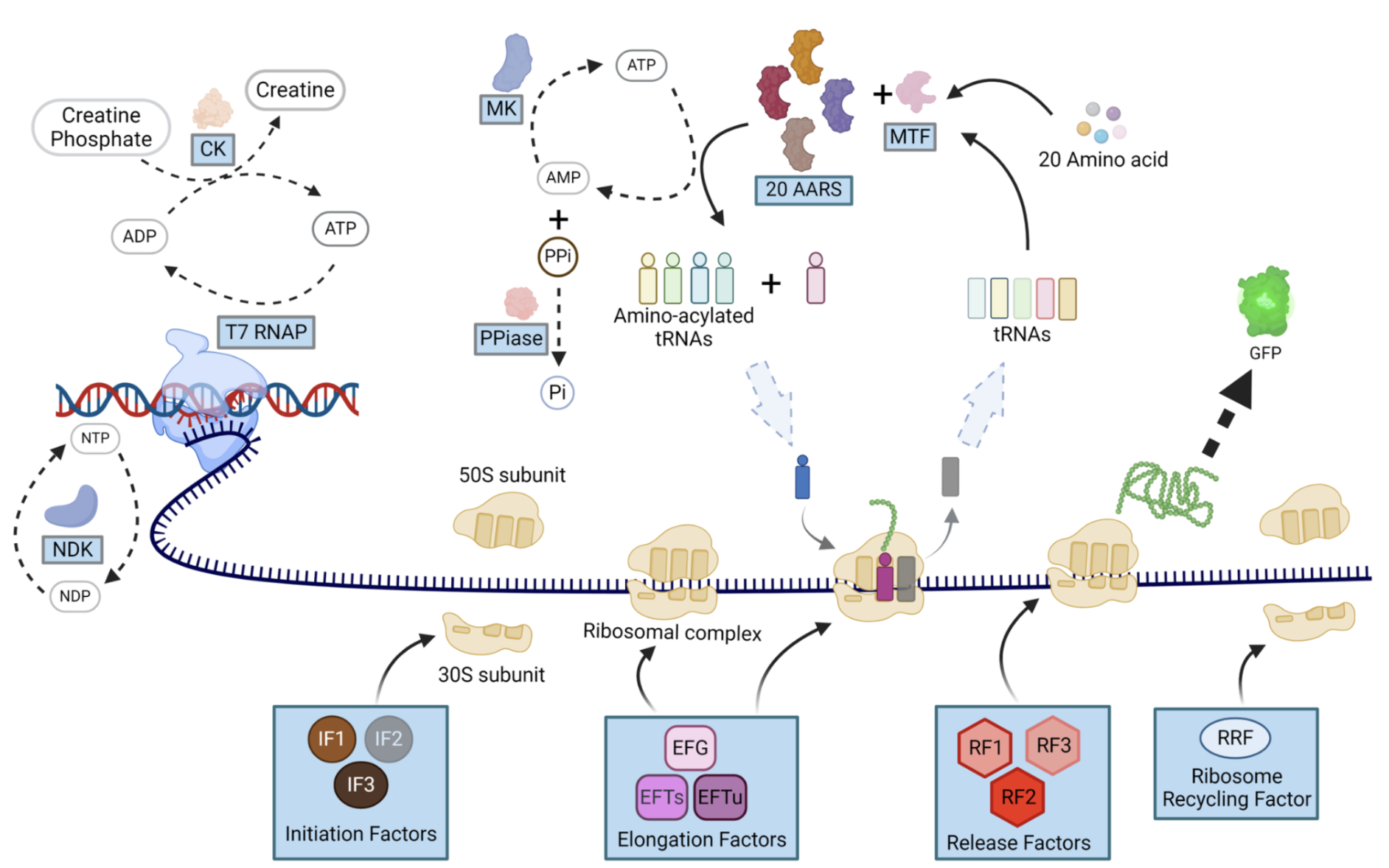
The PURE system is a meticulously defined molecular environment. Mathematically, its composition can be represented as:
These components work in tandem to drive the essential processes of transcription and translation.
The Barriers to Entry
We hit a wall immediately: the 36 plasmids required for the OnePot PURE system were locked behind UBMTA (Uniform Biological Material Transfer Agreement) licenses. As a corporate entity, we were barred from accessing them, despite our intent to open-source the technology.
Furthermore, our discussions with researchers revealed a grim reality:
- The existing plasmid sets were often incomplete.
- Many contained mutations.
- Only a tiny fraction of global labs had successfully built the system.
- The setup time often exceeded 18 months—an absurd delay for technology first published in 2001.
The Path to "Detectable Output"
We decided to rebuild from the ground up. We redesigned and synthesized a superior, open-access set of PURE plasmids and created streamlined assembly protocols.
Milestones Achieved:
- Redesign PURE plasmid set
- Synthesize open-access DNA
- Develop protein production protocols
- Achieve first detectable output (after 9 months)
- Launch Nucleus open commons (mid-2024)
 Yemo Ku (Manufacturing Lead) celebrating the "Ménage à 36" (the 36 proteins) upon achieving detectable output.
The tRNA Crisis and Supply Chain Fragility
Just as our protein system stabilized, we encountered a new disaster. A functioning PURE system requires tRNA and ribosomes. Historically, tRNA was sourced from Roche or Sigma. Suddenly, Sigma ceased supply.
We discovered that tRNA production had been deprioritized globally, leaving the reagent on indefinite backorder. This highlighted the extreme brittleness of the synthetic cell supply chain:
| Component | Previous Status | Current Risk | b.next Solution |
|---|---|---|---|
| Proteins | Restricted/Mutated | High | Open-access Plasmids |
| tRNA | Single-source/Unavailable | Critical | In-house Open Protocols |
| Small Molecules | Commercial/Fixed | Medium | Specified Open Formulations |
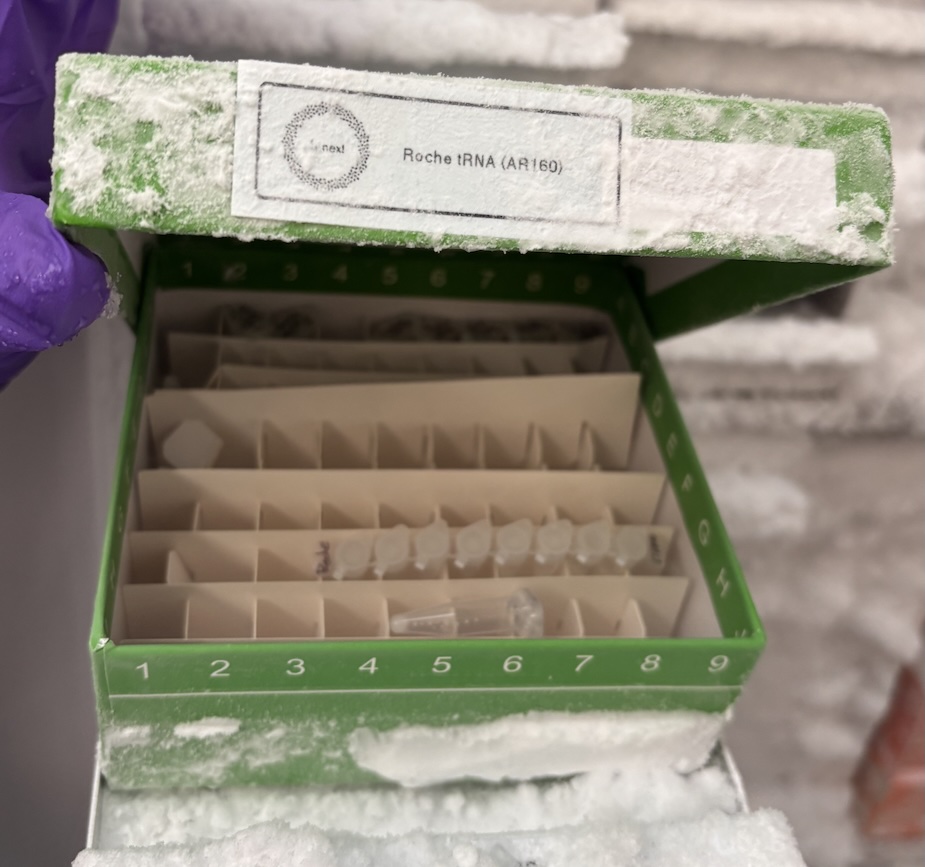 The final remaining tubes of tRNA, provided by collaborators Evan Kalb and Kate Adamala.
Scaling the Solution
By mid-2025, we had successfully optimized open specifications for every PURE component. To disseminate this, we hosted an intensive workshop where 8 graduate students and postdocs built the entire PURE system from scratch in one week.
def build_pure_system(components):
    for item in components:
        if item.is_validated():
            assemble(item)
        else:
            raise SupplyChainError("Component unavailable or restricted")
    return "Functional Synthetic Cell Base"
Despite this success, we realized that for most labs, the process was still too cumbersome. Even with a manual, the time and expertise required to manufacture baseline reagents were too high, and adding modifications created complexities beyond the scope of a standard lab.
The Final Pivot: Defining Cytosol
We concluded that the most effective way to accelerate the field was to move beyond just providing "instructions." We needed to provide the actual material.
Our new mandate involves:
- Developing "Cytosol": Defined, PURE-like systems designed specifically to power synthetic cells.
- Ensuring these systems are extensible and supported by advanced tooling.
- Providing direct access to validated, ready-to-use reagents to ensure reliability and speed.

