Bonsai 2 27B: Near-Lossless Compression in a 9x Smaller Footprint
Bonsai 2 27B: Achieving Near-Lossless Compression with a 9x Smaller Footprint
PrismML has officially unveiled Ternary Bonsai 2 27B, a breakthrough in model efficiency that allows high-tier multimodal intelligence to reside on local hardware without the typical performance penalties of heavy compression.
"At this level of retention, compression becomes a deployment unlock: nearly the same capability, in a footprint that can run in far more places."
🛠️ Technical Architecture & Specifications
Ternary Bonsai 2 27B is built upon the Qwen3.8 27B foundation. It leverages a specialized weight system to slash memory requirements while maintaining high-level reasoning, vision, and agentic skills.
The Core Innovation: Ternary Weights
Unlike standard models, this version utilizes ternary weights:
By combining these with FP16 group-wise scaling, PrismML has achieved:
- Effective Precision:
1.76 bitsper weight. - Total Model Size: 5.9GB.
- Compression Ratio: smaller than the full-precision original.
- Context Window: tokens.
- License: Apache 2.0.
📈 Evolution: Bonsai 27B Bonsai 2 27B
The original Bonsai 27B proved that local deployment was possible. Bonsai 2 27B evolves this by focusing on quality and runtime viability for professional applications.
Key Improvements:
- Stronger Foundation: Migrated to
Qwen3.8 27B. - Higher Fidelity: Increased aggregate performance retention from
95%to 98.2%. - Enhanced Skills: Significant boosts in coding, vision, and long-term agentic planning.
📊 Performance Benchmarks
Ternary Bonsai 2 27B achieves an aggregate score of 83.9, proving that it can mirror the intelligence of much larger models.
| Capability | Ternary Bonsai 2 27B | Qwen3.8 27B (Full) | Qwen3.6 27B |
|---|---|---|---|
| Agentic Tool Calling (τ²-bench, BFCLv3) | 77.57 | 79.74 | 80.05 |
| Coding (HumanEval+, LiveCodeBench v6, etc.) | 81.58 | 82.17 | 82.57 |
| Instruction Following (IFBench, IFEval) | 82.66 | 81.25 | 74.53 |
| Knowledge Reasoning (MMLU-Redux, GPQA) | 83.95 | 86.66 | 84.71 |
| Math (AIME 2026, GSM8K, MATH-500) | 96.57 | 97.06 | 94.64 |
| Vision (CharXiv, OCRBench v2, etc.) | 78.59 | 81.64 | 79.82 |
| Overall Score | 83.9 | 85.4 | 83.6 |
Figure I: Comparison of thinking-mode performance across model versions.
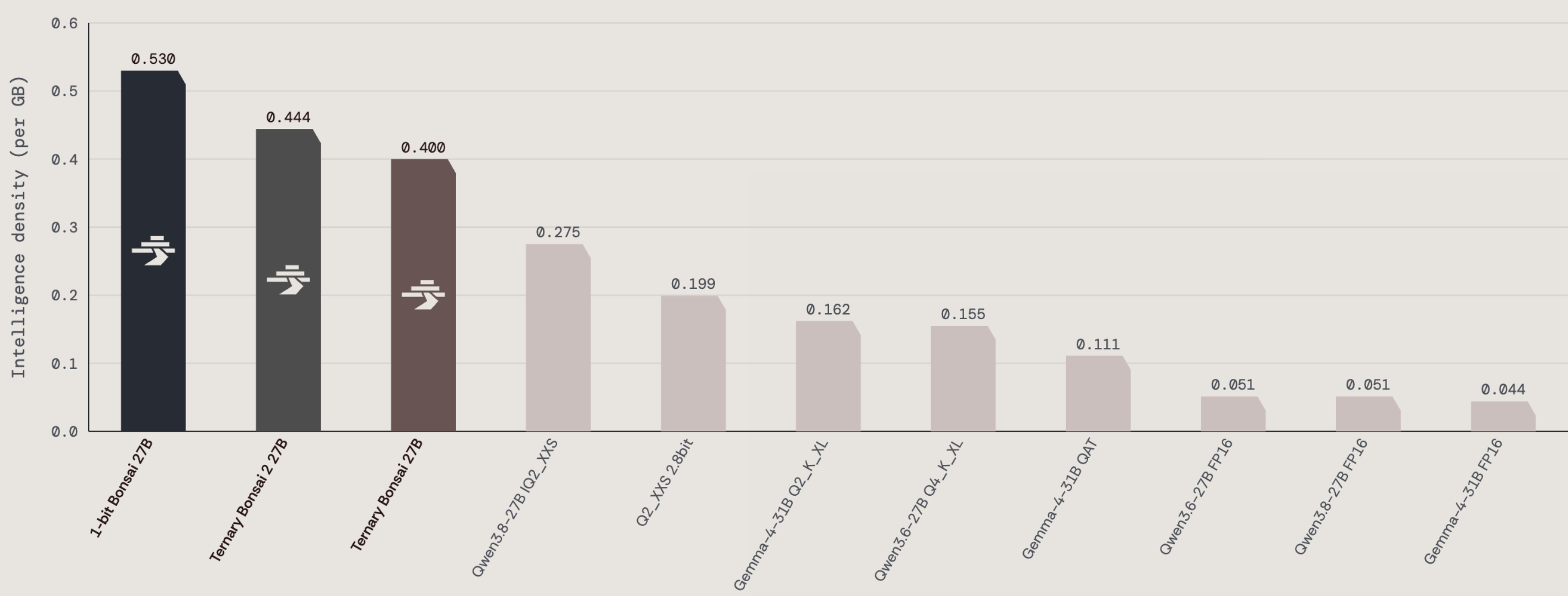
Intelligence Density
The most critical metric here is Intelligence Density (Capability per GB). While other low-bit models often sacrifice coding or vision capabilities to fit into small memory envelopes, Bonsai 2 27B remains an outlier.
⚡ Throughput and Energy Efficiency
By reducing the memory footprint, PrismML has drastically increased the speed and lowered the power cost of inference.
Hardware Performance Metrics:
# Throughput (Tokens per Second)
RTX_5090 = 143.0
M5_Max = 46.8

# Energy Efficiency (RTX 4090)
energy_per_token = "0.714 mWh/token"
efficiency_gain = "40% more efficient than full-precision 8B model"
Why this matters in practice:
- Coding: Faster edit debug cycles for developers.
- Multimodal Agents: Rapid processing of screenshots and document analysis.
- Local Privacy: High-performance assistants that run in the background without draining battery or relying on the cloud.
🚀 The Bigger Picture: Why This Matters
The jump from 95% to 98.2% retention makes this model practically lossless. This shift changes the fundamental economics of AI deployment.
The New Paradigm:
- Hardware Optimization: Fit larger, smarter models into existing memory.
- Scalability: Serve more concurrent users on the same hardware.
- Hybrid Orchestration: Local models handle sensitive, high-frequency tasks, escalating to the cloud only when absolutely necessary.
The industry is moving away from asking "How capable is this model?" and toward "How much intelligence can be delivered within a specific power and memory budget?" As these requirements drop, the potential for AI to integrate into every layer of the tech stack expands.
Related Links & Assets:
 Check out the model on HuggingFace.
 Bonsai Series.