Coulomb's law remains tricky to test at home
The Difficulty of Home-Testing Coulomb's Law
By Casual Physics Enjoyer September 07, 2026
I often find myself reflecting on how much I take for granted. One of my persistent struggles in the study of physics is the simple act of remembering physical laws.
My goal is to reach a level of intuition where applying a law of physics feels as natural as:
- Frying an egg.
- Constructing a sentence.
- Performing basic addition.
I imagine a world where I can manipulate physical reality with the same fluency as language. For instance: "Oh, my chicken is overcooked; no matter, I understand the heat equation, so I'll just decrease the temperature by X and ensure the chicken is more spherical next time!"
While I could easily query an LLM or look up Maxwell's equations, I am constantly struck by how the ancient Greeks uncovered so much about the universe with far fewer tools.
The Spirit of First Principles
I recall a moment in Brighton where my friend Cyrus and I challenged one another to calculate the Earth's radius from first principles, using nothing but the angle of the horizon. I find these challenges both entertaining and enlightening.
This mindset was reinforced by a piece of advice I encountered in R. Shankar's textbook, On Fundamental Physics II, while relaxing by a pool in Malaysia:
To achieve a profound understanding of physics, one must think critically about how a physical law can actually be tested and measured using real-world instrumentation.
Without this practical grounding, it is easy to get lost in "factors of " while performing mindless symbolic manipulations—a trap I frequently fell into as a theoretical physics student in the Cambridge Masters program.
Deconstructing Coulomb's Law
Because I struggle to memorize Coulomb's law, I decided to explore how I could "feel" it and test it manually. However, electric charge is an abstract concept; you cannot simply "summon" a precise amount of it.
The Theoretical Framework
If we have two charged particles, and , separated by a distance , the force is expressed as:
To understand how one arrives at this, we can treat the force as a function: F = F(r, q1, q2).
While symmetry suggests the exponents should be the same, it isn't immediately obvious why in nature. I considered writing a full deep-dive on this rabbit hole, but it's out of scope for now.
Comparing Inverse Square Laws
A logical hypothesis is that this force follows an inverse square law, similar to the intensity of light or gravity.
| Law | Formula | Constant |
|---|---|---|
| Newton's Gravity | (Gravitational Constant) | |
| Coulomb's Law | (Coulomb Constant) |
The Experimental Struggle
To verify the inverse square law at home, one could theoretically:
- Charge two spheres equally.
- Fix one in place.
- Suspend the other by a string.
- Measure the angle of deflection from the vertical to calculate the force.
While Coulomb used a high-precision torsion spring, I wanted a simpler method. However, charging metal spheres cleanly with household items is surprisingly difficult. I considered splitting a single charge between two objects via contact to ensure symmetry, but verifying that the charges were truly equal remained a problem.
Building a DIY Electroscope
Instead, I pivoted to building an aluminium foil electroscope.
Materials & Process:
- Insulated wire (from a breadboarding kit)
- Glass jar (with a hole drilled in the lid)
- Thin strips of aluminium foil
- A charged object (pen rubbed against hair)
The Setup:
- The wire passes through the jar lid.
- The bottom end is bent into a hook holding the foil strips.
- The top end is capped with scrunched-up foil.
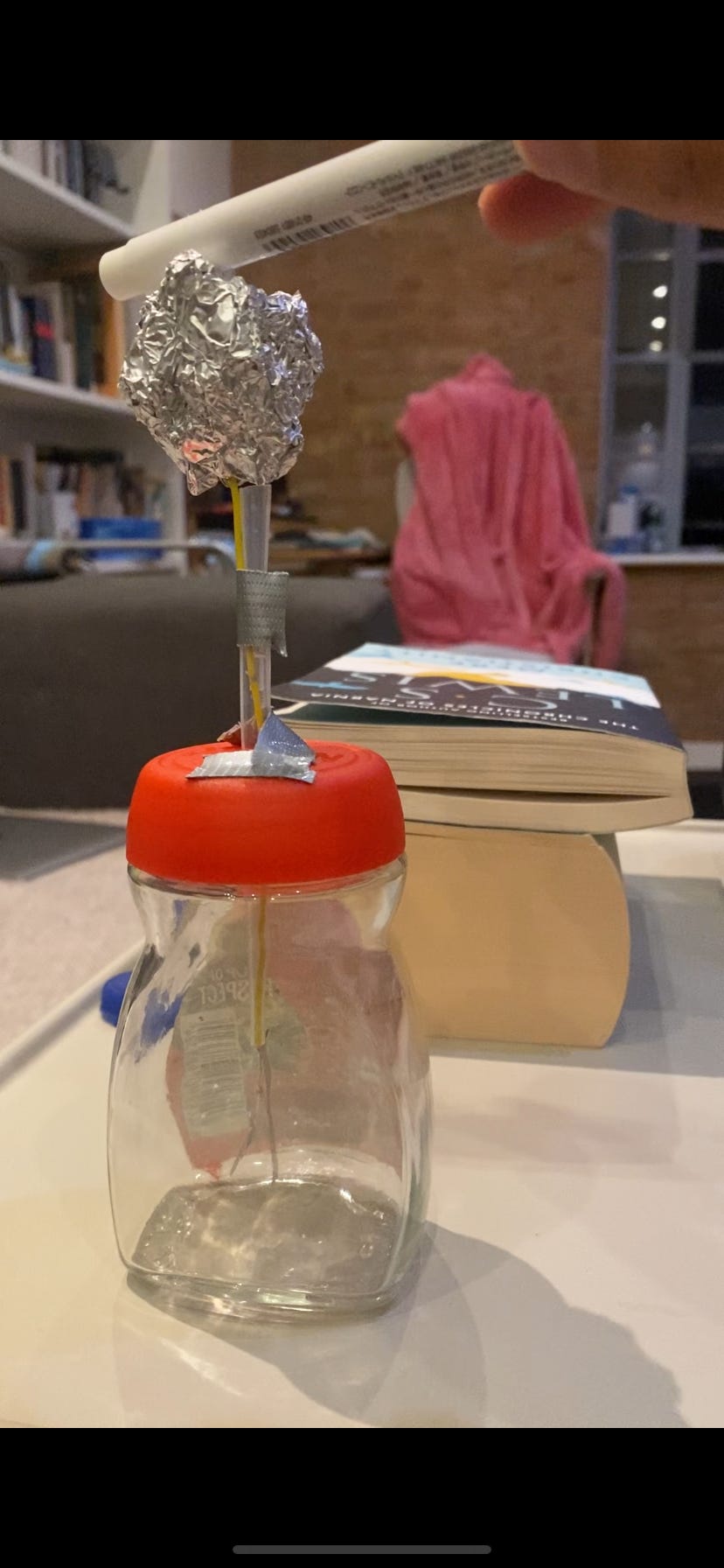
When I touch the external foil with a charged object, the internal foil strips separate due to electrostatic repulsion.
The Verdict: Currently, this method is qualitative rather than quantitative. The primary obstacle is charge decay, as humidity in the air bleeds the charge away from the objects. I am still searching for a more robust, repeatable way to create a stable charge to accurately measure the inverse square law.
Community Discussion
Tiffany, the ADHD PhD: "It's interesting to think about the mathematical representation of behavior that we can, over time, simply get an intuition for. I'm reminded of the ideal g..."


