Ideas on modernizing the open-source desktop
Rethinking the Open-Source Desktop: Insights from Akademy 2026

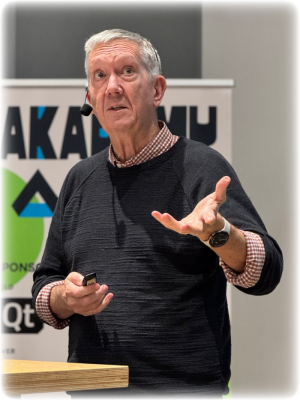
At the 2026 Akademy conference—the annual gathering for KDE developers—Scott Jenson delivered a provocative presentation. Jenson, a veteran of the UX/UI world with a resume featuring giants like Apple and Google, is on a mission to push the open-source community to evolve beyond the stagnant WIMP (Windows, Icons, Menus, Pointer) paradigm.
A Journey of Professional Atonement
Jenson's perspective is shaped by years of corporate experience. He reflected on his time at Google, noting a stark cultural decline. He recalled that when he joined in 2005, the company felt driven by a genuine desire to do the right thing. During his tenure on the Chrome team, he was surrounded by advocates for an open-web and open-source future.
However, as the corporate culture shifted, Jenson felt the need to move on. He described his current efforts as a form of penance:
"I'm trying to atone for my sins working for these companies."
Currently, he contributes his design expertise to projects like Home Assistant and Mastodon, attempting to inject high-quality UX design into the open-source ecosystem.
The UX Innovation Gap
While Jenson avoids being overly confrontational, he believes open-source projects are lagging in UX design—a problem exacerbated by chronic understaffing. He noted that a previous talk on this subject at an Ubuntu conference garnered over 500,000 YouTube views. While modest by global standards, Jenson viewed this as a clear signal that there is a massive appetite for discussing desktop UX.
The "Devil in the Details"
To illustrate his points, Jenson shared anecdotes from his time working on the Macintosh Finder. He highlighted how tiny design choices create a superior user experience:
- Filename Truncation: When a filename is too long for the display, developers typically place ellipses (
...) at the end. Jenson argued—and successfully implemented—placing them in the middle. This preserves the file extension, which is critical information for the user. - Drag-and-Drop Logic: He explained the nuance of mouse interactions.
Comparison: Drag-and-Drop Behavior
| Action | macOS Behavior | Typical Linux Behavior |
|---|---|---|
| Mouse Down | Item is selected; window stays put. | Item is selected; window raises immediately. |
| Mouse Up | Window raises (if applicable). | Action completes. |
This difference means that on Linux, attempting to drag a file from a background window often forces that window to the front, interrupting the workflow. Jenson mentioned that after posting about this on Mastodon, a KDE developer implemented the fix. When Jenson mentioned this at Akademy, a voice from the crowd simply replied, "You're welcome."
Logic Flow of the Mac Drag-and-Drop
Breaking the Cycle of Stagnation
Jenson's primary critique is that desktop UX has essentially evolved stabilized over the last two decades. He argues that the industry hit a plateau in the 90s and hasn't truly moved forward.
He pointed out that Linux desktops have historically "drafted" behind Microsoft and Apple, copying their interfaces to make transitions easier for new users. While this is a pragmatic strategy, it creates a dependency on corporate research.
The problem, Jenson argues, is that Apple and Microsoft have largely stopped innovating in the desktop space. By relying on them to make the mistakes and find the solutions, the open-source community is now following leaders who have lost interest in the frontier.
The Path Forward for Open Source
To modernize, the community must move from copying to creating.
- Establish dedicated funding for UX research.
- Move beyond the
WIMPmodel. - Implement "attention-to-detail" fixes (like the Finder ellipses).
- Conduct independent user testing.
Conceptual Implementation of UX Logic
If one were to programmatically define the "Mac-style" window raise logic, it might look like this:
def handle_mouse_event(event):
    if event.type == "MOUSE_DOWN":
        select_item(event.target)
        # Do NOT raise window here to allow seamless dragging
    elif event.type == "MOUSE_UP":
        if event.is_dragging:
            complete_drop(event.target)
        raise_window(event.source_window)
In summary, Jenson believes that the open-source community possesses the agility to implement great ideas rapidly, but it lacks the design leadership to conceive those ideas independently. It is time for the Linux desktop to stop being a mirror of proprietary systems and start being a pioneer.