New Satellite Engine Could Use Earth's Atmosphere to Stay in Orbit Indefinitely
New Satellite Engine Could Use Earth's Atmosphere to Stay in Orbit Indefinitely
A groundbreaking satellite propulsion system that utilizes atmospheric gases as its primary fuel source has shown significant promise in laboratory simulations and modeling. While it has yet to be flight-tested, the implications for long-term orbital sustainability are profound.
The VLEO Dilemma: High Reward, High Drag
When engineers select an orbit, they must balance operational efficiency against environmental constraints. Very Low Earth Orbit (VLEO)—defined as the region between and ( to )—is particularly attractive for several reasons:
- Enhanced Imaging: Remote sensing cameras can achieve much higher resolution.
- Power Efficiency: Radar and communication systems require less energy to transmit data.
- Self-Cleaning: Atmospheric drag naturally pulls defunct satellites back into the atmosphere to burn up.
However, the "cost" of VLEO is air resistance. To avoid plummeting back to Earth, satellites must generate constant thrust. Traditionally, this meant carrying massive, expensive tanks of xenon gas, which eventually run dry, ending the mission.
The Core Concept: Francesco Romano, during his PhD research at the University of Stuttgart (published via
arXiv), proposed a system that turns the very cause of drag—atmospheric molecules—into the fuel that overcomes it.
This technology is categorized as Atmosphere-Breathing Electric Propulsion (ABEP).
Engineering Hurdles: The "Oxygen Problem"
Designing an engine for VLEO isn't as simple as adding a scoop. Romano had to overcome several critical obstacles:
- Atomic Oxygen (AO) Corrosion: In the upper atmosphere, UV rays split into single oxygen atoms. This is highly oxidative and destroys metal electrodes and acceleration grids.
- The Neutralization Issue: Standard ion engines use an "electron gun" (cathode) to neutralize the exhaust. Without this, the spacecraft would build up a charge and simply pull the expelled particles back, nullifying thrust. typically burns through these cathodes.
- Atmospheric Volatility: The density of the air fluctuates based on:
- Solar activity
- Latitude
- The day/night cycle
The Solution: A Mirror and a Medical Device
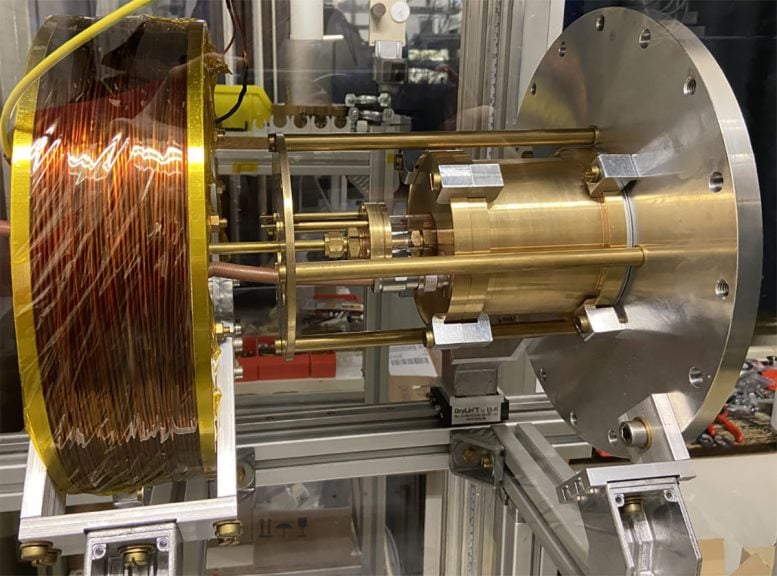
To bypass these issues, Romano developed a contactless, neutralizer-less radio-frequency (RF) helicon plasma thruster.
1. The Intake System
Romano tested three distinct methods for gathering the sparse molecules of the upper atmosphere:
| Intake Design | Mechanism | Result |
|---|---|---|
| Enhanced Funnel | Acts as a molecular trap for distant particles. | Sub-optimal |
| Diffuse Intake | Compact hexagonal design using coated titanium alloy. | Moderate |
| Specular Intake | Parabolic mirror coated in or graphite. | Winner |
The Specular Intake was the most effective, capturing of particles (including , argon, and nitrogen). Even with a tilt, efficiency only dropped by .
2. The Thruster Design
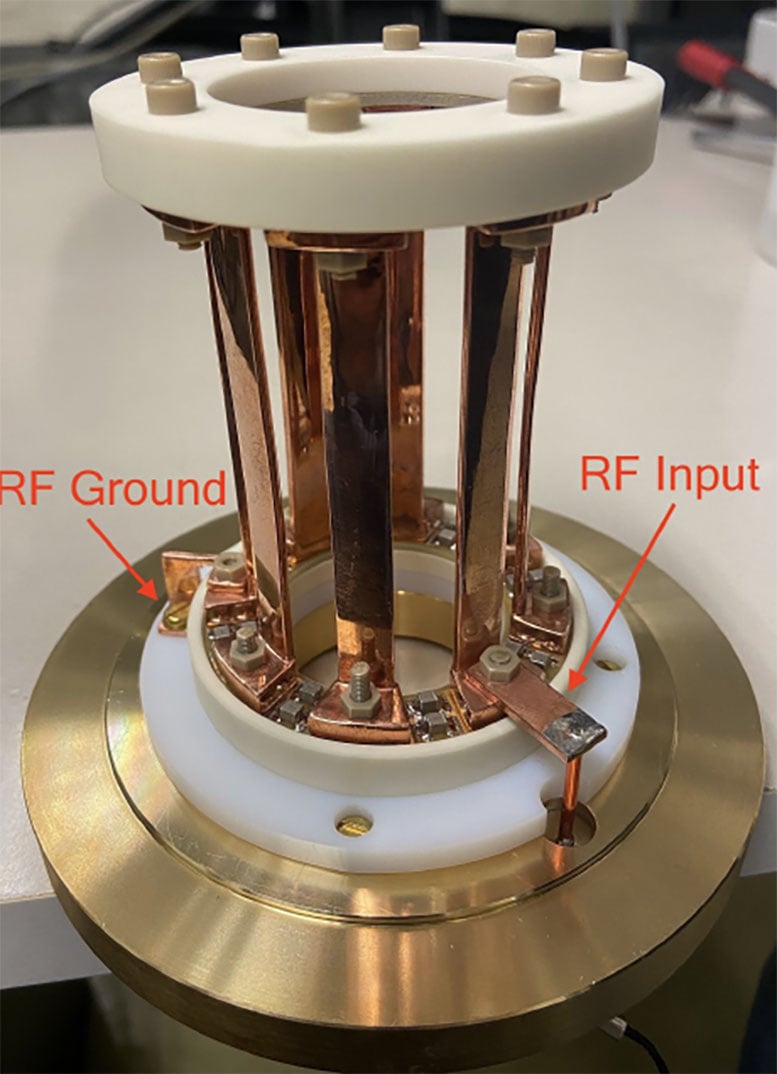
For the engine itself, Romano looked toward medical technology, specifically MRI machines. He utilized a birdcage antenna to ensure that of the electrical power entered the thruster, avoiding the energy loss (reactance) common in standard wire coils.
To solve the neutralization problem, a solenoid creates a magnetic field that ejects a quasi-neutral jet (containing both positive and negative ions), removing the need for a fragile cathode.
Performance and Future Applications
In a vacuum chamber simulating VLEO, the engine produced steady plasma streams using only of RF power. When applied to real-world models, the results were striking:
Case Study: The GOCE Satellite The GOCE satellite previously used a Xenon ion thruster in VLEO but eventually failed once its fuel was exhausted. Romano's model suggests that with this new engine:
- Altitude: It could operate indefinitely between and .
- Power Consumption: It would require , well within the limits of standard solar arrays.
Beyond Earth: The Red Planet The technology isn't limited to Earth. Because Mars has an atmosphere dominated by , this engine could theoretically support a spacecraft indefinitely at altitudes of , allowing for much closer orbital observation than currently possible.
# Conceptual Power Logic
def check_viability(power_required, solar_capacity):
    if power_required <= solar_capacity:
        return "Indefinite Orbit Possible"
    else:
        return "Fuel Supplement Required"

print(check_viability(1.6, 2.0)) # Output: Indefinite Orbit Possible
While it remains to be seen if this thruster will transition from the lab to the launchpad, the potential for permanent, fuel-free orbital presence is a compelling prospect for the future of space commerce and exploration.