Body Awareness in Goffin's Cockatoos
Body Awareness in Goffin's Cockatoos
Overview
This research, published in Scientific Reports (Volume 16, Article 28981, 2026), investigates the capacity for body awareness in Goffin’s cockatoos (Cacatua goffiniana). The study explores alternatives to the traditional Mirror Self-Recognition (MSR) test by utilizing the Body-as-Obstacle (BAO) paradigm.
The Core Conflict: MSR vs. BAO
For decades, the test has been the benchmark for self-awareness. However, its reliance on visual feedback is problematic.
MSR is the only way to measure self-awareness.Modern view: A modular, gradualist framework is required.- The Vision Bias: MSR may not be ecologically valid for species that rely on non-visual sensory modalities.
- The Wrasse Paradox: The fact that the cleaner wrasse (Labroides dimidiatus)—a creature with a very small brain—shows MSR-like behavior suggests the test might not be measuring "self-awareness" in the way we think.
"Animals must represent the affordances of their own bodies in relation to the physical and social environment..." — de Waal
The Body-as-Obstacle (BAO) Framework
Unlike MSR, which focuses on visual recognition, the BAO task assesses whether an animal recognizes its own physical presence as a causal impediment to achieving a goal.
Comparison of Paradigms
| Feature | Mirror Self-Recognition (MSR) | Body-as-Obstacle (BAO) |
|---|---|---|
| Primary Sense | Vision | Proprioception / Physical Interaction |
| Focus | Visual self-representation | Embodied self-representation |
| Requirement | Visual contingencies/mirror experience | Awareness of body-environment interaction |
| Human Dev. | Emerges months | Emerges months |
Note on Human Development: Research indicates that cultural orientation affects these milestones. Infants from autonomy-oriented cultures often pass MSR first, while those from relatedness-oriented cultures tend to master BAO sooner.
Experimental Design
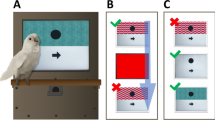
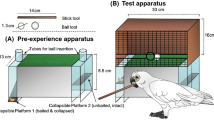
The researchers tested 15 Goffin's cockatoos using a modified avian BAO task. The goal was for the bird to retrieve an object and deliver it to the experimenter.
Experimental Workflow
Procedural Steps
- Conduct pre-test to ensure birds don't step off simply due to discomfort or mat instability.
- Implement Test Condition: Object is fixed to the mat; the bird's weight prevents retrieval.
- Implement Control A: Object is loose (unattached).
- Implement Control B: Object is fixed to the floor beneath the mat.
Results and Analysis
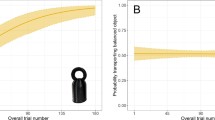
The cockatoos demonstrated a clear understanding of their body's role as an obstacle. To calculate the success rates, the researchers used the following formula for Mean Standard Error:
Data Summary
| Condition | Success Rate (Stepping Off) | Interpretation |
|---|---|---|
| Pre-test | Birds are capable of stepping off. | |
| Test Condition | High awareness of body as obstacle. | |
| Unattached Control | No need to step off. | |
| Attached-to-Ground | Obstacle is external, not the body. |
Technical Logic
The birds' behavior can be represented by the following pseudo-code logic:
if object_is_stuck == True:
    if weight_source == "my_own_body":
        action = "step_off_mat"
    else:
        action = "pull_harder"
else:
    action = "retrieve_object"
Conclusion
This study marks the first time the BAO paradigm has been successfully applied to birds. The results suggest that Goffin's cockatoos possess a form of embodied self-representation. By moving beyond vision-centric tests, researchers can better understand the diverse ways different species perceive themselves.
Visual References