One month coding with GLM 5.3 Flash
One Month Coding with GLM 5.3 Flash
By Thibaud Colas | Wagtail Core Team | Published: 2 Oct 2026
"Setting a challenge to spend the whole of September on only one efficient open model felt like a great idea at the time."
In a nutshell: 2 billion tokens later, the mission was a total success 🤖 task failed successfully.
📊 The Token Distribution
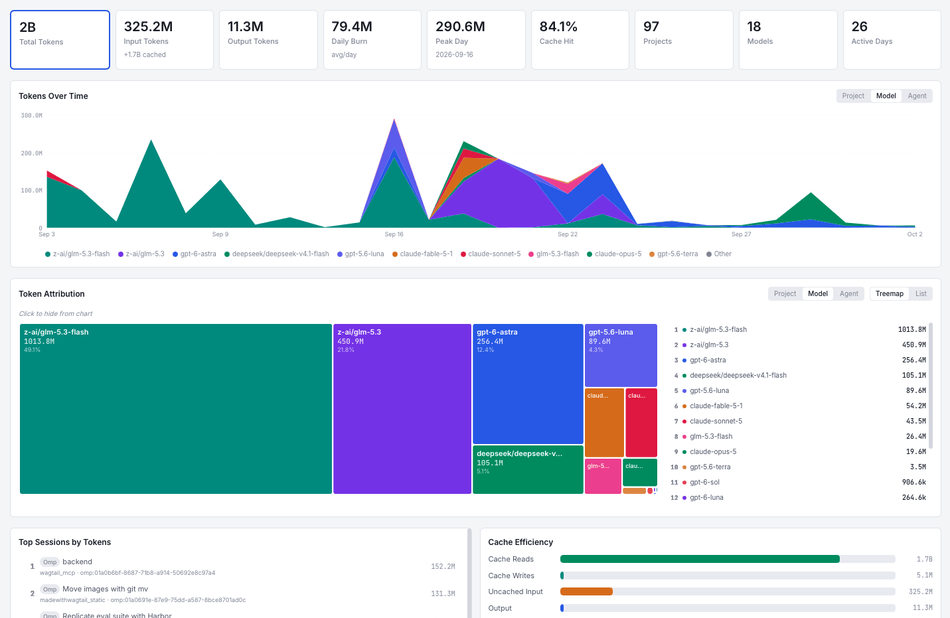
To track AI consumption, we utilized AgentsView, a tool recommended for agentic engineering. The primary objective was to rely exclusively on GLM 5.3 Flash (represented in teal in the data).
The Breakdown
- The Win: For the first two weeks, I stuck strictly to the plan.
- The Cost: Usage for the target model remained highly efficient:
- Spend: $68
- Energy:
- Carbon Footprint:
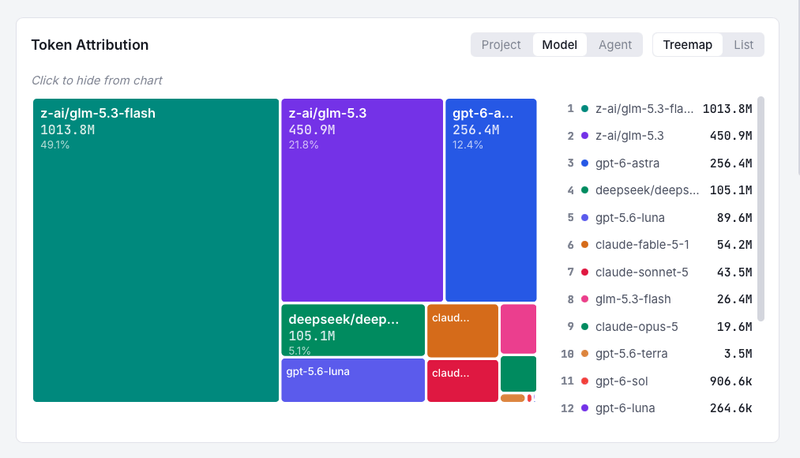
- The Slip: In the latter half of the month, approximately 1 billion tokens leaked into other models.
⚠️ Unexpected Hurdles
1. The Price of "Vibe Coding"
We've been open about the fact that our experimental Wagtail MCP server is a vibe-coded prototype. While "vibe coding" isn't our standard for production, it's perfect for rapid prototyping.
However, I selected the wrong model for this specific task, leading to a massive spike in resource consumption almost overnight:
- Tokens: 450M
- Cost: $150
- Energy:
While the MCP server is now a functional and impressive demo, it serves as a stark warning: be cautious with agentic patterns and model selection. We likely could have reached the same result for of the cost with minimal extra effort.
2. Infrastructure & Availability
We have previously discussed the nuances of comparing inference providers. While our chosen providers are usually reliable, they lack the massive GPU hoarding capacity of the "big labs."
We noticed a performance dip in GLM 5.3 Flash, likely because it sits so high on the Pareto Frontier of efficiency and utility for our specific needs.
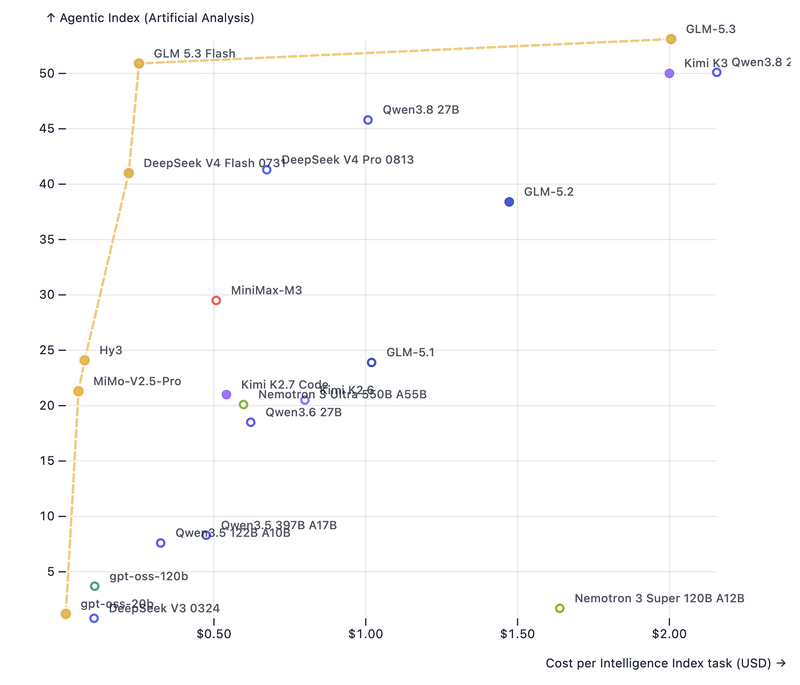
Note: The data above is filtered for open models available in European data centers.
Because of these capacity issues, I had to pivot to alternatives like DeepSeek V4.1 Flash and Qwen 3.8 Flash.
3. The R&D Tax
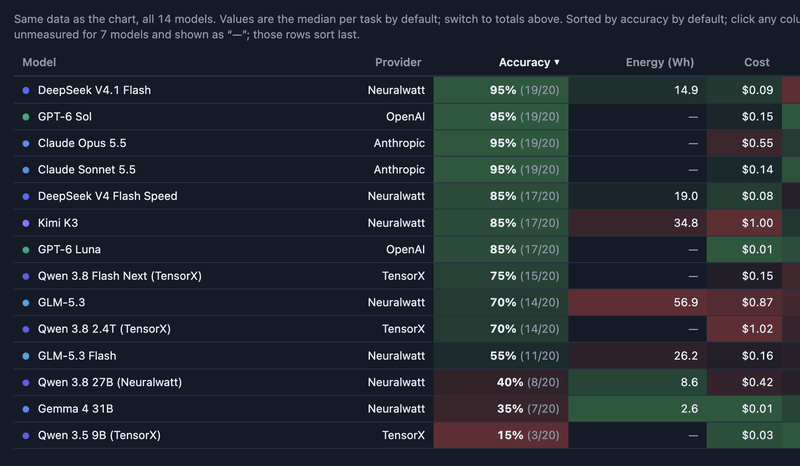
Beyond daily engineering, it is vital to keep a pulse on the industry. We are currently benchmarking model performance on Wagtail-specific tasks, which requires a diverse dataset across many models.
This data helps us steer users toward leaner options and informs the development of our new CLI prototype, designed specifically for agent compatibility.
Sneak peek at our benchmark data:
| Model | Accuracy (%) | Energy (Wh) | Cost ($) |
|---|---|---|---|
DeepSeek V4.1 Flash | 95% | 14.9 | 0.09 |
| ... | ... | ... | ... |
✅ What Actually Worked
Despite the "failure," I intend to continue this approach for of my daily production work (excluding R&D). GLM 5.3 Flash is exceptionally well-suited for this because:
- Massive Context: A
1Mtoken window makes extended coding tasks feasible. - Multimodal: Vision support allows for building from screenshots or visual QA.
- Competitive: Availability across multiple providers keeps costs down.
🚀 Takeaways & October Roadmap
Technically, the challenge failed, but the lessons learned are invaluable. For October, the strategy is as follows:
- Implement local monitoring: Track not just tokens, but .
- Strategic Prototyping: Be more intentional about which prototypes get built and how.
- Explore Efficiency: Investigate Jev-style decision diffusion models and latest flagship efficiency gains.
Final Thought
For the average developer, focusing on one or two "flash-tier" models is entirely viable. The goal should be to ensure the bulk of AI inference is handled by efficient models, measuring success by energy and cost rather than arbitrary token counts.
Want to hear the results? Come visit us at Wagtail Space 2026 this November!

Related Reading:
- Open models only: back to school challenge (3 Sep 2026)
- Agentic engineering recommendations (Our guiding principles for LLM-assisted software engineering)
# Example of a lean agent call
def call_efficient_model(prompt):
    model = "glm-5.3-flash"
    return ai_provider.generate(model=model, prompt=prompt)