What I learnt co-leading an AI Safety bootcamp for legal and governance practit
Reflections on Co-Leading an AI Safety Bootcamp for Legal and Governance Experts
AI safety has transitioned from a niche concern to a marginal mainstream priority. While there is an unprecedented surge in people wanting to conduct safety research and significant policy milestones have been reached across the US, UK, and Europe, a new hurdle has emerged.
The primary bottleneck is no longer just a lack of awareness, but a lack of political will and market incentives. Policy officers cannot ensure the correct implementation of safety standards in a vacuum.
The Power of Internal Leverage
Drawing from my experience building a Responsible AI (RAI) program within an Accenture joint venture, I've observed that while profit-driven corporations are notoriously difficult to steer, internal agents can create compounding shifts in practice. This happens through:
- Implementing more rigorous contractual clauses.
- Increasing the level of scrutiny applied to vendors.
- Closing the loopholes that allow providers to bypass compliance.
The European Union, despite lacking its own native frontier labs, possesses immense market power (and a dedicated AI safety unit within its regulatory body). However, this leverage is only effective if the legal professionals drafting the mechanisms and implementing the legislation truly grasp the technical landscape. They must know how to interpret research and identify exactly where safety guarantees fail.
The goal is a market that prioritizes partners with the strongest safety incentives over those who simply offer the most capable models.
Event Overview: The European Seminar on Frontier AI and Law
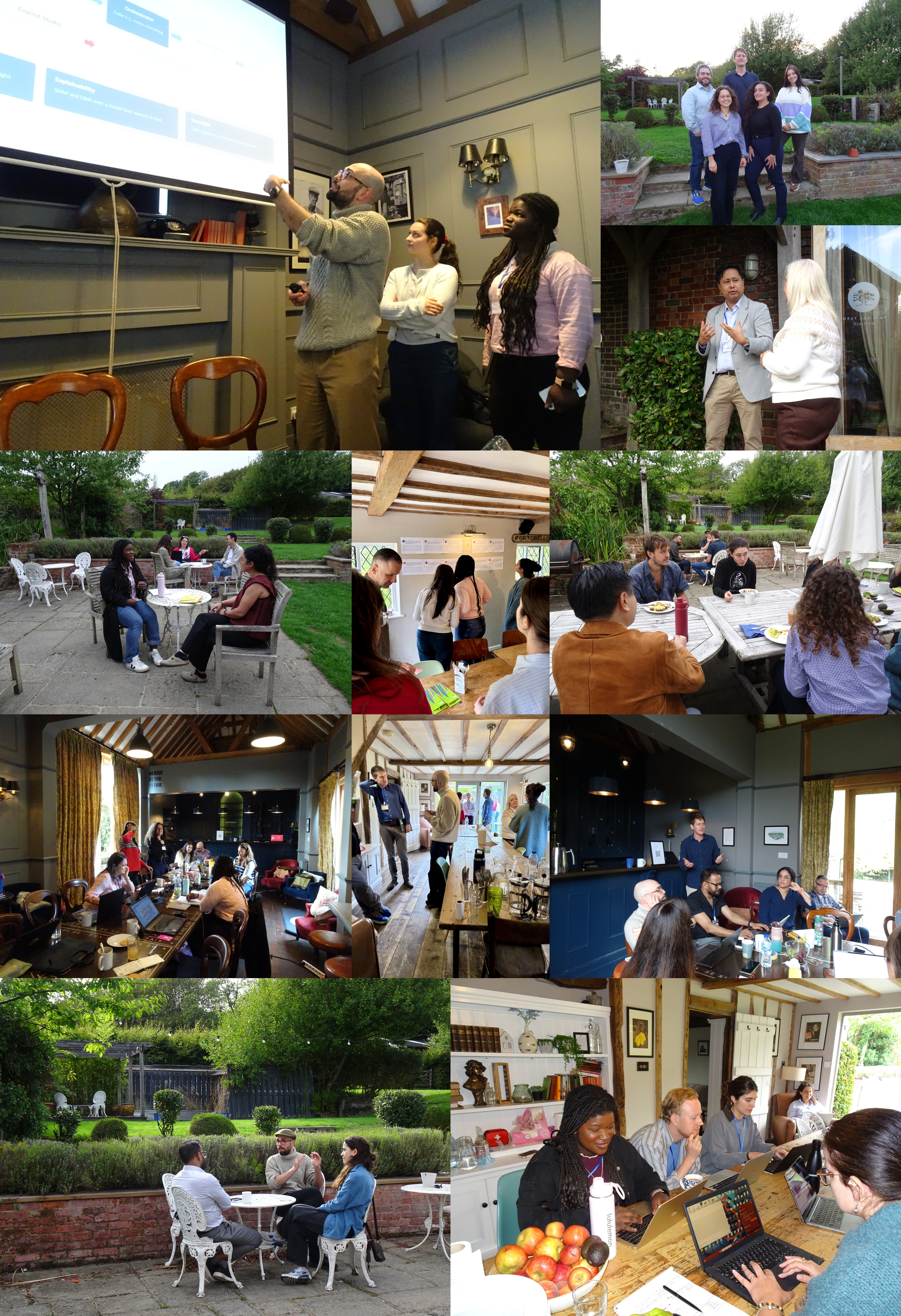
In September, ML4Good, in collaboration with EquiStamp, hosted an intensive five-day residential bootcamp in East Sussex.
| Detail | Description |
|---|---|
| Participants | 19 senior legal, governance, and risk professionals |
| Scope | 12 different jurisdictions |
| Focus | Frontier AI pipeline, procurement, and risk assessment |
| Leadership | Co-led by Katalina Hernandez & Elsa Donnat |
| Technical Leads | Douw Marx & Jeff Iuliano |
The Technical Journey
The curriculum was designed to move participants through the entire frontier AI lifecycle. We mapped technical stages to the practical questions these professionals face daily:
To represent the technical complexity, the instructors had to translate high-level concepts into a language accessible to a non-technical, legal audience. For example, we might conceptualize the risk of a system as:
Who Was in the Room?
Unlike typical AI safety fellowships, we specifically targeted experienced professionals who were already managing legal, compliance, and risk functions but had little to no prior exposure to Effective Altruism (EA) or AI Safety circles.
The cohort included:
- In-house and law firm attorneys
- AI governance, privacy, and compliance specialists
- Financial risk professionals
- Legal scholars and research fellows
- Members of the judiciary and public sector
Key Realizations
1. The Burden of Intellectual Isolation
Even those with prestigious titles at major firms can feel profoundly alone in their concerns. I experienced this personally; in my professional circle, I was often the only one asking:
"What actually makes an AI safe? What are the systemic consequences of deploying various AI systems across a massive corporation? How does this impact the broader market and society?"
In roles focused on compliance or regulation, these existential questions are often dismissed as distractions. There is rarely a dedicated space to discuss the "what comes next" of AI evolution. When we gathered these senior practitioners, the chemistry was instant—they were hungry for a community of peers who shared their anxieties and interests.
2. The Value of Humility
The social bond was a cornerstone of the event. We utilized "sugar cubes"—envelopes where participants left positive, anonymous Post-it notes for one another. I was deeply moved to receive a note from one of the most influential figures in the group.
Beyond the social, there was a striking intellectual humility. During a session on evaluations and safeguards—specifically discussing the Hugging Face incident—the conversation lasted far longer than planned. These experts weren't seeking validation; they were genuinely seeking understanding.
3. Engagement with Research
It was inspiring to see participants reference high-level safety research that had reached them independently, such as:
- The
AI Controlpaper from Redwood Research. - The
Golden Gate Claudeexperiments.
Correcting a simple technical misunderstanding can often lead to a breakthrough in how a legal professional views a contractual safeguard.
# Conceptual logic of the bootcamp's impact
def impact_of_knowledge(professional_role, technical_understanding):
    if professional_role == "Legal/Governance" and technical_understanding == "High":
        return "Effective Safety Implementation"
    else:
        return "Compliance Checkbox Exercise"

print(impact_of_knowledge("Legal/Governance", "High"))