FDA may allow some toxic chemicals to be added to food without safety review
FDA May Permit Toxic Chemicals in Food Without Safety Evaluations
Analysis: Experts express alarm over the Trump administration's regulatory direction.
The U.S. Food and Drug Administration (FDA) is currently considering an expansion of a contentious regulatory loophole. This move could potentially allow some of the most hazardous chemicals on earth to be integrated directly into food products without undergoing a formal safety review.
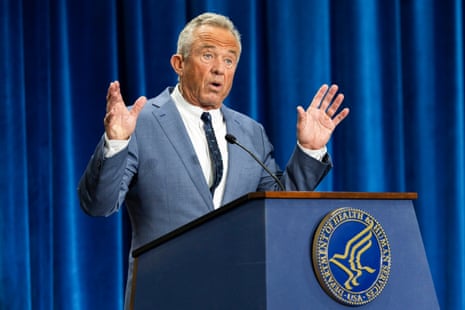 The US health secretary, Robert F Kennedy Jr, speaking at a health and human services event in Washington DC.
Understanding the "Threshold of Regulation" (TOR)
The Threshold of Regulation (TOR) is an existing exemption. Currently, it permits the use of dangerous compounds—provided they are not carcinogenic—in materials that come into contact with food (such as processing machinery or packaging), as long as the concentration remains below a specific limit.
Comparison of TOR Application
| Feature | Current TOR Loophole | Proposed TOR Expansion |
|---|---|---|
| Application | Indirect (Packaging/Equipment) | Direct (Added as Ingredients) |
| Safety Limit | 0.5 ppb (parts per billion) | 0.5 ppb (parts per billion) |
| Restriction | Must not be carcinogenic | Must not be carcinogenic |
| Review Req. | No safety review needed | No safety review needed |
However, public health advocates argue that the limit of is dangerously high for certain substances. Many chemicals, particularly endocrine disruptors, can cause reproductive damage or cognitive impairment in children at concentrations significantly lower than this threshold.
The Political Paradox: "Promises Kept"?
Recently, Robert F Kennedy Jr. and the FDA celebrated a victory, claiming they had closed a different loophole known as GRAS (Generally Regarded As Safe). For years, the GRAS designation allowed companies to launch ingredients without rigorous oversight, which critics say led to widespread health issues.
While the public relations narrative focused on "promises kept," the actual proposed GRAS rule submitted to the Federal Register quietly includes the TOR expansion.
"They’re widening another loophole, but trying to say they made our food safer," warns Maria Doa, a scientist at the Environmental Defense Fund (EDF). "They did not make our food safer."
Scientific Concerns and Risks
The proposed rule suggests that any substance—whether added directly or indirectly—is exempt from regulation if there is "no appreciable risk to human health." Experts argue the definition of "appreciable risk" is fundamentally flawed.
Potential Hazards
The following categories of chemicals could theoretically be added to food under this expanded rule:
- Forever Chemicals: Certain PFAS.
- Plasticizers: Some phthalates and bisphenols.
- Industrial Agents: Certain flame retardants.
- Other Toxins: Neurotoxic substances, immune system disruptors, and chemicals that damage the gut microbiota.
The "Ultra-Processing" Danger
Maricel Maffini, an independent food consultant, is particularly worried about the use of these chemicals in ultra-processed foods as:
- Flavorings
- Preservatives
- Emulsifiers
- Processing aids
- Enzymes
- Stabilizers/Binders
Maffini notes that flavorings often target the nervous system to encourage overconsumption. Furthermore, the FDA ignores the cumulative effect: while one chemical at a low dose might be acceptable, the sum of multiple toxic chemicals creates a significant health burden.
The "Impurity" Clause
The rule also contains a secondary loophole:
If a carcinogen is present as an "impurity" rather than an intentional additive, it may still be permitted.
Case Study: The Perchlorate Warning
The dangers of the TOR loophole are already evident in the case of perchlorate, a chemical used in rocket fuel.
The Biological Impact
Perchlorate interferes with the thyroid gland's ability to absorb iodine. This disrupts the production of the essential hormone :
Low levels of are directly linked to lower IQ scores in children. Despite publishing data that showed an increase in perchlorate levels in children's cereal following the 2005 exemption, the FDA reapproved the chemical's use six months later.
Summary of Advocate Concerns
- Lack of consumer transparency (no labeling for TOR chemicals).
- Reliance on flawed science regarding "low-dose" safety.
- Failure to account for synergistic toxicity.
- Prioritization of "Big Food" interests over pediatric health.