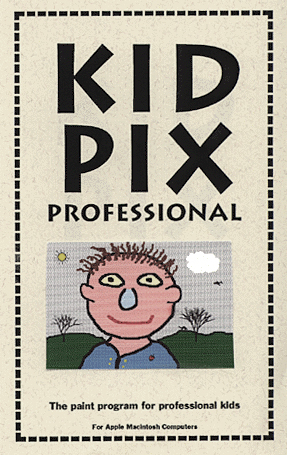
The Origin Story of Kid Pix
The Genesis of Kid Pix
The Duality of Mind
There is a common belief that people fall into one of two camps: the analytical, rational, and sensible, or the spontaneous, creative, and intuitive. Growing up in the 1950s, my perception of these archetypes was shaped by television. I saw the world as a choice between being a Sergeant Joe Friday (the stoic lawman from Dragnet) or a Maynard G. Krebs (the quintessential beatnik).
| Archetype | Characteristics | TV Example |
|---|---|---|
| Analytical | Rational, Sensible, Logical | Sgt. Joe Friday |
| Creative | Spontaneous, Intuitive, Artistic | Maynard G. Krebs |
The struggle for me was that I felt like a blend of both.


Early Encounters with Code
My journey into computing began in 1972 while I was working in the photography department at The Evergreen State College. I remember hearing a rhythmic clattering coming from the "Terminal Room." Inside, a friend was operating a machine that resembled a massive typewriter. He was programming and invited me to learn the craft.

I began crafting small programs. They weren't designed for utility; rather, they were experiments in curiosity—designed to be fun and unexpected.
The Atari Era and the "Windy Night"
After leaving Evergreen in 1974, I co-founded the non-profit Blue Sky Gallery in Portland. Later, during my graduate photography studies at the University of Washington, I was introduced to the Apple II via my professor, Paul Berger. However, my own home setup became an Atari 400.

Despite the clunky membrane keyboard, I was enamored by its sound and graphics. I became obsessed with the joystick ports, eventually building a home security system using Radio Shack magnetic switches. I even added tilt switches to the outdoor bushes.
The result? It worked perfectly—until a windy night when I wasn't home, and the breeze triggered the alarm every few minutes.
Designing for the User
I developed a deep fascination with user interface (UI) and program design, heavily influenced by the writings of Alan Kay (Scientific American) and Chris Crawford (Byte Magazine). My goal was to find the most streamlined path to complete any digital task.
Using an "Electronics Made Simple" guide, I programmed my computer to control my darkroom enlarger and manage record-keeping. I utilized a "card" metaphor for the interface, effectively creating a precursor to HyperCard.
While I loved the Atari, I realized it lacked a significant software audience. I shifted my focus to the Macintosh because:
- It offered a more enlightened, consistent vision.
- It was fundamentally graphical, expanding visual possibilities.
- It felt more "fun" to program than the "serious" computers of the era.
The Road to Kid Pix
Initially, I used Rascal (a hybrid of C and Pascal) to learn the Mac's QuickDraw routines. My early projects included:
- Company: A desk accessory featuring a game and an animated face.
- Artist Books: Signal to Noise and Dry Reading.
- Camera: An educational tool demonstrating the physics of aperture, specifically the relationship involving the f-stop:

The Catalyst: Ben
In 1988, my three-year-old son, Ben, tried using MacPaint. While he mastered the mouse quickly, he lacked the precision to avoid accidentally triggering menus or dialog boxes. Since he couldn't read, he couldn't dismiss them, leading to frequent tantrums of frustration.
I realized that the computer experience for a child was broken. I decided to create a new program. I had previously tried to sell a darkroom timer for the Atari, but it failed commercially because the Atari market was too small. This time, I decided to give the software away for free, which granted me total creative freedom.

The Philosophy of Design
I established a set of guiding principles for the software, centered around one core rule:
The Prime Directive: The program must be exceptionally easy to use. No manual should be required; features must be self-explanatory through interaction. Every task must be achievable via the most direct path possible.
As long as the Prime Directive remained intact, I allowed myself to add elements that made the program surprising and delightful.
Design Checklist:
- Eliminate the need for a manual.
- Ensure intuitive tool selection.
- Maximize user satisfaction and surprise.
- Maintain absolute simplicity.